
How to Build Muscle With Limited Equipment at Home or in Small Gyms

 0
0
 0
0 That tightness in your chest when you walk into a nearly empty workout space—no racks of dumbbells, just a few resistance bands and your own body. It’s a common doubt, but here’s the truth you need to hear.
Science confirms that low-load, high-volume resistance work stimulates hypertrophy just as effectively as heavy lifting. The real mechanism isn’t the gear; it’s progressive overload and technical mastery.
Whether your home setup is sparse or your local facility is more yoga studio than powerlifting haven, you can achieve impressive results. We’re cutting through the fitness industry noise to give you what works.
This evidence-based roadmap covers the science of growth, practical techniques, and nutrition essentials that actually matter. Forget the myth that real gains require specialized machines—your body and simple tools are more than enough when you apply the right principles.
Key Takeaways
- You do not need a fully stocked commercial gym to develop significant strength and size.
- Research supports that bodyweight and minimal gear workouts can be equally effective for hypertrophy.
- The core principle for success is applying progressive overload, not accumulating more equipment.
- Proper exercise execution and volume are far more critical than the amount of weight you lift.
- This guide provides a science-backed plan to turn your current limitations into a strategic advantage.
- Focus on mastering fundamental movement patterns before seeking complex or expensive tools.
Understanding Muscle Growth Without Heavy Weights
Forget the notion that size requires massive loads. Your body responds to specific signals, not specific gear. Skeletal muscle hypertrophy is simply your body building more protein than it breaks down.
Three primary drivers trigger this growth process. You can create them with bodyweight or light resistance.
- Mechanical Tension: The force your muscles produce under load.
- Muscle Damage: Microscopic tears that repair stronger.
- Metabolic Stress: The “burn” or pump from intense sets.
Mechanical tension isn’t about the barbell. It’s about challenging your muscles through a full range of motion. A slow, controlled push-up creates tremendous tension.
Muscle damage activates satellite cells—your muscle’s stem cells. These cells fuse to existing fibers for repair and growth. Any training that pushes your current capacity causes this.
Metabolic stress comes from high-rep work and short rest. It floods the tissue with metabolic byproducts. This process signals your body to adapt and grow, even without heavy external loads.
Understanding these mechanisms changes everything. Shift your focus from the weight on the bar to the stimulus you create. That’s the real game-changer for effective training.
How to Build Muscle With Limited Equipment
You’re about to learn that equipment scarcity is an advantage, forcing mastery over momentum. Research confirms bodyweight movements, performed through a full range of motion, stimulate growth independently of external load.
The non-negotiable principle is progressive overload. You must continually increase demands on your muscles over time. This prevents adaptation and provides the ongoing stimulus for gains.
Limited gear forces intelligent programming. The difference between success and stagnation is manipulating key variables. You increase difficulty without adding weight.
Use this table to apply progressive overload strategies effectively.
| Method | How to Implement | Primary Benefit |
|---|---|---|
| Tempo Manipulation | Slow the lowering phase to 3-4 seconds. | Dramatically increases time under tension. |
| Volume Increase | Add one extra set or rep each week. | Creates a measurable overload stimulus. |
| Density Training | Complete the same work in less total time. | Boosts metabolic stress and conditioning. |
| Exercise Progression | Advance to a harder movement variation. | Enhances mechanical tension and skill. |
Your goal is consistent, measurable progression in every session. Track your performance. Ensure you’re doing more work over time, regardless of gear available. This approach builds real strength and muscle.
Bodyweight vs Traditional Weightlifting: What’s the Difference?
Research cuts through the noise, showing both bodyweight and traditional weightlifting are potent tools for hypertrophy. The real question isn’t which is better, but how each serves your goals.
Comparing Benefits and Limitations
Each method has a distinct profile. Traditional weightlifting offers straightforward progression. You simply add more plates. This is fantastic for tracking pure strength gains.
Bodyweight training demands more creativity. You progress by manipulating leverage, tempo, and movement complexity. This often recruits more stabilizing muscles, building functional strength that transfers to real-world activities.
Joint health is another key differentiator. Bodyweight movements typically flow through natural ranges of motion, which can improve mobility. Heavy training with weights can sometimes restrict flexibility if not balanced properly.
Injury risk also tends to be lower with bodyweight exercises. You’re not loading joints with external weight, supporting long-term sustainability. Neither approach is inherently superior—they excel in different areas.
Scientific Insights on Muscle Growth
The evidence is compelling. A study in the Journal of Exercise Science & Fitness found push-up training produced comparable muscle and strength gains to bench press after eight weeks.
This proves bodyweight exercises aren’t just beginner movements. When volume and intensity are matched, research shows no significant difference in hypertrophy between methods.
Your best strategy? Use both if possible. If equipment is limited, understand that a well-programmed routine of best bodyweight exercises can absolutely deliver the results you’re after. The stimulus, not the tool, drives growth.
Foundations of Resistance Training with Minimal Gear
Your body doesn’t recognize dumbbells or machines—it only responds to specific physiological signals. Effective training with minimal gear requires mastering three core mechanisms.
Mechanical Tension & Muscle Damage
Mechanical tension is the force your muscles generate under load. It happens during both the lowering (eccentric) and lifting (concentric) phases of movements.
This tension, combined with microscopic muscle fiber tears, triggers growth. The damage activates satellite cells at the neuromuscular junction. These cells repair and enlarge the tissue.
Metabolic Stress Explained
Metabolic stress is that burning pump during high-rep sets. It results from lactate accumulation and cellular swelling.
High-intensity interval training (HIIT) leverages this. Short bursts push your heart rate to 80-90% max, creating significant metabolic stress. This signals your body to adapt and grow.
Understanding tension, damage, and stress lets you design potent exercises without a full gym.
Smart Tips for Setting Up Your Home Gym
The most productive home gyms prioritize versatility over volume of equipment. You don’t need thousands of dollars worth of gear to develop serious strength.
A few strategic pieces unlock dozens of effective movements. Start with a doorframe pull-up bar for upper body development.
Add adjustable dumbbells for pressing and rowing variations. An adjustable bench or sturdy box enables chest work and step-ups.
Resistance bands provide joint-friendly variable resistance. Your existing staircase works for step-ups and incline work.
Choose gear that solves specific training problems. This table shows foundational pieces for maximum value.
| Equipment | Key Function | Smart Investment Reason |
|---|---|---|
| Doorframe Pull-Up Bar | Vertical pulling movements | Installs in seconds, enables pull-ups and core work |
| Adjustable Dumbbells | Pressing, rowing, isolation | Compact, versatile, replaces multiple fixed-weight pairs |
| Adjustable Bench | Chest press, step-ups, dips | Creates multiple angles, supports compound movements |
| Resistance Bands | Variable tension assistance | Travel-ready, adds difficulty to bodyweight exercises |
Before any purchase, ask one question. Does this piece enable new movement patterns or progressive overload you can’t achieve otherwise?
This filter prevents impulse buys. Build your space around what you’ll actually use consistently.
Effective Bodyweight Exercise Techniques
Precision in movement protects your joints and unlocks your true strength potential. Perfect form maximizes muscle activation for decades of sustainable training, not just short-term gains.
Mastering Proper Form
For push-ups, create a rigid plank from head to heels. Engage your core and glutes before you move.
Lower until your chest hovers an inch from the floor. Pause, then explosively press up. This tempo builds better muscle.
Pull-ups demand total-body tension. Squeeze the bar, pack your shoulders down, and drive your elbows toward your hips.
During burpees, maintain a rigid core in the push-up phase. Explode through the jump with full hip extension.
Adapting Movements to Your Fitness Level
Every exercise has regressions and progressions. Can’t do a regular push-up? Start with incline push-ups against a wall.
If pull-ups are too tough, use resistance bands for assistance. Perform negative-only reps by jumping up and lowering slowly.
For a harder challenge, try decline or diamond push-ups. These progressions increase mechanical tension effectively.
Film yourself occasionally. Small form adjustments prevent injury and unlock better results from your workout.
Focus on quality reps over quantity. This approach builds resilient muscles and lasting full-body strength.
Integrating HIIT and Circuit Training for Optimal Results
Research from Kennesaw State University shatters a myth: a 20-minute bodyweight circuit beats steady-state cardio for training impact. Their study showed a simple AMRAP of pull-ups, push-ups, and squats delivered a greater stimulus than running at 85% max heart rate. This proves your most efficient workouts are often the simplest.
HIIT and circuit training aren’t just cardio tricks. They’re legitimate muscle-building tools. Short bursts of max intensity push your heart rate to 80-90% capacity, creating massive metabolic stress.
Design a brutal, effective workout in minutes. Try 30 seconds of max-effort burpees, followed by 30 seconds of rest. Repeat for 8 rounds. This protocol torches calories and signals growth.
For circuits, alternate between upper, lower, and core exercises. Perform each for 45 seconds with minimal transition time. Complete 3-5 rounds. This keeps your heart rate elevated, maximizing training density.
Keep your rest intervals strategic—45 to 60 seconds. This maintains performance without losing the metabolic benefits. Time-efficient workouts matter. A focused 20-minute circuit delivers superior results to an unfocused hour. Embrace the intensity.
Training Volume and Progressive Overload Strategies
Your progress hinges on two non-negotiable principles: training volume and progressive overload. Without increasing your weekly workload, adaptation stalls completely.
Research confirms strength training at least two days per week triggers growth. Start here if you’re new. Beginners should aim for 2-3 full-body sessions weekly.
Perform 3 sets of 10-15 reps per exercise. Allow 48 hours between sessions for recovery. This foundation builds sustainable strength.
As you advance, increase frequency to 3-4 sessions per week. Consider split routines like upper/lower body days. This boosts volume on specific muscle groups without burnout.
Advanced trainees can handle 4-5 weekly sessions. Use a 3 days on, 1 day off pattern. Always include at least two full rest days.
Progressive overload with minimal gear means manipulating variables. Add reps, add sets, decrease rest intervals, or advance exercise difficulty.
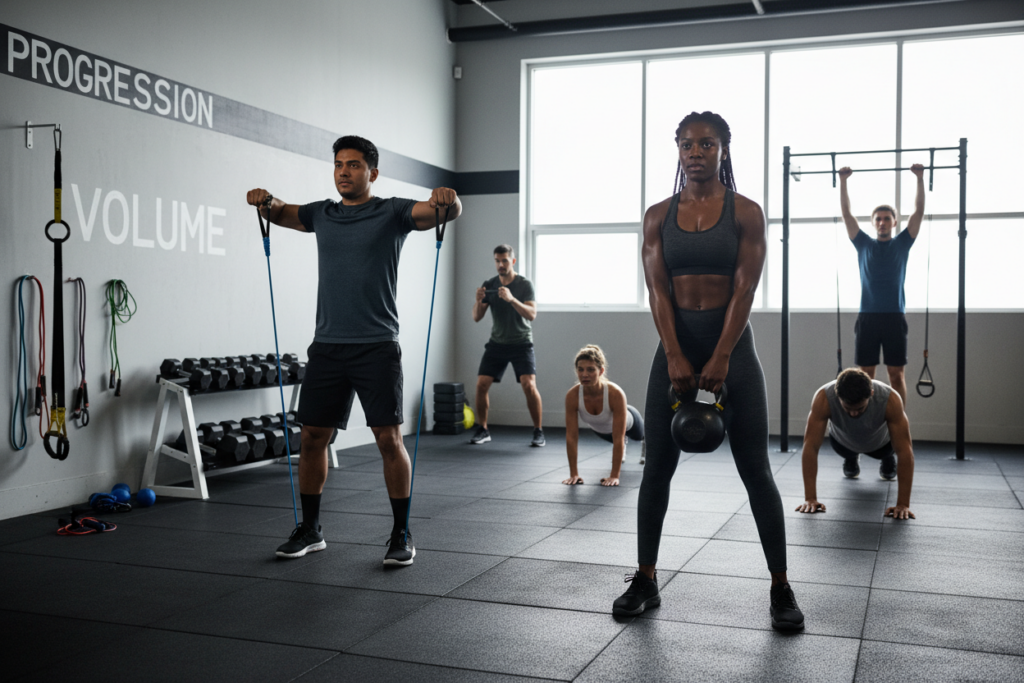
Track every workout. Log exercises, sets, reps, and rest periods. This data drives your next progression step.
Increase volume gradually—add 1-2 sets per week or an extra session every 3-4 weeks. This prevents overreaching while ensuring continuous gains.
| Training Level | Sessions Per Week | Recommended Sets & Reps | Progression Strategy |
|---|---|---|---|
| Beginner | 2-3 full-body | 3 sets of 10-15 reps | Master form, add reps weekly |
| Novice | 3-4 (split routine) | 3-4 sets of 8-12 reps | Increase sets or decrease rest |
| Advanced | 4-5 (split routine) | 4-5 sets of 6-15 reps | Advanced variations, density training |
Harnessing Eccentric and Concentric Movements
Every repetition has two distinct phases, and one is far more potent for triggering adaptation. The eccentric phase is where your muscle lengthens under tension. The concentric phase is where it shortens to produce force.
Slow Eccentric for Muscle Gains
Rushing the lowering portion is a common error. It sacrifices growth and increases injury risk. Science shows eccentric contractions spark faster protein synthesis.
Slow your descent to 2-3 seconds on every rep. Control your push-up lower. Descend gradually into squats. This extended time under tension multiplies the stimulus.
This focused work creates optimal microscopic damage. It activates satellite cells and growth factors. You create more opportunities for repair and increased strength.
Explosive Contraction Techniques
Pair a controlled eccentric with an explosive concentric. Lower into a squat for three seconds. Pause briefly, then drive upward as fast as possible.
Use a specific tempo prescription. Try a 3-1-1-0 cadence. That’s three seconds down, a one-second pause, one second up, and no rest at the top.
Negative-only training builds strength for difficult exercises. Jump to the top of a pull-up bar. Lower yourself as slowly as possible for five to ten seconds. This method develops raw power effectively.
Functional Exercises for Total-Body Strength
Functional training prepares your muscles for the unpredictable demands of real-world activity, not just the predictable path of a barbell. True strength means your entire body works as a coordinated system.
This integrated power transfers directly to daily life. Compound exercises like burpees and spider crawls are perfect examples. They force your chest, arms, legs, and core to fire together.
More advanced movements offer even greater rewards. Handstand wall walks build incredible shoulder stability and total-body tension. Crab walks powerfully develop the posterior chain while hitting your core.
Stop thinking about “arm day” or “leg day” in isolation. Your body doesn’t operate that way outside the gym. Train fundamental movement patterns—push, pull, squat, hinge.
This approach builds resilient muscles that protect you from injury. It turns every workout into practice for life’s physical challenges. That’s the ultimate measure of your functional strength.
Incorporating Plyometric Movements for Explosive Power
Power isn’t built by slow grinding—it’s forged in explosive bursts that recruit your largest muscle fibers. Plyometric exercises target fast-twitch fibers. These fibers are significantly larger than slow-twitch ones, offering the greatest potential for size and strength gains.
Transform standard movements into power-builders. Squat jumps demand you descend, then explode upward with maximum force. Jumping lunges build single-leg stability—lunge down, switch legs mid-air. Standing long jumps develop horizontal power and total-body coordination.
Your creativity unlocks endless variations. Turn push-ups into clapping push-ups. Convert step-ups into box jumps. This training philosophy prioritizes speed and intensity over slow, heavy reps.
Start with 2-3 sets of 6-10 reps for each plyometric drill. Quality and explosiveness matter far more than grinding out high reps with poor form. This approach safely develops explosive power in your legs and entire body.
Balancing Cardio and Strength for Lean Muscle
Strategic cardiovascular work is not your enemy; it’s a powerful ally for achieving a lean, muscular physique. The myth that cardio “kills gains” is outdated. Excessive volume with poor recovery hinders progress, not smart, integrated conditioning.
Your workout routine thrives on balance. HIIT workouts two to three times per week boost work capacity and aid recovery between strength sets. This approach supports, rather than sabotages, your goals.
Follow this evidence-based framework to structure your week:
- Beginners: Perform full-body strength training 2-3 days per week. Add two days of steady-state cardio, like brisk walking.
- Novices: Advance to a 3-4 day split routine. You can handle three cardio days—just avoid intense sessions before heavy leg training.
- Advanced: With 4-5 strength days, place HIIT on upper body days. Use steady-state cardio on full rest days for active recovery.
The key is to treat cardio as a strategic tool. It improves cardiovascular health and aids calorie management. Monitor your performance in the weight room.
If your strength stalls, you’re likely overdoing it. Adjust your cardio volume to keep your primary training days powerful and productive.
Recovery, Nutrition, and Supplementation Essentials
Think of your body as a construction site—your workouts are the demolition, but real muscle is built during the repair phase with the right materials. You can’t out-train a poor diet. Growth happens when you provide the essential nutrients and allow for proper rest.
Importance of Protein and Creatine
Aim for 0.7 to 1.0 grams of protein per pound of bodyweight daily. For a 180-pound person, that’s 125-180 grams. Spread it across 3-5 meals to optimize synthesis.
Whey protein is the gold standard. It’s fast-absorbing and provides all essential amino acids. Grass-fed whey isolate offers premium quality.
Plant-based? Pea or rice protein blends work effectively. Just ensure you hit your total daily targets.
Creatine monohydrate is the most researched supplement for athletes. Take 5 grams daily. It increases strength, muscle mass, and training performance.
Smart Rest and Recovery Strategies
Recovery isn’t optional. Schedule at least 2 complete rest days per week. Do minimal physical activity on these days.
Prioritize sleep—7 to 9 hours nightly. This is when growth hormone peaks and protein synthesis accelerates. Shorting sleep sabotages your hard work.
Manage stress to support muscle repair. This holistic approach is what will truly help build lasting muscle mass and strength.
Creative Modifications for Small Gym Workouts
When you’re working with just a bench and a few dumbbells, your imagination becomes your most valuable piece of equipment. This constraint sparks innovation. It often leads to better results than following generic plans made for fully-stocked spaces.
Change your exercise angles to target muscles differently. Elevate your feet for decline push-ups to hammer the lower chest and triceps. Single-side movements like pistol squats place all the weight on one leg, exposing imbalances.
Superset antagonistic muscle groups for efficiency. Pair push-ups with pull-ups or dips with rows. Minimal rest creates maximum metabolic stress. Use furniture strategically—a sturdy chair for triceps dips, a loaded backpack for added weight.
Combine your simple gear creatively. Perform dumbbell chest presses on the bench. Immediately transition to decline push-ups with your feet on that same bench. This back-to-back approach intensifies the workout.
Think in movement patterns, not specific equipment. Can’t do a barbell squat? Substitute a goblet squat with a dumbbell or a Bulgarian split squat. These exercises target the same muscle groups effectively. Your resourcefulness turns limitations into strengths.
Overcoming Common Obstacles in Limited Equipment Training
The most common roadblock to serious gains isn’t a lack of gear—it’s a story you’re telling yourself about what ‘real’ training looks like. Let’s rewrite that narrative.
Research is clear. High-rep bodyweight work stimulates growth as effectively as heavy weightlifting when volume matches. Your equipment situation is not an excuse. It’s your unique advantage.
Break through mental barriers with actionable solutions. This table tackles frequent objections head-on.
| Common Objection | Actionable Solution | Key Benefit |
|---|---|---|
| “I can’t progress without more weight.” | Increase reps, slow tempo, use unilateral moves. | Creates new overload stimulus. |
| “Bodyweight exercises are too easy.” | Attempt pistol squats or one-arm push-ups. | Exposes true strength gaps. |
| “Leg development requires a rack.” | Use Bulgarian split squats and jump lunges. | Builds legs and stability. |
| Lacking motivation or direction. | Follow a simple, structured weekly plan. | Ensures consistency and progress. |
Consistency beats a perfect program you won’t do. A straightforward routine executed 3-4 times weekly will help build more muscle than an ideal one you skip.
Track every workout. Seeing rep or set increases proves progress, even when the scale doesn’t move. This objective data is your motivation.
Connect with other people on the same journey. Online communities offer creative solutions and proof that your way works. For a proven routine, check this minimal equipment strength plan. Your best training happens when you master the equipment you have.
Conclusion
Let’s cement the core principles that turn everyday effort into lasting muscle and strength. Your success hinges on applying progressive overload through your current routine. This is the proven way to build muscle.
The three growth mechanisms activate fully with bodyweight and minimal gear. Focus on exercise quality for optimal muscle mass development. Perfect your form on fundamental movements.
Support your training with adequate protein and smart rest. Track every workout to measure progress. Make consistency your top priority over time.
You now possess the knowledge. The only thing required is your action. Start today, stay consistent, and trust the process. Your stronger physique awaits.
FAQ
Can I really stimulate muscle growth without heavy barbells and machines?
What’s the main difference between bodyweight training and traditional weightlifting for gaining mass?
How important are rest periods between sets when I’m working out with limited gear?
What are the best nutritional strategies to support muscle building with a minimalist setup?
How can I modify basic exercises to keep making progress at home?
What’s a common mistake people make when training without a full gym?