How to Improve Squat Balance and Feel More Stable Under Load

 0
0
 0
0 If you’ve ever wondered how to improve squat balance, that shaky feeling under load is your body asking for help. You load the bar, begin your descent, and suddenly everything feels unsteady. That wobble isn’t just annoying—it caps your potential and invites injury.
True stability is a conversation between your nerves, muscles, and joints. It’s the coordinated effort that keeps you centered when forces try to knock you off course. The good news? Heavy training itself builds this skill, creating a powerful cycle. Better steadiness leads to stronger lifts, and stronger lifts enhance your steadiness.
This isn’t about standing on one leg. It’s about building a foundation that lets you handle heavier weight with confidence. We’ll focus on evidence-based techniques that target the root causes of instability. You’ll learn to activate the right muscles and move with purpose through your entire range of motion.
These methods protect your joints and unlock new levels of performance. For a deeper dive into building foundational upper body strength that supports your squat, check out these lower trap workout tips for strength.
Key Takeaways
- That wobbly sensation during a squat is a direct signal from your body that stability is lacking.
- Genuine balance is a complex, coordinated effort involving your nervous system and muscles.
- Strength training naturally enhances your stability, which in turn allows you to lift more weight safely.
- Improving your foundation targets the root causes of instability, not just the symptoms.
- Proper technique and muscle activation are crucial for feeling solid throughout the entire movement.
- A stable squat protects your joints from harmful compensatory patterns.
- Building this skill creates a positive cycle, leading to sustainable progress and greater strength.
Understanding the Mechanics of a Squat
A stable squat relies on a precise interplay between major muscle groups and joint mobility. Your body isn’t performing one action—it’s executing a complex, multi-joint movement pattern.
Key Muscles and Joints Involved
Your quads, glutes, and hamstrings are the primary drivers. They work with your adductors and calves to power the lift. Meanwhile, your core and back muscles act as vital stabilizers for your spine.
This symphony of muscles depends on your ankles, knees, and hips moving in harmony. A restriction at any joint forces a compensation pattern. That’s when instability and a shaky feeling begin.
The Role of Proper Squat Form in Stability
Correct form is your mechanical blueprint for safety. It efficiently distributes force across your muscles and joints. No single structure gets overloaded.
Your knee tracking and hip hinge are critical. Knees should follow your toes, and your hips need to push back. This loads your posterior chain correctly.
Limited ankle flexibility can shift your center of mass forward, ruining your body position. Small breakdowns in technique cascade into major stability issues under heavy loads. Understanding these mechanics lets you diagnose the root cause of any wobble.
How to Improve Squat Balance: Evidence-Based Techniques
Forget standing on wobble boards—real stability comes from mastering your body’s own internal bracing system. The most effective techniques train your stabilizers under conditions that directly translate to the barbell.
Activating Your Core for Better Stability
True core work isn’t about crunches. It’s about creating a rigid cylinder from your ribs to your pelvis. Take a deep breath into your belly and brace as if bracing for impact.
This builds intra-abdominal pressure. Your entire torso becomes a stable pillar. Your spine stays safe, and power transfers cleanly to the bar.
Stabilizing Your Hips, Knees, and Ankles
Your lower body joints are a chain. Weakness in one link causes a breakdown everywhere. Strong glutes keep your knees tracking properly over your toes.
Your ankles need both mobility to move and strength to stay put. Practice unilateral squat form cues to build this coordinated control. It’s the best way to train balance for real lifting.
| Method | Why It Works (or Doesn’t) | Carryover to Heavy Lifting |
|---|---|---|
| Single-Leg Romanian Deadlifts | Challenges hip & ankle stability under load, mimics unilateral demands. | High – directly trains balance under realistic conditions. |
| Lateral Lunges | Develops dynamic control in frontal plane, strengthens glute medius. | High – improves stability during stance transitions. |
| BOSU Ball Squats | Creates artificial instability, disrupts force production mechanics. | Low – doesn’t replicate the stable base needed for heavy bars. |
| Core Bracing Drills | Builds intra-abdominal pressure, creates a rigid torso. | Very High – foundational for all loaded movements. |
Focus on these functional methods. They build the specific strength your body position needs to feel unshakable.
Exercises to Enhance Lower Body Stability
Your squat’s steadiness is often limited by weaknesses that bilateral training misses. Specific unilateral and lateral movements target these gaps directly.
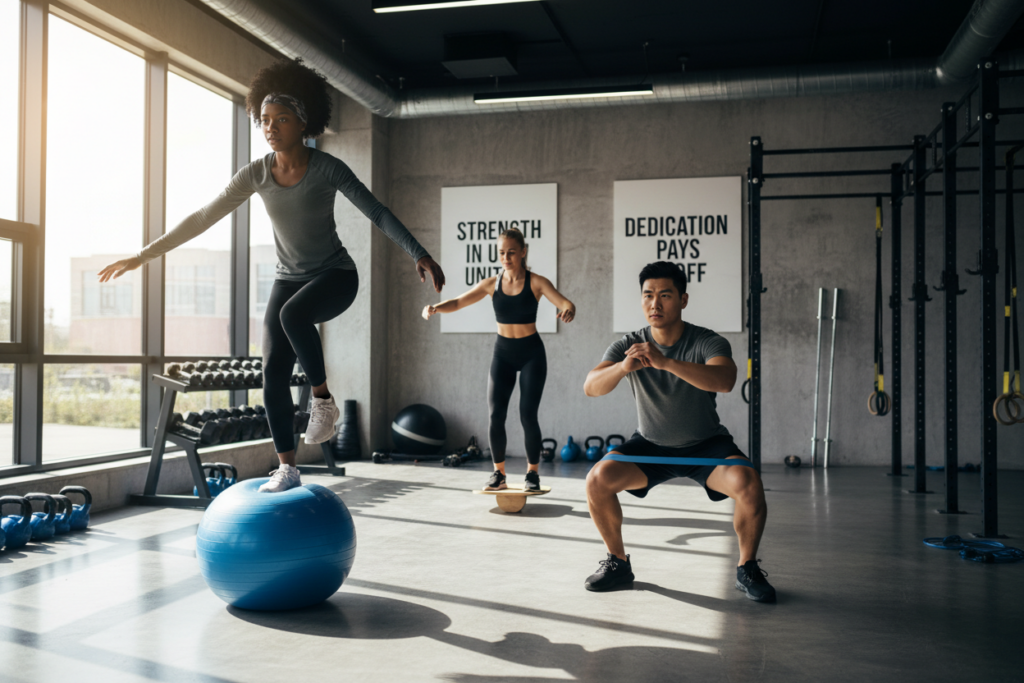
These drills build the exact control you need under a bar. They reveal imbalances and forge resilient lower body strength.
Single-Leg Romanian Deadlift and Variations
This exercise forces you to stabilize in an off-kilter position. Hold dumbbells in front of your thighs, lift one foot, and push your hips back.
Your chest moves toward the floor as your lifted leg extends. Keep your hips level. Descend until you feel your hamstring tighten, then drive through your glutes to stand.
Use a kickstand variation if needed. Lightly touch the toe of your non-working leg to the ground behind you for support.
Lateral Lunges and Dynamic Movements
Lateral lunges build side-to-side control. This is critical for handling unpredictable forces during heavy squats.
Take a wide step to the side, push your hips back, and bend the stepping knee. Keep your torso upright. Start with bodyweight, then progress to holding weight.
Aim for sets of 6 to 8 reps with heavier loads for strength. Use 12 to 15 reps with lighter weight for endurance and stability.
| Exercise | Primary Stability Benefit | Recommended Sets & Reps |
|---|---|---|
| Single-Leg Romanian Deadlift | Builds unilateral hip stability & posterior chain control | 3 sets of 8-10 reps per leg |
| Lateral Lunge | Develops frontal plane control & glute medius strength | 3 sets of 6-8 reps per side (heavy) or 12-15 (light) |
| Box Step-Up with Knee Drive | Enhances single-leg strength & dynamic balance | 3 sets of 10-12 reps per leg |
Integrate these movements to fortify your foundation. Your entire body will feel more connected and powerful.
Integrating Balance Training Into Your Routine
A 2022 study revealed a stark fact: failing a simple 10-second balance test doubled mortality risk in older adults. This isn’t just about lifting. It’s a core marker of your overall health and functional capacity.
The good news? You don’t need an hour of dedicated work. Strategic integration of 10-15 minutes of functional drills into your existing routine delivers real gains. These drills mimic real-life movement for the best carryover.
Incorporating Functional Balance Drills
Start your lower body sessions with balance-focused exercise. Try the “around the clock” drill. Balance on one foot and tap the other to different positions, like a clock face.
This builds multi-directional stability. For loaded work, suitcase carries are superb. Hold a heavy weight in one hand and walk. Your core fights lateral lean, building the anti-movement strength that stabilizes your squats.
Program these drills smartly. Do balance work at the start when you’re fresh for better motor learning. Place carries at the end to build stability under fatigue.
Consistency trumps volume. Two or three focused sessions per week beat sporadic marathons. Your nervous system needs regular practice.
Track your progress. Can you hold a single-leg position longer? Use heavier weight on unilateral sets? These metrics show your foundation solidifying, paving the way for bigger lifts.
Strengthening Supportive Muscles for Effective Squat Performance
Think of your squat performance as a chain—its strength depends entirely on the weakest link in your supportive musculature. If your core or back can’t stabilize the load, your legs never get a chance to shine.
Building Core and Back Strength
True core strength is about anti-movement. You must resist rotation and flexion under weight. The plank with shoulder taps is perfect for this.
Assume a pushup position with feet wider than your hips. Slowly lift one hand to tap the opposite shoulder. Keep your body rigid and hips level. Start with 5 taps per side, aiming for 2-3 sets.
Your lower back and spinal erectors must hold position. Exercises like Romanian deadlifts build strength in this posterior chain. They support a consistent torso angle.
Targeting Glutes and Leg Muscles
Weak glutes are a hidden enemy. They cause knee cave and hip shift, wrecking your platform. Target them directly with hip thrusts and bridges.
Cable single-arm rows are a game-changer. Stand in a quarter-squat, row the handle while resisting the pull on your torso. This builds back strength and anti-rotation stability simultaneously.
| Exercise | Primary Stability Benefit | Recommended Programming |
|---|---|---|
| Plank with Shoulder Taps | Anti-rotation core stability, shoulder/wrist stabilization | 2-3 sets of 10-15 taps per side |
| Cable Single-Arm Row | Anti-rotation back strength, mimics loaded balance demands | 3-4 sets of 8-12 reps per arm |
| Hip Thrust | Direct glute activation & hip extension strength | 3-4 sets of 8-12 reps |
| Romanian Deadlift | Posterior chain & lower back strength for spinal stability | 3-4 sets of 8-10 reps |
Program this supportive work 2-3 times weekly. It’s your best injury insurance and the foundation for heavier squats. For a dedicated plan, see this abs and glutes workout plan.
Practical Tips for Safe Squats in the US Gym Culture
In any gym across the US, the difference between a shaky lift and a solid one often starts with the feet. Your foundation is non-negotiable. Getting this right builds everything else.
Let’s break down the specifics of your base. Small tweaks here create massive changes in how you feel under the bar.
Ensuring Proper Foot Placement and Weight Distribution
First, stand with your feet roughly shoulder-width apart or slightly wider. Point your toes out 15 to 30 degrees. This opens your hips for a better descent.
Press your entire foot into the ground. Think “tripod foot”: contact at the heel, big toe, and little toe. This full-foot connection is your anchor.
The cue “spread the floor” activates your glutes. Imagine trying to split the ground apart by driving your knees outward. This creates incredible stability.
Your weight distribution will shift. You’ll feel more pressure on your heels as you drive up. Never completely lose contact with your forefoot or rock back enough to lift your toes.
If you consistently shift forward onto your toes, don’t just force a better position. You likely have ankle mobility restrictions or weak posterior muscles. Address that root cause.
Your knee position follows from your foot placement. With a solid tripod base, your knees naturally track over your toes. This prevents knee cave and protects your joints.
Experiment within a reasonable range. You’ll see wide powerlifting stances and narrow Olympic ones. Find what feels stable for your unique anatomy.
Film your sets from the front and side. Visual feedback is gold. Check that your feet stay flat and your weight doesn’t shift excessively.
Remember, a small adjustment in your stance width or toe angle can lock everything in. Your entire body will feel more connected and powerful.
Conclusion
Building a rock-solid foundation for your lifts is about more than just adding weight—it’s a commitment to your long-term health and performance. The benefits extend far beyond the rack, reducing injury risk and improving your movement quality in daily life.
This systematic approach corrects muscle imbalances from sedentary lifestyles. Start with foundational elements: proper foot position, core bracing, and joint coordination.
Integrate specific exercises into your routine consistently. Single-leg squats to a chair build unilateral strength and balance for your lower body. Master the controlled descent and drive back up.
Track your progress through metrics like heavier dumbbells on unilateral sets or more stable working weights. Dedicate time to flexibility and mobility for your ankles and hips.
The investment is minimal. Just 10-15 minutes of focused work twice per week transforms how you feel under the bar. This isn’t about perfection—it’s about consistent progress toward powerful, controlled lifts. For balanced strength development, explore these deadlift variations.
FAQ
Why do I wobble or feel unstable when I perform a squat?
Where should my feet be positioned for optimal squat stability?
How important is core engagement for a heavy back squat or front squat?
Can improving my ankle mobility really help my squat performance?
What are the best accessory exercises to build better squat stability?
How often should I train for balance and stability?