Why New Fitness Equipment Can Make Training Stick

 0
0
 0
0 Buying new fitness equipment is worth it when it removes the barriers that keep you from training. The real benefits of buying new fitness equipment are easier access, known condition, warranty support, and a setup built around measurable progress. Buy versatile basics that fit your space and program. Skip novelty machines that promise excitement but cannot earn a regular place in your week.
Last updated: 2026-08-10
What are the real benefits of buying new fitness equipment?
The biggest benefit is consistency. Home equipment removes the commute, crowded floors, and long waits for popular stations. As a result, you have fewer excuses between you and the next productive set.
New equipment also gives you a known starting point. You aren’t inheriting worn cables, bent frames, damaged upholstery, or a barbell that lived in a damp garage. A warranty may help if something fails, though you still need to read what it covers.
More equipment does not create better training by itself. The useful benefits are practical:
- You can train when your schedule allows.
- You can choose equipment that fits your body and program.
- You can track weight, reps, and technique without changing stations.
- You control cleaning, maintenance, music, and interruptions.
- You may avoid recurring membership and transport costs.
- You can build a setup slowly instead of buying everything at once.
The new-equipment smell and delivery boxes lose their charm quickly. What remains is access to training you can repeat.
How does home equipment save time compared with a gym membership?
A gym workout takes more time than the session written in your logbook. You still have to travel, park, change, store your belongings, and wait for equipment. Then you do it all again on the way home.
Home equipment cuts most of that dead time. You can finish work, change clothes, warm up, and start. That matters on busy days when a longer gym trip would become a skipped workout.
However, do not respond by rushing every set. Heavy squats, presses, rows, and hinges still need proper rest. Save time by removing travel and station changes, not by turning strength work into frantic conditioning.
Home training is also easier to trim when the day goes wrong. You can perform the main lifts, record the work, and leave smaller exercises for another session. A focused short workout still moves the plan forward.
Can new fitness equipment be more cost-effective than ongoing gym fees?
It can, but only if you use it. An expensive rack that holds laundry is not an investment. It is furniture with plate storage.
Compare the full costs before buying:
| Cost | Home equipment | Gym membership |
|---|---|---|
| Starting cost | Equipment, delivery, flooring, and assembly | Joining or enrolment charges |
| Ongoing cost | Maintenance and occasional replacement parts | Membership, assessment fees, and transport |
| Time cost | Setup and maintenance | Travel, parking, changing, and waiting |
| Exit value | Some equipment can be resold | Payments create no resale value |
| Main risk | Buying too much too early | Paying during months you rarely attend |
Commercial lifespan figures show why equipment type matters. Commercial cardio equipment often has a replacement interval of 7–10 years, while commercial treadmills commonly fall around 5–7 years. Selectorized strength equipment, which uses a weight stack and pin, may remain in service for 10–15+ years.
The Internal Revenue Service uses a 7-year useful life for commercial fitness equipment. However, that is an accounting category, not a promise that every machine will last that long. Build quality, use, maintenance, and available parts still decide the real lifespan.
Do the comparison with your own bills. Include membership charges, transport, delivery, repairs, and likely resale value. Most of all, be honest about how often you will train at home.
Which equipment gives a busy natural lifter the best return?
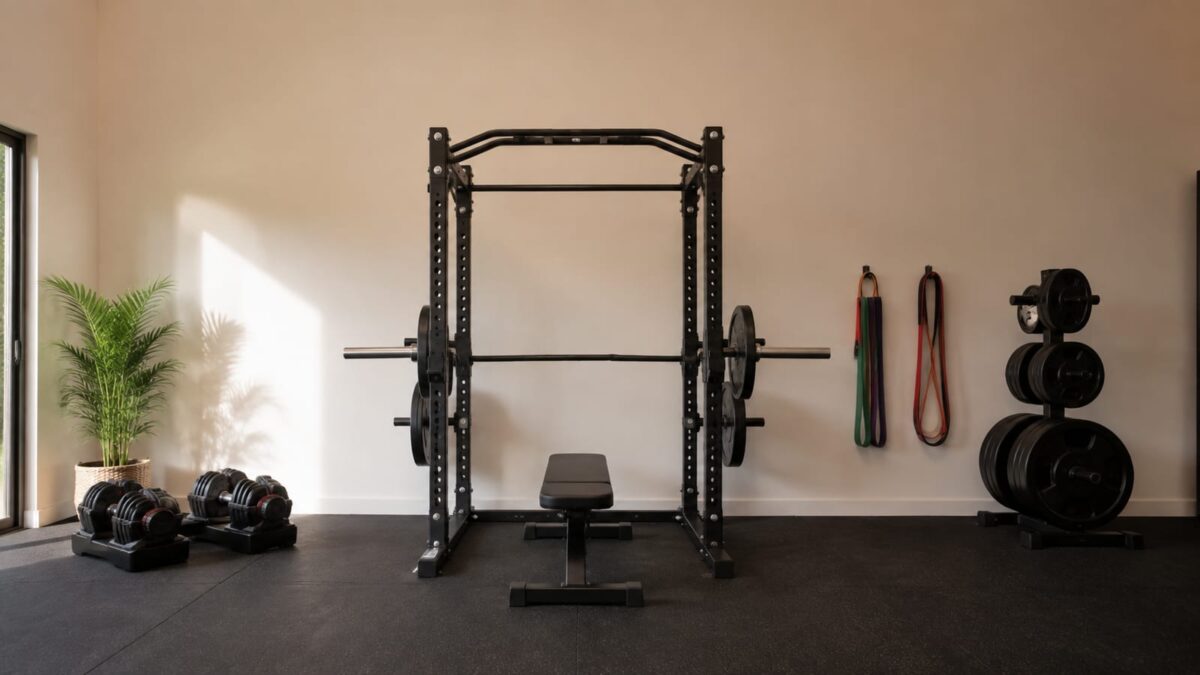
Start with equipment that supports several basic movement patterns. Adjustable dumbbells, a stable bench, resistance bands, and a pull-up option can cover presses, rows, split squats, hinges, curls, extensions, and shoulder work.
If space and floor strength allow, a rack, barbell, plates, and safety arms add more room for progressive loading. However, a rack is not automatically the right first purchase. It takes space, costs more to deliver, and needs safe clearance around it.
Use this order of priority:
- Choose the exercises your program requires.
- Buy the smallest setup that supports those exercises safely.
- Train with it long enough to find the real limits.
- Add equipment only when the current setup blocks progression.
For a tighter starting list, use this guide to essential workout gear for beginners. You do not need to copy somebody else’s home gym. Your equipment has to fit your week, your room, and your lifts.
Cardio machines deserve more scrutiny. They are large, harder to move, and contain more parts that may need service. Buy one if you enjoy that exact activity and will use it consistently. Do not buy one because a display screen makes walking look more advanced.
Why does privacy make home training easier to sustain?
A private training space removes the feeling that someone is judging your setup, body, or exercise choice. That can help beginners practice technique without rushing because another person is waiting.
Privacy also makes simple training easier to accept. You can repeat the same useful movements for months without feeling pressured to perform a different workout every day. That repetition is how you build repeatable technique and beat the logbook.
Still, privacy removes useful feedback too. Record important lifts from a clear angle, use safeties, and ask a qualified coach for help when a movement keeps breaking down. Training alone should make you more deliberate, not careless.
How does on-demand access improve workout consistency?
On-demand access gives you more chances to train before the day gets away from you. You can lift before work, between family duties, or later in the evening without checking opening hours.
Home equipment also weakens the all-or-nothing mindset. A shortened session can still include a main press, pull, or leg movement. That is better than skipping because you cannot complete the full workout you planned.
Access is only useful if the equipment is ready. Keep the floor clear, store plates safely, and leave commonly used items easy to reach. If every workout starts with moving boxes and finding collars, your home gym has created a new barrier.
The right setup makes starting easier. It does not remove the need to train with intent.
When should you buy fitness equipment to avoid demand and delivery problems?
Buy before the seasonal rush if you already know what you need. New Year demand can reduce stock, delay freight, and stretch assembly schedules. Ordering after motivation peaks often means paying for the least convenient delivery window.
Year-end promotion periods may offer better pricing. However, price is only part of the decision. Check stock status, dispatch estimates, delivery terms, replacement-part support, and the return process before paying.
Large equipment can spend time in a warehouse or freight network. Therefore, do not plan your training week around an optimistic delivery estimate. Keep using your current routine until the equipment is assembled, checked, and ready.
Most important, write the program before placing the order. That prevents you from buying whatever happens to be available during a demand surge.
Are year-end promotions actually a good reason to buy equipment?
A promotion is useful only when it reduces the price of equipment already on your list. It is not a reason to invent a need.
Make an essentials list before sales begin. Record the exact model, dimensions, weight capacity, included parts, warranty terms, and normal delivered cost. Then compare the full checkout price rather than the headline discount.
Watch for bundles filled with low-value extras. A rack package may include weak collars, poor storage, or plate combinations that do not suit your progression. You are still paying for those parts, even if the page labels them free.
Buy the tool you planned to use. Skip the deal that leaves you solving storage and maintenance problems for equipment your program never required.
What should you check before ordering large equipment?
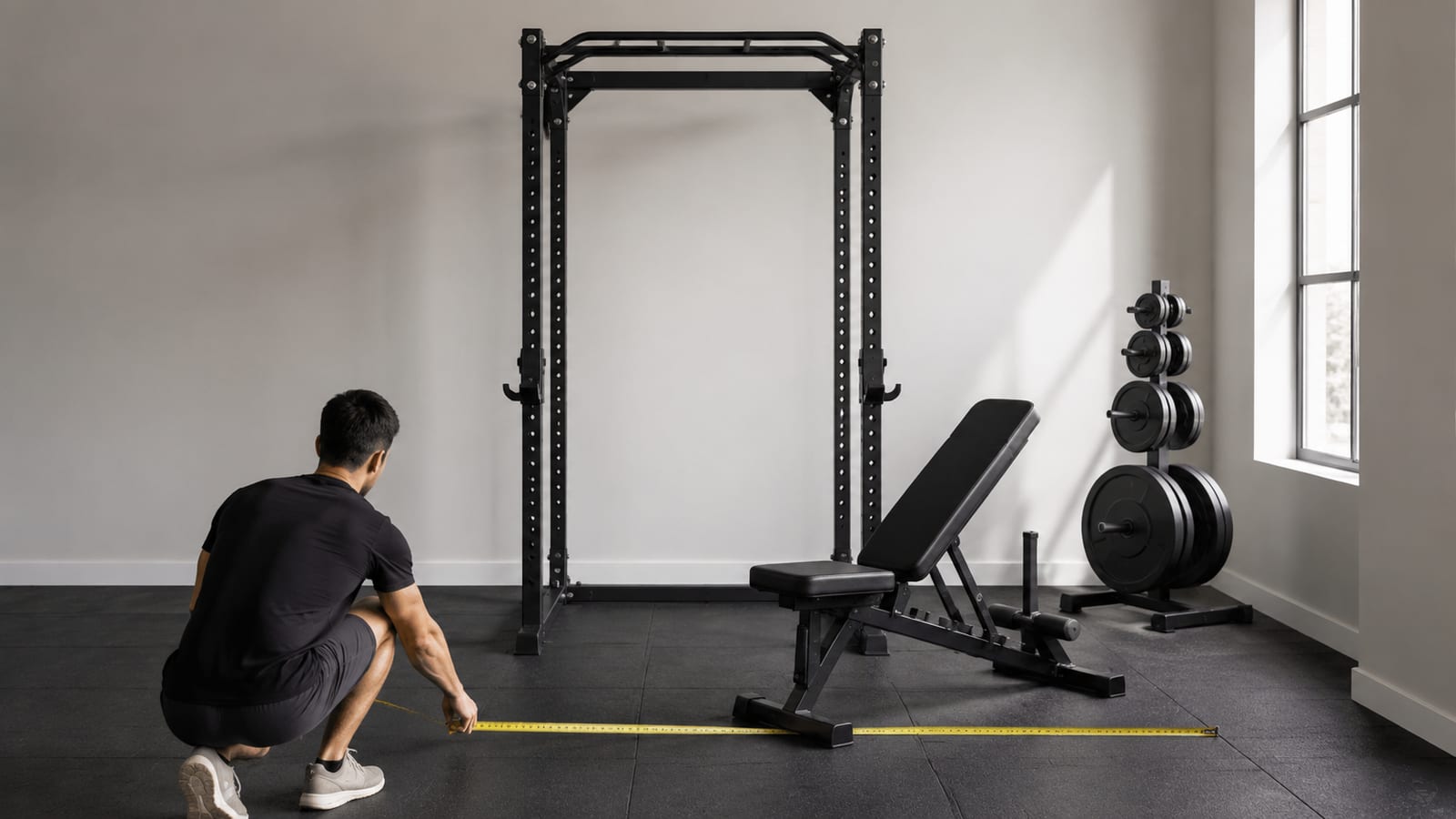
Measure the room, doorway, stairs, and delivery path. Then check the assembled dimensions, not just the shipping box. A rack that technically fits may still leave no room to load the bar or move safely around it.
Check these points before ordering:
- Floor space around the equipment
- Ceiling clearance during pull-ups and overhead work
- Floor strength and suitable protection
- Noise transferred through walls and floors
- Equipment weight and stated user capacity
- Assembly tools and help required
- Access for freight delivery
- Warranty exclusions
- Return freight costs
- Availability of replacement cables, pads, and hardware
- Safety arms, catches, guards, or emergency stops
- Compatibility with your plates, bar, bench, and attachments
Also search the Consumer Product Safety Commission recall database for the product and manufacturer. New equipment can still have design faults or missing hardware. “New” does not mean “skip the safety check.”
After assembly, inspect every fastener, cable, weld, adjustment pin, and moving part. Test the equipment with light work before loading it hard.
How do you avoid buying equipment that becomes clutter?
Give every item a clear training job before it enters your home. If you cannot name the exercise, progression path, storage place, and expected use, do not buy it.
Use this filter:
- Does it solve a real problem in the current program?
- Can you add weight, reps, range, or control over time?
- Does it fit the room without blocking other exercises?
- Can you use it safely when training alone?
- Is it quicker or more useful than the equipment you already own?
- Can you maintain it and find replacement parts?
- Would you still buy it without the promotion?
Be suspicious of single-purpose machines unless that movement matters enough to justify the space. A good machine can be excellent for stable, hard sets. However, a mediocre machine often becomes an expensive obstacle with handles.
Wait until your current equipment creates a genuine limit. Earn the next purchase the same way you earn the next increase.
Can home equipment replace a gym completely?
A modest home setup can cover most strength and muscle-building needs. Dumbbells, a bench, bands, and a pull-up option already allow plenty of productive work. Add a rack and barbell where practical, and the exercise menu becomes broad enough for years of progress.
A gym still wins in some cases. Keep the membership if you need specialized machines, heavier loading options, coaching, spotters, or an environment that gets you out of the house and focused.
Home equipment is not automatically better. It is better when convenience improves attendance and the available exercises suit your body. Your joints get a vote, and so does your calendar.
You can also use a mixed setup. Train the main sessions at home, then visit a gym for equipment you cannot justify owning. Cancel the membership only after your home routine has proved that it can carry the full plan.
What training plan makes new equipment pay off?
Build the plan around a squat or split-squat pattern, a hip hinge, a press, and a pull. Add smaller shoulder, arm, calf, or hamstring exercises where they serve your goals. You do not need to use every tool in every workout.
Keep most working sets hard enough to count while leaving a few clean reps in reserve. Record the load, reps, and exercise setup. Then add weight or reps when you can repeat the work with sound technique.
Use the same bench position, stance, range of motion, and tempo each time. Otherwise, the logbook cannot tell you whether you became stronger or merely changed the lift. Good reps before more weight.
Also eat enough to support the goal and recover before repeating hard work. New equipment cannot compensate for poor sleep, low effort, or a routine that changes every week.
If you plan to test heavier strength, follow a careful approach to one-rep max testing. However, regular training does not need constant maximum attempts. Small increases add up when your technique stays repeatable.
The benefits of buying new fitness equipment appear only after the novelty wears off. Choose useful basics, follow a simple plan, and make every set serve a purpose.
FAQ
Is new fitness equipment always better than used equipment?
No. Well-maintained used equipment can be a strong buy, especially for simple items with few moving parts. Inspect welds, cables, bearings, adjustment points, rust, and missing hardware before paying.
Buy new when warranty support, known condition, exact sizing, or replacement-part access matters more than the lower used price.
Should I finance home gym equipment?
Usually, skip financing for nonessential equipment if the payments strain your budget. Start smaller and add pieces as your training proves you need them.
If you use financing, compare the full repayment cost and check for deferred-interest terms. A low monthly payment can hide an expensive purchase.
Do I need to register the warranty?
Register it if the warranty requires registration or if doing so makes support easier. Keep the receipt, serial number, model details, and photographs of the equipment after assembly.
Also read the exclusions. Some warranties treat home and commercial use differently or exclude damage caused by poor assembly.
Should I buy rubber flooring before weights?
Protect the floor before regular lifting starts. The right flooring depends on the room, the equipment, and how you handle weights.
Flooring reduces damage and noise, but it does not make dropping weights safe in every building. Check the structure and local lease or housing rules before setting up a lifting area.
Can family members share the same equipment?
Yes, if the equipment adjusts safely for each person. Benches, racks, cable handles, and safety catches should be easy to reset without guesswork.
Give each person a separate training log. Shared equipment works well, but shared settings can make progress hard to track.
Related on this blog