Basic Stretching Routine Every Beginner Should Follow

 0
0
 0
0 stretching routine for workout beginners should feel simple, safe, and worth your time—so you actually keep it. Imagine moving with less stiffness and more confidence; that light relief after a few gentle moves is a good sign.
I’ll show a clear warm-up plan: dynamic moves before training and longer holds after. This stretching routine aims to improve posture, reduce nagging aches, and make lifts and squats easier.
Keep one rule of thumb in mind: dynamic before, static after, and a tiny set on desk-heavy days. Expect quick wins like less stiffness and smoother warm-ups, while deeper flexibility takes more time.
Plan 5–8 minutes before and 6–10 minutes after most sessions. You should feel mild tension, never sharp pain or numbness. We’ll cover form cues, common mistakes, and simple modifications so you’re not guessing.
Key Takeaways
- You’ll learn a beginner-safe plan you can stick to.
- Success means better movement, not extreme flexibility.
- Dynamic moves first; longer holds after training.
- Expect quick relief in stiffness; full gains need consistency.
- 5–8 minutes pre and 6–10 minutes post is a practical time window.
Stretching basics that keep beginners safe and consistent
Begin by learning how a good stretch should actually feel. A right stretch gives steady tension in the muscle. Pain feels sharp, electric, pinchy, or like pressure inside a joint. If you and a friend compare, aim to breathe calmly while holding the position.
What a “good stretch” should feel like versus pain
A simple intensity scale helps: aim for about 3–6 out of 10 effort. You should still speak and breathe easily. Stop if you feel numbness, tingling, or sharp pain.
Flexibility vs. mobility: what you’re actually improving
Flexibility is how long a muscle can get. Mobility is control and usable range at the joint. Both matter, but mobility keeps your body safer during real motion.
Quick form cues that protect knees, hips, and the low back
- Knees track over middle toes — don’t let them cave in.
- Ribs stacked over hips; avoid cranking the low back to go deeper.
- If a twist hurts your spine, skip it and choose a gentler option.
Common mistakes: bouncing, holding your breath, or chasing depth day one. Modify by cutting range, using a wall or chair, shortening the hold, and stop and reassess if symptoms worsen.
When to stretch for better performance and fewer injuries
Pick a simple timing plan so you won’t skip the prep that protects your joints. The pre-session goal is short and clear: you’re prepping your nervous system and joints to move well, not trying to lengthen muscles.
Why dynamic stretches work best before a workout
Dynamic moves raise temperature, reduce stiffness, and improve controlled range of motion. They help you feel coordinated fast and lower the chance of early fatigue that can lead to injury.
Do about 10 reps per move (or 20–30 seconds of movement). Keep brief holds to 2–3 seconds if you include them. Aim for 2 rounds when you’re short on time, 3 rounds when you feel tight.
Why static stretching belongs after your workout
Post-session holds help the nervous system calm down and give tight muscles a chance to relax. This helps restore comfortable resting length and supports recovery.
Hold stretches steadily without forcing depth. Breathe slowly and aim for 30–60 seconds when you can.
How long to hold: seconds, reps, and total time that’s realistic
- Minimum warm-up: 5 minutes to wake the body and joints.
- Ideal warm-up: 8–10 minutes with 2–3 rounds of dynamic work.
- Short cool-down: 6–8 minutes, hitting major muscles with 30–60 seconds per stretch.
Decide by feel: if you’re cold and stiff, add another round. If you’re already warm, keep it short and start the main session. When in doubt, a quick dynamic set protects performance and cuts injury risk.
Want a deeper read on pre-session myths? See stretching before workouts myths for science-backed context.
Dynamic warm-up: a stretching routine for workout beginners
Start your session with a short, active warm-up that moves joints through clean ranges and wakes up muscle firing.
Follow this sequence as a single flow so you don’t waste time choosing moves. Keep posture tall, ribs down, and a gentle brace through the midsection. Shoulders stay relaxed and away from ears.
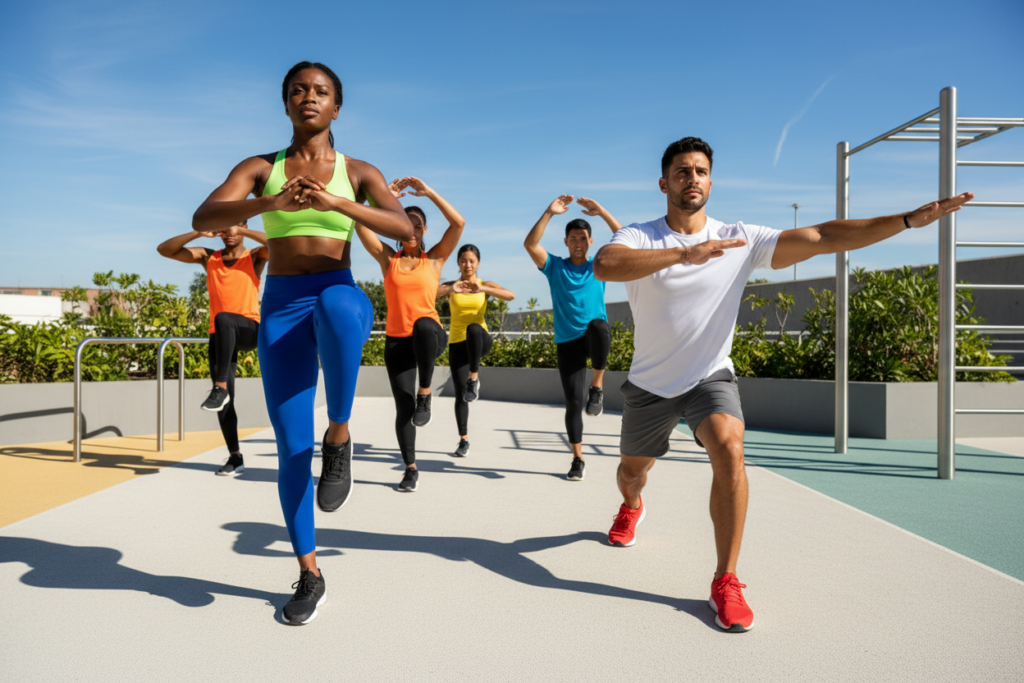
- Lower-body movers: bodyweight squats, walking lunges, and leg swings to open hips, wake glutes, and teach knees to track over toes.
- Full-body patterns: jumping jacks or toe taps and plank walk-outs to raise heart rate and improve coordination without tiring you out.
- Upper-body openers: arm circles and reach-and-rotate reps to prime shoulders, chest, and arms for pressing or pulling.
Set/rep plan: 2 rounds when short, 3 rounds if it’s cold or you feel stiff. Do about 10 reps or ~20 seconds per drill, with quick transitions.
Scale intensity by starting small and increasing range as motion improves. Treat this as part of the exercise, not optional prep.
Go-to dynamic stretches to do before you train
Warm up smart with a short set of active moves that wake joints and steady your posture. Do 8–12 reps or ~20 seconds per drill, keeping motion controlled and breathing steady.
High knees & butt kicks — posture and coordination
- High knees: tall posture, core engaged, light contact through the feet. Keep rhythm steady; don’t sprint.
- Butt kicks: pull heels quick toward the glutes, keep hips under you and avoid arching the low back.
Leg swings & hip circles — loosen stiff hips
- Leg swings: use a wall, hips squared, start small and increase range gradually.
- Hip circles: lift the knee, open the hip, and keep the trunk quiet so the hip does the work.
Walking lunges, squats, plank walk-outs, and arm circles
- Walking lunges: long step, front thigh near parallel, drive up through the whole foot.
- Squats: chest up, sit hips back, let knees track over toes without caving in.
- Plank walk-outs: hands under shoulders; walk to a strong plank and back to warm shoulders, core, and back.
- Arm circles: start small, build to larger circles, then reverse to hit the shoulder joint both ways.
Jumping jacks & toe taps — easy full-body option
Use these when you want low-equipment moves that raise temperature and sync foot, hand, and eye coordination. Common mistake: overreaching or landing stiff; keep soft knees and light feet.
Static cool-down stretches to reduce soreness and restore length
After training, a short still-hold sequence helps your body shift from peak effort to calm. Post-session holds help blood flow return to baseline and give warm muscles a chance to relax and lengthen.
Why this matters and how it should feel
When your muscles are warm they respond better to slow, steady holds. A good stretch feels like a steady pull, not sharp pain or joint pressure. Expect gentle relief, not magic; this can reduce the tight, cramped feeling and help recovery for your next session.
Best-practice holds and simple breathing cue
- Hold each position 30–60 seconds, 1–2 rounds. Let slow breathing guide you.
- Inhale quietly through the nose, exhale long and use that exhale to soften deeper into the pose.
- Don’t force depth — avoid shaking, numbness, or sharp sensations.
Short on time? Spend a few minutes on hips/hip flexors, hamstrings/calves, and chest/shoulders first. Small, consistent cool-downs most days beat occasional long sessions.
Post-workout stretch sequence for the muscles beginners tighten most
Finish your session with a calm, ordered set that targets the places most likely to feel tight after training. Move through each position slowly and breathe. Hold each stretch about 30–60 seconds, then switch sides if needed.
Hips and quads
Start kneeling for a hip flexor stretch. Keep a tall torso and gently squeeze the glute on the back side so you feel the pull in the front of the hip and quad — not pinching in the low back.
Progress to a runner’s stretch with your hands on the ground by the front foot and hips lowered. Finish with a Samson variation: a deep lunge with arms overhead to open the front chain.
Hamstrings and calves
Shift to a forward fold or toe touch using a hinge at the hips. Keep soft knees if the back tenses.
Then stand facing a wall for a calf stretch. Press the back heel down and feel it along the lower leg and foot.
Back and spine
On the floor, settle into child’s pose to decompress the spine. Follow with cat-cow to add gentle motion.
Use cobra for a front-body opening. Only do the seated back twist if your back tolerates rotation; skip twists with disk or sharp symptoms.
Chest, shoulders, inner thighs, and side body
Stand in a doorway for a chest stretch to undo forward hunch. Then use a cross-body shoulder stretch to calm the shoulder capsule after pressing and pulling.
Sit into bound angle (butterfly) with a long spine and steady tension in the groin. Finish standing with a side bend to open the lats and trunk — feet planted, avoid rotation, breathe into the open side.
- Order: hips/quads → hamstrings/calves → back/spine → chest/shoulders → inner thighs → side body.
- Timing: 30–60 seconds per side; slow breaths, no forcing.
- Safety: If a twist or hold causes sharp pain, back off and choose a gentler position.
Want extra work on the hamstring area? See this quick guide to targeted hamstring moves: hamstring exercises.
Short daily mobility routine for desk days and rest days
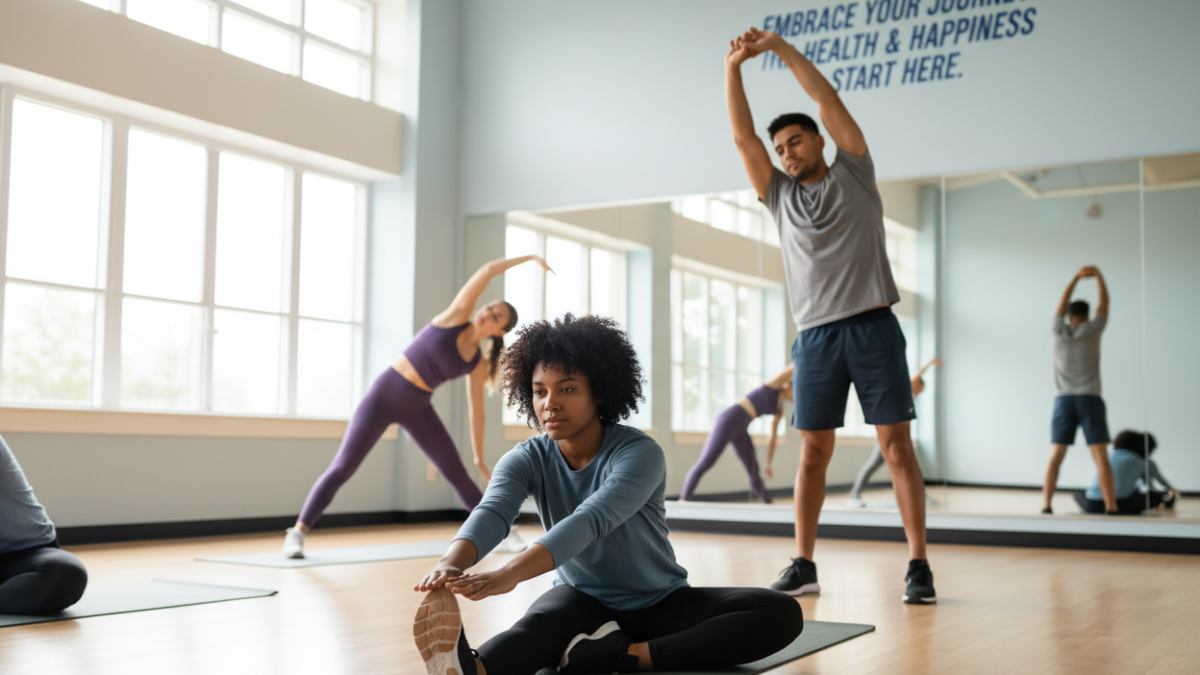
You don’t need a class — a tiny, repeatable set can free your shoulders and hips. Do this five-minute flow on the floor or from a chair to ease tight chest, upper traps, and hip flexors.
A five-minute flow that targets tight pecs, upper traps, and hip flexors
Start with child’s pose for 30–45 seconds to calm the low back and breathe into your chest. Move to a seated pec stretch (goalpost arms or hands interlaced behind the head) for 30 seconds each side if you can’t get on the floor.
Do a kneeling hip flexor stretch with a tall torso and a gentle forward shift for 30 seconds per side. Finish with two upper-back moves: thread the needle on the floor (keep hips stacked) and a thoracic extension over a foam roller or rolled towel — slow exhales as you lift the chest.
Thread the needle and thoracic extension for a less-hunched upper back
Thread the needle restores thoracic rotation without twisting the low back. Keep the bottom hip steady and reach under with control for 6–8 slow reps per side.
Thoracic extension with a roller or towel should be gentle. Pause at the top, inhale, then exhale to relax into the open position for 10–20 seconds.
How to fit in 10–15 minutes up to three times per day without overthinking it
Attach sessions to simple anchors: after breakfast, a mid-afternoon break, and after dinner. Each session can be one five-minute flow or split into shorter blocks.
Keep it easy and consistent. The goal is usable mobility for daily life, not a yoga class every rest day.
| Move | Position | Time / Reps | Main benefit |
|---|---|---|---|
| Child’s pose | Floor | 30–45 seconds | Calms low back, opens chest |
| Seated pec stretch | Chair | 30 seconds per side | Releases tight chest and shoulders |
| Kneeling hip flexor | Floor or bench | 30 seconds per side | Lengthens front of hip, improves posture |
| Thread the needle | Floor | 6–8 reps per side | Restores thoracic rotation |
| Thoracic extension | Foam roller / towel | 10–20 seconds holds | Opens chest, reduces hunch |
Want a simple plan that pairs mobility with strength? Check this short guide to a bodyweight program that fits desk life: calisthenics quick start.
How to personalize your stretching routine by workout type and problem areas
Tailor what you do after training to the activities that tax your body most. Pick the tight spots that hold you back and give them priority. Use the simple “pick 3” rule: choose three areas that limit your sessions, work those consistently for two weeks, then add more if needed.
If you lift weights: prioritize hips, chest, shoulders, and ankles
Lifting commonly tightens the hips and chest. Open hips and ankles to improve squat depth and knee tracking. Freeing the chest and shoulders helps pressing and overhead motion. Spend most of your post-session holds on these areas.
If you run or bike: prioritize calves, hamstrings, quads, and hip flexors
Endurance training stresses calves and hamstrings, and shortens the front of the hip. Target those muscles to smooth your stride or pedal stroke. Consistent, steady holds will reduce pull in the leg chain and help your feet land cleaner.
If your back feels tight: skip twisting and choose gentler options
If rotation causes sharp pain or reproduces symptoms, avoid twists. Use child’s pose, cat-cow, and gentle hip flexor work instead. Prioritize breathing and control; if a position sends pain into a nerve, stop and consult a clinician.
Simple progress markers you can track
- You reach the same position while breathing easily and without bracing.
- You need less warm-up time to move well the next session.
- Your motion under light load is smoother and more controlled.
- If you feel the pull mostly in a joint instead of muscle, reduce range or tweak alignment.
| Training Type | Primary Targets | Quick Goal (post-session) |
|---|---|---|
| Weight lifting | Hips, chest, shoulders, ankles | Improve squat depth, shoulder reach, and knee tracking |
| Running / Cycling | Calves, hamstrings, quads, hip flexors | Smoother stride/pedal, less tightness in feet and legs |
| Tight back days | Low back-friendly moves: child’s pose, cat-cow, hip flexors | Reduce sharp symptoms, protect spine; skip twists if painful |
Conclusion
Finish with a simple plan that makes your next session easier and safer. Dynamic work before your workout, steady static holds after, and a short mobility reset on desk-heavy days is the clearest approach.
Do this today: pick five dynamic moves and do two rounds. After training, hold three to five static stretches for 30–60 seconds each. That small time investment brings real benefits.
Safety first: you should feel a stretch in the muscle, not sharp pain. If your back or knees spike, scale down or swap the move.
Technique tips: place hands where you’re stable, and shift weight slowly instead of dumping into end range. Give it two weeks and notice how warm-ups, flexibility, and overall fitness improve.
Need extra guidance? See these workout tips to pair with this plan.
FAQ
What does a basic stretching routine every beginner should follow look like?
How should a “good stretch” feel versus pain?
What’s the difference between improving flexibility and improving mobility?
What quick form cues protect my knees, hips, and low back?
When is the best time to do dynamic versus static work for better performance?
How long should I hold stretches and how many reps are realistic?
Which lower-body dynamic movers best prep hips, legs, and knees?
What full-body patterns raise temperature and range of motion quickly?
What upper-body openers help my shoulders, chest, and arms?
What simple set/rep plan will make a warm-up fast and effective?
Which dynamic stretches should I use before training?
How do high knees and butt kicks help posture and coordination?
How do leg swings and hip circles loosen stiff hips safely?
Which walking lunges and squat variations prime legs and glutes best?
What plank walk-outs and arm circles do for shoulders, core, and back?
When should I use jumping jacks or toe taps as a warm-up option?
Why do post-workout static holds help blood flow and recovery?
What’s the best-practice hold time for static stretches?
Which post-workout stretches target hips and quads effectively?
What are reliable hamstring and calf stretches to reduce tightness?
Which back and spine moves help with stiffness after training?
How do I open chest and shoulders after a session?
What stretches help inner thighs and groin safely?
How can I reset my side body and lats quickly?
What does a short daily mobility flow for desk and rest days include?
How do thread-the-needle and thoracic extension help a hunched upper back?
How can I fit 10–15 minutes of mobility into a busy day without overthinking it?
How should I personalize my stretching choices by workout type?
What should I do if my back feels tight — are twists safe?
What simple progress markers show my flexibility and mobility are improving?