
Common Knee Injury Prevention Tips for Runners and Lifters

 0
0
 0
0 Every step you run drives a force up to four times your body weight straight into your joints. Think about that the next time you hit the pavement or the treadmill.
These hinges are engineering marvels, but they’re also vulnerable. Discomfort here can sideline anyone, from weekend warriors to competitive athletes.
The good news? A huge majority of these problems are avoidable. They often trace back to muscle imbalances, poor movement patterns, or just skipping a proper warm-up.
We’re cutting through the noise. The strategies you’ll get come straight from sports medicine pros. This is about building resilient, healthy joints through smart training and proper form.
You’ll get actionable steps—from choosing the right shoes to strengthening the muscles that matter. For instance, balanced leg strength is crucial, which is why we recommend targeted hamstring exercises as part of a solid foundation.
Key Takeaways
- Most joint issues stem from correctable causes like muscle weakness or tightness.
- Proper movement form is non-negotiable for long-term joint health.
- Strength imbalances are a primary culprit behind discomfort and structural stress.
- Your footwear and equipment choices directly impact how your body absorbs load.
- A dynamic warm-up routine prepares your tissues for the stress of your workout.
- Listening to your body’s early signals stops minor twinges from becoming major injuries.
- Building strong, supportive muscles is the best defense against impact and strain.
Understanding Knee Health and Injury Risks
Sports medicine draws a clear line between problems you can fix with smart training and those needing a surgeon’s skill. Knowing which side you’re on saves months of frustration.
Here’s the reality. Inflammation comes from overuse, muscle imbalances, or poor form. It typically responds incredibly well to rest, targeted exercises, and smart pain management strategies.
Structural damage is different. This involves torn ligaments or damaged cartilage. These issues often require surgical intervention when conservative care fails.
Inflammation Versus Structural Problems
Dr. Charles Bush-Joseph, a leading sports medicine surgeon, explains the distinction. If you can fully straighten your leg without sharp pain, you’re likely dealing with inflammation.
Persistent swelling or an inability to squat to 90 degrees often signals structural trouble. His advice? Ice, stretch, and use anti-inflammatory meds for 7-10 days.
If swelling remains, it’s time for professional evaluation and imaging.
Everyday Activities and Their Impact on the Knee
Your body’s largest joint handles stress from simple acts like climbing stairs. Running and lifting multiply that load exponentially.
Catching irritation early stops it from becoming chronic pain that sidelines you. Address small signals before they wreck your training schedule.
This understanding separates effective recovery from wasted time.
Essential Common Knee Injury Prevention Tips
The most powerful tool for joint health isn’t found in a pill bottle—it’s your own muscular system. Smart prevention is about managing risk, not avoiding activity altogether. It comes down to two core principles: staying active within your limits and understanding why proactive care beats reactive treatment every time.
Stopping is Not the Solution
Inactivity weakens the very muscles that protect your joints. Even with existing issues, targeted strength training builds a muscular support system. This takes load off damaged tissues and can significantly reduce pain.
Knowing your limits means choosing activities that challenge you without causing aggravation. Swap high-impact running for swimming or cycling. Listen closely when your body sends pain signals—it’s giving you crucial feedback.
| Choose This (Low-Impact) | Avoid This (High-Stress) | Why It Works |
|---|---|---|
| Swimming, Elliptical | Downhill Running, Jumping | Builds cardio without excessive joint pounding |
| Leg Press, Stationary Bike | Deep Knee Bends, Heavy Squats with Poor Form | Strengthens quads & hamstrings with controlled motion |
| Walking on Level Ground | Prolonged Kneeling | Promotes blood flow and mobility with minimal strain |
The Smart Investment in Your Future
Proactive care drastically reduces the severity of problems when they happen. It’s about proper preparation and addressing small twinges before they become major setbacks.
Physical therapy is a powerful prevention tool, not just a treatment. It teaches movement patterns that protect your joints from overuse.
The way you care for your body now determines your capability decades from now. This long-term investment is the smartest one you’ll make.
Strengthening and Flexibility: Exercises for Resilient Knees
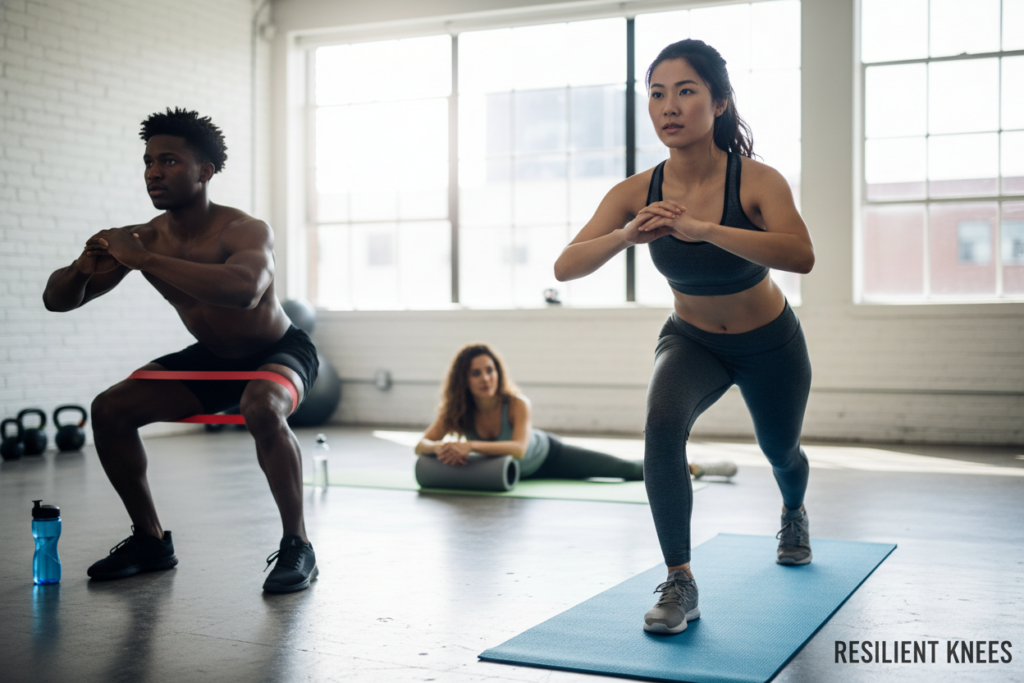
The secret to durable joints lies not in a brace, but in balanced muscle development and supple tissues. You need targeted exercises and dynamic stretches to build this protective system.
Targeted Muscle Training for Quadriceps and Hamstrings
Your quads (front of thigh) and hamstrings (back of thigh) work as opposing forces. When one group is stronger, you set yourself up for strain.
These moves build the strength that acts as a natural shock absorber.
| Exercise | Primary Muscles Worked | Key Benefit for Joints |
|---|---|---|
| Step-Ups | Quads, Glutes, Hamstrings | Builds single-leg stability for running and climbing |
| Hamstring Curls | Hamstrings | Protects the knee from hyperextension and strain |
| Straight-Leg Lifts | Quadriceps | Strengthens the front thigh to stabilize the kneecap |
Dynamic Stretches to Maintain Flexibility
Tight muscles pull your joints out of alignment. Your knee compensates, leading to overuse problems.
As Dr. Bush-Joseph notes, stretching these muscles takes pressure off the joint. The butterfly stretch opens the hips. The standing hip flexor stretch is crucial for runners.
If you hate static stretching, warm up smartly. Start with 10-15 minutes of easy walking or jogging. This prepares your tissues and helps prevent injury.
A well-conditioned, flexible body is far more resistant to overuse injuries. This unglamorous work is essential.
Gear Up and Manage Weight for Optimal Knee Health
You can build all the muscle you want, but if your shoes are wrong or you’re carrying extra pounds, your joints are fighting a losing battle. These two factors—what you put on your feet and what you carry on your frame—directly control the stress your body absorbs.
Choosing Supportive Shoes to Reduce Knee Strain
Your footwear dictates your leg alignment. Supportive shoes with proper cushioning distribute force evenly.
High heels are a major culprit. They tip your weight forward, forcing your thigh muscles to work overtime just to keep you stable. This constant strain leads directly to knee pain.
Swap stilettos for flats daily. For training, get professionally fitted. Experts at a running store analyze your gait and arch type. They match you with shoes that lower your specific risk for overuse injuries.
Replace running shoes every 300-500 miles. Worn-out cushioning transfers shock straight to your joints.
| Footwear Type | Effect on Alignment | Best For |
|---|---|---|
| Stability Running Shoes | Promotes neutral leg position, controls excess motion | Runners with mild overpronation |
| Neutral Cushioned Shoes | Maximizes impact absorption without correction | Runners with efficient, neutral gaits |
| Minimalist Shoes / Flats | Encourages natural foot strike, strengthens foot muscles | Short-distance training, daily wear |
Weight Management Techniques to Ease Joint Pressure
Here’s the math that changes everything. With each step, 2-4 times your body weight transmits through your knee joint.
Lose just 10 pounds, and you reduce the pressure on your knees by 40 pounds per step. That’s thousands of pounds of cumulative stress removed daily.
For those with arthritic knee pain, research shows about a 20% pain reduction for every 10 pounds lost. Drop 20 pounds, and you could cut your discomfort nearly in half.
This isn’t about vanity—it’s mechanical relief. Less weight means less inflammation and slower cartilage breakdown. Combine modest weight loss with your strengthening routine. The synergy dramatically lowers pain and protects your joints for the long run.
Posture, Alignment, and Core Strength for Knee Protection
How you hold yourself upright isn’t just about looking confident—it’s a primary defense against joint stress. Dr. Charles Bush-Joseph points out that slouching forces your body off-center. Your muscles then work overtime to keep you balanced.
This constant compensation fatigues them. Once they give out, your knee joint absorbs the beating. Perfect alignment stacks your head over your shoulders and hips over your ankles.
This lets your skeleton bear weight efficiently. Your muscles maintain position without excessive strain.
Simple Core Exercises to Support Better Alignment
Core strength builds a stable foundation in your abdomen and lower back. It maintains proper alignment during every movement. This removes compensatory stress from your knees.
Planks are a powerhouse. Get into a forearm position, squeeze your abs and glutes. Hold your body in a straight line for 15-45 seconds.
This builds anti-extension strength. It prevents your lower back from sagging and pulling you out of line.
Back extensions target the muscles along your spine. Lie face-down, hands under your shoulders. Press your upper body up, keeping hips on the floor.
Hold for 5-10 seconds. Repeat 5-10 times. This combats the forward hunch that leads to knee pain.
Yoga and Pilates develop deep body awareness. They teach integrated strength that improves your form automatically. This directly lowers your risk for knee injuries.
Pay obsessive attention to form. One set of squats with poor leg alignment does more harm than ten perfect sets. Quality always trumps quantity when protecting your joints.
The way you hold yourself during training predicts injury risk more than volume. Fix your posture, strengthen your core. Watch chronic pain fade as your body moves the way it was designed.
Conclusion
Your long-term ability to stay active hinges on the small, consistent choices you make today. View this not as a temporary fix, but as an ongoing commitment to your body’s resilience.
Understand the main culprits behind joint issues—ACL tears, meniscus damage, and overuse inflammation. Most respond well to rest and smart rehab.
Persistent swelling or instability means it’s time to see a sports medicine professional.
The habits you build now are everything. Strengthen your legs, maintain flexibility, manage your weight, and choose supportive shoes.
Integrate this mindset into your smart programming for compound lifts and all your training.
Stay proactive. Listen to your body’s signals. This consistent, intelligent approach is how you safeguard your joints for decades of strong, pain-free movement.
FAQ
What’s the difference between general inflammation and a serious structural problem in my knees?
How do I balance staying active with not pushing my body too hard?
Which muscles are most important to strengthen for protecting my joints?
Do my shoes really make that much of a difference for joint health?
Can losing weight actually help if my knees already hurt?
How does my core strength connect to protecting my knees?