How to Schedule Ab Training for Better Progress

 0
 0
Train your abs directly two to four times a week, and drop the daily ab circuits. Pick two or three exercises, progress them like any other lift, and stop each set with a rep or two left. For most natural lifters with a busy week, that settles how often you should train abs. The six-pack itself gets decided somewhere else. Training builds the muscle, while your body fat decides whether anyone can see it.
How often should you train abs?
Work in the range of two to four direct ab sessions per week. Two is enough if you already squat, deadlift, and press with real effort, because those lifts force your trunk to brace hard. Three or four makes sense if your abs lag or you prefer short ab blocks spread across the week.
That range matches general strength guidance. The CDC's adult guidelines, which follow the federal Physical Activity Guidelines for Americans, call for at least 2 days of muscle-strengthening activity each week. They pair that with 150 minutes of moderate-intensity activity.
Your abs are skeletal muscle, the same kind of tissue as your quads and lats. So they respond to the same inputs: hard sets, gradual progression, and time to recover. Use this table to pick your starting point.
| Your situation | Direct ab sessions per week | Hard sets per session |
|---|---|---|
| Heavy compound lifter, short on time | 2 | 3 to 4 |
| Training three full-body days | 3 | 2 to 3 |
| Abs lag behind, recovery is good | 3 to 4 | 2 to 3 |
| Beginner still learning to brace | 2 | 2 |
Start at the low end of your row. Add a session only if your ab exercises have stalled for several weeks and your sleep, food, and effort are already in order. If you run four sessions, keep each one short and avoid hard ab work on back-to-back days.
Can you train abs every day?
You can, but it rarely beats three focused sessions. If you can train abs hard every single day, the sets probably aren't hard enough to count. And if they are hard, you're piling fatigue onto a muscle that never gets a full day off.
Hundreds of crunches a day is the classic version of this mistake. It builds the ability to do lots of crunches and very little else. Once a set takes several minutes, you're mostly chasing a burn, and a burn tells you nothing about progress.
Light daily activity is a different matter. Walking, breathing drills, a dead bug in your warm-up, or a short plank before you lift won't hurt recovery. Just don't count that as ab training. It's practice, and it should leave you fresh.
Here's a simple test. If your ab numbers haven't moved after a month of daily work, cut back to three sessions and push those harder.
Abs need recovery like any other muscle
Experts generally recommend 48 to 72 hours of recovery between resistance training sessions for the same muscle group. Your abs aren't exempt just because they're small or because you use them all day. They bounce back quickly from light work. However, heavy weighted crunches or long sets of rollouts take longer.
Watch for these signs that your ab volume or effort is outrunning recovery:
- Reps or load on your ab exercises drop two sessions in a row
- Soreness hasn't cleared by the time your next ab session arrives
- Your lower back aches after ab work, which usually means your hip flexors or spine took over
- Bracing feels weak or shaky during squats and deadlifts
Sleep and food matter here too. Short nights and a steep calorie deficit slow recovery for every muscle, abs included. So if you're dieting, hold ab volume steady instead of adding more.
Placement matters as well. Train abs at the end of a session, never right before heavy squats or deadlifts. A tired trunk gives your spine less support on the lifts that load it most.
Use a small menu of exercises and progress them
Two or three exercises cover it. A new ab circuit every week feels productive, but it makes progress impossible to track. Pick one movement from each group below and run them for months.
Flexion movements (curling your spine forward against resistance):
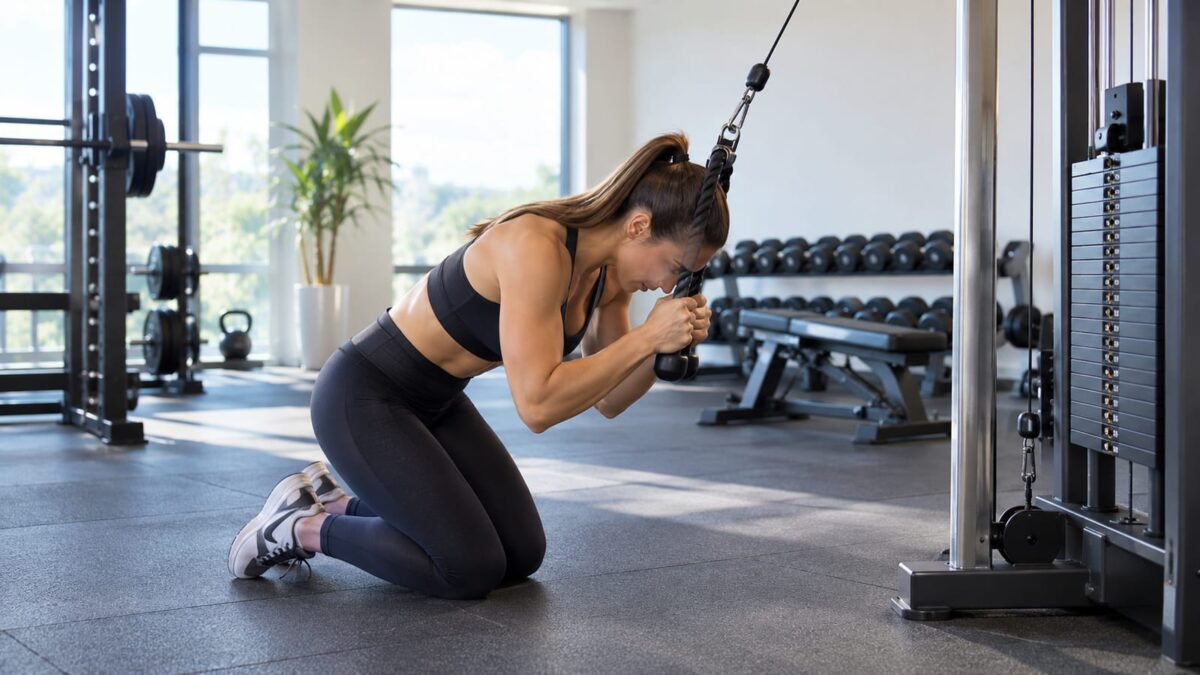
- Cable crunch
- Hanging knee raise or leg raise
- Weighted decline crunch
Stability movements (holding a braced position while something tries to move you):
- Ab wheel rollout
- Pallof press
- Suitcase carry
- Dead bug
Flexion work builds the muscle that shows. Stability work teaches your trunk to hold position under load, which carries straight over to your big lifts. One of each, done two to four times a week, gives you both.
How to progress ab exercises
Progress them the same way you'd progress a curl. Use a rep range, such as 8 to 15, and stay with the same load until every set reaches the top of the range with clean form. Then add a small amount of weight or move to a harder version.
For example, knee raises become straight-leg raises, and short rollouts from your knees become longer ones. Loaded exercises make progress much easier to measure. For a closer look at when to add load, see this breakdown of weighted vs unweighted ab training.
Write every session down. If you can't beat the logbook, you can't tell whether the plan is working.
Technique and recoverable effort matter more than punishment
The burn is not the goal. Quality reps are. Most ab training goes wrong because people grind out sloppy reps until something hurts, then call that a workout.
Brace first. Before each rep, breathe into your belly, then tighten your trunk as if someone were about to poke you in the stomach. Keep your ribs pulled down toward your hips.
Control the range. On crunches, curl your spine forward instead of yanking your head or just bending at the hips. On leg raises, tilt your pelvis up at the top and don't swing. On rollouts, stop before your lower back starts to sag.
Respect your spine. Flexion exercises round your spine on purpose, while rollouts and planks train you to resist arching. Both are fine when they're slow and controlled. Still, your lower back gets a vote. If it aches, shorten the range or pick an easier variation.
Leave reps in reserve. End most sets with 1 to 3 good reps left. Taking the last set of a cable crunch to failure now and then is fine. Meanwhile, end a plank the moment your hips sag, whatever the clock says. Multi-minute planks add little, so move to a harder variation instead.
Body fat decides whether your abs show
Everyone has abs. Training makes them thicker, which helps them show at a slightly higher body fat. Even so, crunches don't burn the fat sitting directly on top of them.
Spot reduction doesn't work. Your body pulls fat from stores all over, in an order mostly set by your genetics. That's why your belly can be the last place to lean out, even when your arms and face already have.
So ab training builds what's underneath, and fat loss removes the cover. You need both, in that order of patience. This guide on how to get abs covers the full process.
If you're in a gaining phase right now, keep training abs anyway. The muscle you build will show later, and this post on training your abs while bulking explains how to handle that phase.
Subcutaneous and visceral fat are different problems
Subcutaneous fat sits just under your skin. It's the soft layer you can pinch, and it's what hides your abs. Visceral fat sits deeper, packed around the organs inside your abdomen. You can't pinch it, and it tends to push the belly out from the inside so it feels firm.
Visceral fat is the bigger health concern. Higher levels are linked to heart disease and type 2 diabetes. Fortunately, it tends to respond well to regular exercise and steady fat loss.
Both kinds come down the same way: lose body fat overall and stay active. A tape measure tracks this better than the scale alone. Measure your waist at your navel once a week, in the morning, under the same conditions. If your waist is shrinking, you're making progress, even when your weight barely moves.
Diet drives six-pack visibility
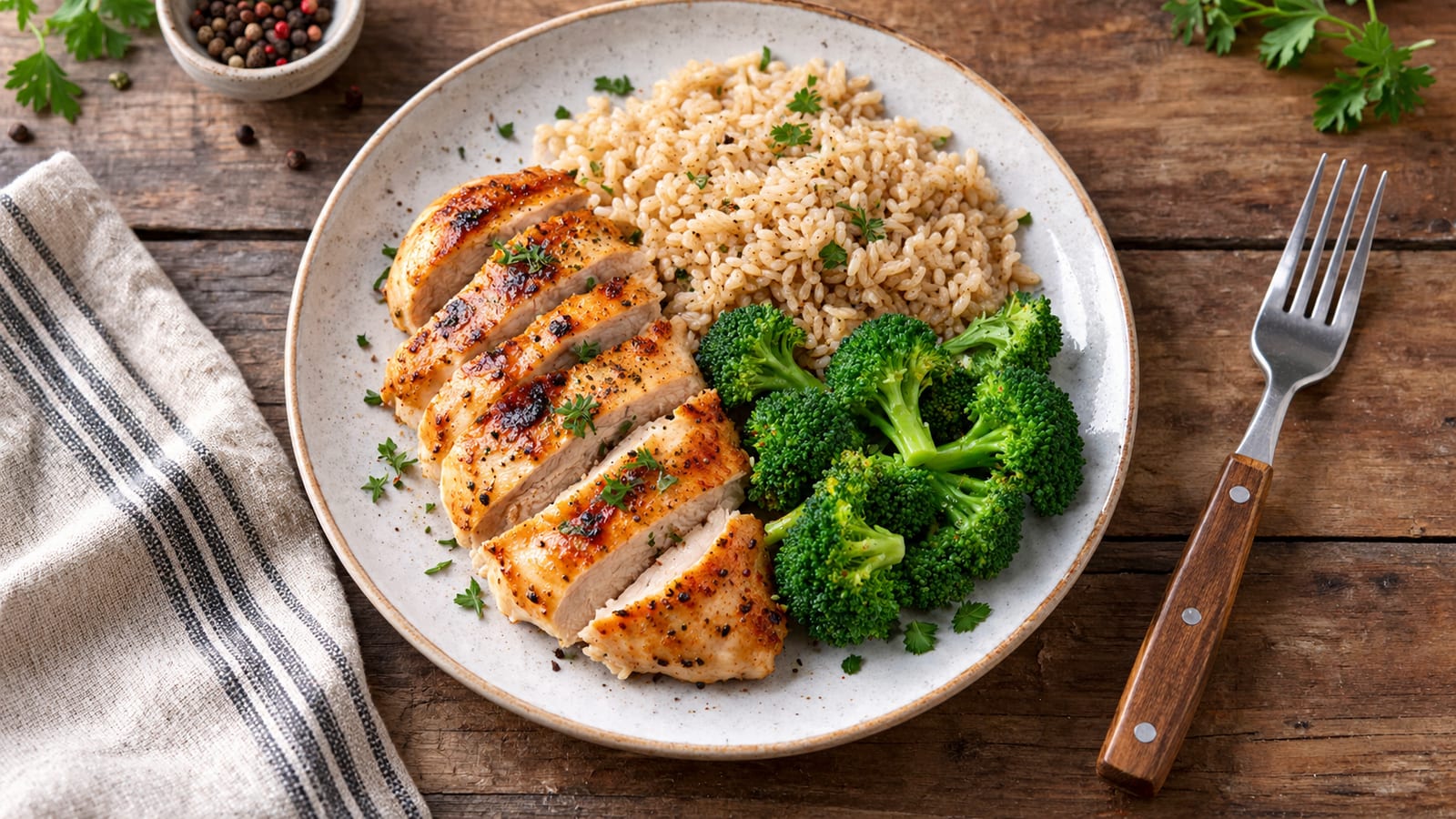
You can't out-crunch your diet. Visible abs come from a long, steady fat-loss phase that keeps your muscle. Get these basics in place:
- Eat in a moderate calorie deficit. That means eating a bit less than you burn. Aim for a pace you can hold for months, because crash diets cost muscle and wreck your training.
- Get protein at every meal. Protein helps you hold on to muscle while you lose fat, and it keeps you fuller between meals.
- Keep lifting hard. Training tells your body the muscle is still needed. As a result, more of what you lose comes from fat.
- Build meals around filling foods. Lean meat, eggs, dairy, vegetables, fruit, potatoes, rice, and oats keep hunger manageable. Leave room for foods you enjoy so the plan survives real life.
- Judge your weekly average. One rough day doesn't matter much. Instead, look at the trend across the whole week.
Weigh yourself most mornings and compare weekly averages. If your weight and waist both stall for a few weeks, trim a little food or add more daily walking. Don't slash calories in one big cut.
How long does it take to get a six-pack?
Nobody can give you a fair deadline, because the answer depends on where you start. These factors decide your timeline:
- Starting body fat. The more you have to lose, the longer it takes.
- Muscle development. Thicker abs show sooner, so training time counts.
- Rate of fat loss. A pace you can sustain beats a fast start you abandon.
- Genetics. Some people store belly fat last, and the shape of your abs is inherited.
- Adherence. The plan you follow most weeks wins.
If you're already fairly lean with decent muscle, a few focused months may be enough. If you're starting with more fat to lose, expect it to take a good deal longer, and that's normal. Lower abs are often the last to show.
Take progress photos every few weeks in the same lighting, alongside your waist measurement. Those two together show progress long before the mirror does. Small changes add up.
A simple weekly ab plan that fits limited time
This plan fits three full-body sessions on Monday, Wednesday, and Friday. Each ab block takes about ten minutes at the end of your workout. Rest about a minute between sets.
| Day | Flexion exercise | Stability exercise |
|---|---|---|
| Monday | Cable crunch, 3 sets of 10 to 15 | Pallof press, 2 sets of 10 to 12 per side |
| Wednesday | Hanging knee raise, 3 sets of 8 to 15 | Suitcase carry, 2 walks per side |
| Friday | Weighted decline crunch, 3 sets of 10 to 15 | Ab wheel rollout, 2 sets of 6 to 12 |
If you only lift twice a week, run the Monday and Friday blocks and add one extra set to each exercise. The plan has to fit your week, so pick the version you'll actually repeat.
Run it with these steps:
- Leave 2 to 3 reps in reserve on every set for the first two weeks while you learn the movements.
- Add a rep to each set when you can, until every set reaches the top of the range.
- Then add the smallest load you can, or move to a harder variation, and work back up.
- If two sessions in a row go backward, drop a set for a week, then build again.
Stay on the same exercises for at least two to three months before you swap anything. It's simple on paper and demanding in practice, and that combination is what makes it work.
FAQ
Will ab training make my waist look thicker?
For most people, no. Your waist size comes mostly from body fat and your bone structure. Very heavy side-bending and loaded oblique work can add some muscle at the sides. So if that worries you, keep oblique-focused exercises at moderate loads and spend your effort on crunches and rollouts.
Do squats and deadlifts train abs enough on their own?
They make your trunk work hard to stay rigid, which builds real strength. However, they rarely take your abs through a full curl under load. If you want abs that show, a few sets of direct flexion work each week fills that gap.
Is it fine to train abs on leg day?
Yes, as long as the ab work comes after your squats and deadlifts. Tired abs make bracing harder on your heaviest lifts, while finishing with them costs you nothing.
Can I train abs at home without equipment?
You can. Use crunches with a slow lowering phase, lying leg raises, dead bugs, and side planks. Progress by slowing each rep, pausing at the hardest point, or holding a backpack or water jug for added load. Once bodyweight sets get easy into the high teens, it's time for a harder variation.