

Mindfulness Tips for Beginners in Fitness and Training

 0
0
 0
0 You’re counting reps, pushing sets, chasing PRs. But what if your mind is the weak link holding back your gains? Mindfulness tips for beginners in fitness aren’t about meditation cushions—they’re tactical mental drills that protect you from injury and unlock new performance levels.
Research shows that just five minutes of regular practice can improve workout satisfaction and commitment. Your nervous system directs every lift and sprint. Ignoring this mind body connection leaves progress on the table.
This isn’t about sitting cross-legged. It’s about training your attention to stay present during a heavy squat. When your focus wanders, form breaks down. That’s when injuries happen.
We’ll show you evidence-based strategies to build mental resilience. This skill separates good athletes from great ones. Integrating a few minutes into your routine boosts focus, manages stress, and ensures long-term consistency.
Key Takeaways
- Mental focus is a performance tool, not just for relaxation.
- The mind and body work together during physical activity.
- Staying present during workouts helps prevent injuries.
- Short, regular practice sessions can improve your results.
- This approach builds resilience for consistent training.
- It applies to any style of exercise, from lifting to cardio.
- You gain a competitive edge in focus and stress management.
Starting With Mindfulness: What It Means for Your Fitness Journey
Your workout isn’t just physical—it’s a mental game you can win. This is where mindfulness comes in. For training, it means full presence in your body. You experience each rep, breath, and sensation without distraction.
Understanding Mindfulness and Its Role in Exercise
Think of it as complete inhabitation of your movement. In the gym, you notice muscle tension during a lift. You feel your feet grounded. You track your breathing pattern.
This sharp awareness is a performance tool. When you’re present, you catch form breakdown before it causes injury. You recognize true fatigue signals. You optimize muscle engagement for better results.
Mindfulness vs Meditation: Key Differences
Many people confuse the two. Meditation is a dedicated tool to develop mindfulness. It often involves sitting still, focusing on breath.
Mindfulness during exercise is the state you access. You bring that same quality of attention to your movement. Your workout becomes the meditation.
You don’t need hours of seated practice. Just five minutes of consistent effort builds neural pathways. This improves focus and body awareness. It’s a learnable skill, like training a muscle. The payoff is measurable in performance and safety.
Mindfulness Tips for Beginners in Fitness
The secret to safer, more effective training lies in your present-moment awareness. Simple practices build this skill. Integrate them into your routine today.
Simple Practices to Get Started
Before you move, set a clear intention. A short phrase like “stay present” grounds your session. It’s your mental anchor when focus fades.
Next, do a 60-second body scan. Notice tightness or energy levels. This check-in gathers crucial data to prevent injury.
Everyday Mindful Exercises for Your Routine
Sync your breath with movement during warm-ups. Inhale for four counts, exhale for six. This pattern primes your nervous system for performance.
Try the “sensation spotlight.” Pick one physical cue, like the bar’s pressure during a squat. Focus on it completely.
Between sets, take three conscious breaths. This micro-practice builds the habit of returning to your body.
Consistency beats duration. Two minutes of genuine practice each workout builds neural pathways faster than a weekly marathon.
| Practice | When to Use | Primary Focus | Key Benefit |
|---|---|---|---|
| Intention Setting | Pre-workout | Mental clarity | Anchors focus for the entire session |
| Body Scan | Pre-workout check-in | Physical sensation | Injury prevention intelligence |
| Breath Sync | During warm-up sets | Rhythmic breathing | Activates optimal performance state |
| Sensation Spotlight | During any working set | Specific physical cue | Deepens mind-body connection |
Start with just one of these exercises. Master it. Then add another. This is the smart way to build mental resilience.
Benefits of Incorporating Mindfulness Into Your Workout
Beyond the physical burn, a sharper mind delivers tangible performance upgrades you can measure. The benefits extend far beyond feeling calm. They create a measurable edge in both mental health and physical health.
Mental Health Advantages
This practice sharpens your cognitive tools. Improved short-term memory helps you sequence complex lifts perfectly. Increased focus means higher-quality reps.
Research is compelling. A major review of Mindfulness-Based Stress Reduction programs showed participants built better coping skills during stress. This isn’t just feeling good—it’s measurable psychological resilience for tough training blocks.
Physical Health Benefits
Your body responds directly to mental training. In one study, eight weeks of mindfulness training led to clinically significant drops in systolic and diastolic blood pressure.
Chronic pain management improves. You learn to distinguish productive strain from injury signals. Sleep quality skyrockets, supercharging muscle recovery.
A 2020 study confirmed it assists long-term positive behavioral change. This is the secret to sticking with your nutrition and training plan for life.
| Benefit Area | Research Finding | Mechanism | Training Impact |
|---|---|---|---|
| Cognitive Performance | Upswings in working memory & focus | Enhanced attention control | Better form retention & exercise sequencing |
| Stress Resilience | Improved quality of life & coping skills | Regulated emotional response | Consistent training during life chaos |
| Cardiovascular Health | Reduced systolic/diastolic blood pressure | Calmed nervous system | Improved workout efficiency & recovery |
| Long-Term Adherence | Sustains positive behavioral changes | Enhanced self-regulation | Lifetime consistency in fitness habits |
These aren’t just feel-good stats. They’re the foundation for a sustainable competitive advantage.
Transforming Your Routine with Mindful Movement
Transforming your exercise from automatic to intentional starts with where and how you move. Mindful movement is physical activity done with full presence. You feel each rep, step, and breath deliberately.
This approach upgrades your entire routine. You self-correct form issues naturally. You engage target muscles more fully and reduce injury risk.
Creating a Calming Exercise Environment
Your training space is a performance variable. Cluttered, chaotic areas create mental distraction. An intentional environment supports focus and presence.
Take your workout outside when possible. Nature reduces mental fatigue and lifts your mood. It also decreases perceived effort, so you can push harder.
Optimize your indoor space too. Minimize visual distractions and control noise levels. Adjust lighting to match your workout’s intensity.
Create a physical boundary that signals “training time.” A simple pre-session ritual, like three deep breaths, shifts your mind into movement mode.
Your social environment matters. Train with people who support this practice. They help you stay attuned to your body.
Connect your sense of place to your body in motion. The goal is calm alertness—focused intensity where you’re fully present.
Enhancing Performance Through a Mind-Body Connection
Your physical strength has a silent partner: your focused mind. When they work in sync, performance skyrockets. This mind body connection is your ultimate performance multiplier.
Synchronized mental commands and physical execution generate more power. You maintain better form under fatigue and access higher levels of endurance.
Improved Focus and Concentration
Research in the Journal of Health Psychology proves it. People who practiced mindfulness during exercise felt better and reported lower perceived exertion.
You can train harder while enjoying it more. This rare combo fuels long-term progress.
The mechanism is attention regulation. Your mind learns to direct focus to form cues and muscle engagement. It ignores distractions like discomfort.
Another study in the Journal of Sport and Exercise Psychology is clear. Mental training interventions improved athletic performance and reduced stress.
Think practically. During a heavy lift, your thoughts don’t wander. On a long run, you avoid negative spirals. In competition, you stay locked on execution.
This sustained attention is protective. When focus breaks mid-movement, injury risk spikes. Your concentration becomes safety equipment for your body.
You gain the ability to regulate emotions when stakes are high. This removes the psychological limiters capping your physical potential.
Enhanced performance is the final product of a strengthened connection. Integrate mental and physical work to unlock what you’re truly capable of.
Techniques for a Mindful Warm-Up
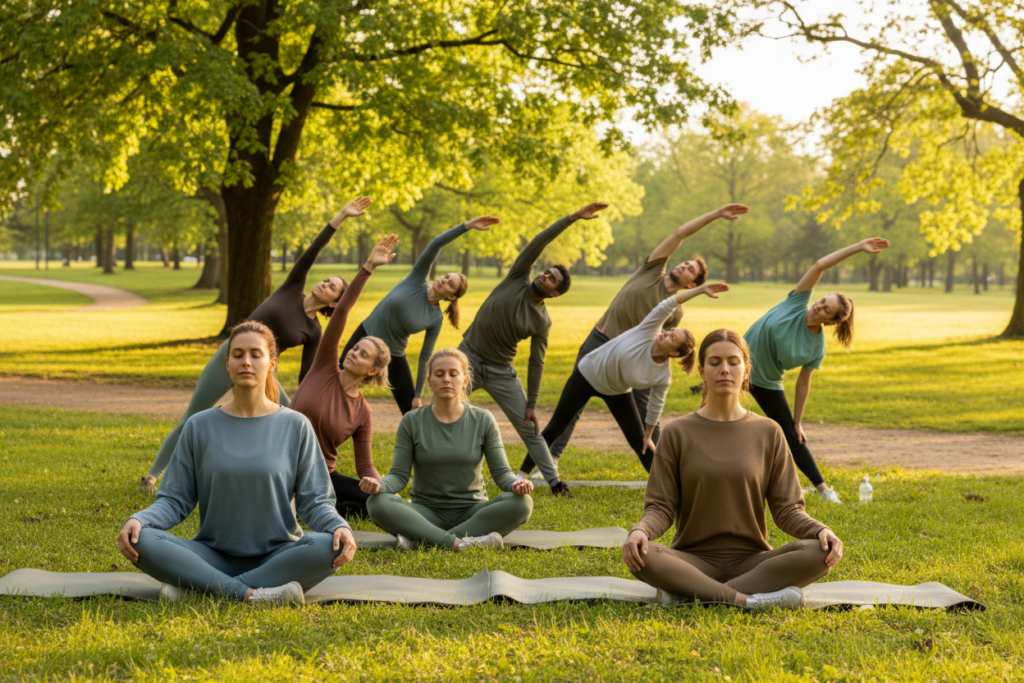
Your warm-up is your neural boot camp, preparing your attention for the work ahead. These first few minutes train your brain to enter a focused, present-state mode. You’re setting the mental tone for your entire session, not just loosening muscles.
Breathing and Stretching to Center Your Mind
Start with a basic breathing protocol. Inhale deeply for a count of four. Then exhale slowly for a count of six. Repeat this for five to ten cycles.
This extended exhale activates your parasympathetic nervous system. It downregulates stress and optimizes your body for controlled, powerful movement.
Now, add simple stretching. Reach your arms overhead and twist gently side to side. As you move, deliberately notice the sensations in your body.
Where do you feel tension? Where does movement feel smooth? This “stretch-and-sense” technique builds crucial awareness.
Your breath is your constant anchor. When your mind wanders during tough exercises, return your attention to each breath. This is a reliable touchpoint for presence.
Try a progressive body scan. Start with awareness at your feet. Move your focus up through ankles, calves, knees, and so on. Combine this mental scan with gentle movement.
Centering your mind before exertion is key. Scattered mental energy produces inefficient output. Calm, focused energy translates to precise movement.
Invest just two to three minutes. This small investment creates measurable improvement in focus and body awareness. The breathing control you practice here establishes the pattern for loaded movements.
This skill is vital for practicing mindfulness during high-intensity training. You rehearse the mental tool before the physical demand hits.
| Technique | Duration | Primary Focus | Key Benefit |
|---|---|---|---|
| Breathing Protocol | 1-2 minutes | Rhythmic breath control | Activates calm, focused state |
| Stretch-and-Sense | 2-3 minutes | Physical sensations | Enhances body awareness & injury prevention |
| Progressive Body Scan | 1-2 minutes | Systematic attention | Connects mind to entire body before exertion |
Choose one technique to master first. Then layer in another. This systematic approach builds a rock-solid mental foundation for every workout.
Harnessing Breath to Maximize Your Workout
You can lift more, run longer, and recover faster by upgrading one fundamental skill: how you breathe. It’s your body’s built-in performance dial.
Diaphragmatic Breathing Benefits
Forget shallow chest breaths. Diaphragmatic breathing draws air deep into your belly, fully engaging the diaphragm muscle. This action stimulates your vagus nerve, calming your nervous system for better emotional control during tough sets.
Sync your breath with your movement. Exhale during the exertion phase—the push in a press. Inhale during the easier phase—lowering the weight. This timing optimizes spinal stability and intra-abdominal pressure.
Proper breathing is free performance enhancement. It increases oxygen delivery, reduces premature fatigue, and lets you sustain higher intensity. Your breath is also a real-time biofeedback tool. Rapid, shallow breathing signals a stressed nervous system. You can use deliberate breath control to downregulate this response mid-workout.
Avoid common mistakes. Don’t hold your breath unnecessarily during lifts. Don’t let your breathing become erratic during cardio. Rhythm is key.
When your mind wanders, use your breath as an anchor. Notice the thought, then gently redirect your attention to the sensation of air moving in and out. Your breathing tempo will naturally increase with effort. The goal is to maintain diaphragmatic quality, not switch to panicked chest breathing.
Think of breath work as skill training. Just like progressive overload for muscles, you can train your breathing capacity. Athletes with superior breath management have a measurable edge in power and endurance.
| Breathing Focus | Exercise Type | Key Technique | Primary Benefit |
|---|---|---|---|
| Power & Stability | Strength Training | Exhale on exertion, inhale on release | Optimizes intra-abdominal pressure |
| Sustainable Pace | Cardio & Running | Maintain diaphragmatic rhythm as intensity climbs | Reduces perceived effort & fatigue |
| Nervous System Reset | Cool-down & Recovery | Extended exhales (4-count inhale, 6-count exhale) | Activates parasympathetic recovery state |
Start by practicing this way during your warm-up. It builds the neural pathway for automatic use when the workout gets hard.
Integrating Yoga and Tai Chi Into Your Fitness Routine
The most effective training plans incorporate contrasting modalities to forge a complete athlete. Your primary fitness work builds power. Adding yoga or tai chi develops control and awareness.
Yoga as a Mindfulness Practice
Think of yoga as movement meditation. Holding postures trains sustained attention to alignment and breath.
This directly builds the mental skills you need for heavy lifts. Research confirms it reduces stress and supports healthier exercise habits.
Add just 10-20 minutes post-workout. It enhances recovery and mobility. Styles like vinyasa offer flow, while yin focuses on deep stretching.
Tai Chi for Fluid Movement and Balance
Tai chi uses slow, deliberate movement with coordinated breathwork. It’s the perfect counterpoint to high-intensity exercises.
These ancient practices dramatically improve proprioception and stability. Better balance means safer performance during complex lifts.
Use a short sequence as active recovery. Elite athletes rely on it for focus and injury prevention. It’s a strategic tool, not a soft option.
Your body learns new patterns. Your mind gains calm clarity. Both practices transfer their benefits directly to your main training goals.
Mindful Visualization and Goal Setting in Training
What if you could train your nervous system for perfect form without moving a muscle? This is the power of mental rehearsal. It’s a direct line to better performance.
Using Visualization to Enhance Performance
Visualization is neuromuscular rehearsal. Your brain creates neural patterns identical to physical execution.
Spend two minutes before your workout. Mentally see yourself moving with perfect form and confident power. This primes your motor patterns for the real thing.
The mechanism is clear. It creates helpful impulses that prepare your body. This improves motor unit recruitment and reduces hesitation.
Setting Intentions for Success
Before training, set one simple intention. Phrases like “stay controlled” or “trust the process” program your mind.
Research proves this small practice enhances commitment. It creates measurable improvements in training consistency.
Focus on process intentions, not just outcome goals. “Breathe through each rep” keeps you in the moment. This presence actually helps you hit bigger targets.
Between tough sets, briefly visualize the next one done perfectly. This in-the-moment rehearsal boosts actual performance more than passive rest.
Together, these tools are protective. Mentally rehearsing proper movement and setting a control-focused intention drastically lowers injury risk when fatigue hits.
Practical Mindfulness Exercises for Daily Fitness
You don’t need to find extra time for mental training—you’re already doing it every day. Walking is your most accessible mindfulness exercise. Transform your stroll to the gym or pace between sets into a powerful drill.
This practice is called walking meditation. The goal isn’t to reach a destination. It’s to bring full awareness to the act of walking itself.
Walking Meditation and Its Impact
Start by slowing your pace slightly. Bring your attention to the physical sensations in your feet. Feel the ground contact and the weight shift from heel to toe.
You can do this anywhere. Walk 50 steps back and forth. The way you move matters more than where you go.
Use a structured sensory progression to train attention. Shift your focus every minute. This method prevents your mind from wandering.
| Focus Point | Duration | Sensory Target | Training Benefit |
|---|---|---|---|
| Ground Contact | 1 Minute | Soles of the feet | Anchors attention & builds body awareness |
| Environmental Sounds | 1 Minute | Auditory senses | Trains attention flexibility |
| Visual Details | 1 Minute | Sight & peripheral vision | Enhances present-moment observation |
| Body in Motion | 1 Minute | Muscle engagement & balance | Directly improves movement proprioception |
Apply this during rest periods or your warm-up. Walk the gym perimeter with full body awareness. It turns downtime into skill-building exercises.
When your mind drifts, gently note it. Then return your focus to your feet touching the ground. This simple redirection builds mental resilience.
The focus you build here transfers directly to your lifts and runs. You’ll maintain better form under pressure.
Overcoming Challenges with a Mindful Approach
When the burn hits and your mind screams to quit, that’s the moment your training truly begins. High-intensity workouts create real discomfort. Your instinct is to escape.
Staying Present During High-Intensity Workouts
Acceptance is your secret weapon. Resistance to the present moment wastes mental energy. Acknowledge the difficulty, then channel that energy into your execution.
Use a focused anchor. Narrow your attention to one thing: your breath count or a specific muscle. This stops overwhelm and keeps you in the now.
In group settings, the comparing mind creates stress. Recognize those thoughts. Then, redirect your focus back to your own body and process. Good gym etiquette includes managing your own mental space.
Label distracting thoughts as “thinking.” Don’t fight them. Gently return to physical sensation. This breaks the pain-panic spiral.
Replace self-judgment with strategic appreciation. Thank your body for what it can do right now. This maintains psychological resources for the hard workout.
| Challenge | Mindful Technique | Immediate Action |
|---|---|---|
| Physical Discomfort | Acceptance & Anchoring | Acknowledge “this is hard,” focus on one sensory cue |
| Comparing to Others | Thought Redirection | Notice the thought, return attention to your own breath |
| Negative Self-Talk | Labeling & Releasing | Say “thinking,” feel the ground under your feet |
| Stress Amplification | Self-Compassion Reframe | Appreciate your effort; it’s a strategic performance tool |
Mastering this part of your practice lets you push limits safely. You recover faster and build unshakable consistency. Whether you’re facing heavy sets or sprints, your mind is now trained for the tension.
Conclusion
The final piece of your athletic puzzle isn’t found in a new supplement—it’s already in your head. Mindfulness isn’t an extra chore. It’s a performance enhancer woven directly into the fitness training you’re already doing.
The rewards are concrete. You gain lower blood pressure, sharper focus, and better stress management. These aren’t vague ideas. They’re evidence-based outcomes that protect your health and boost your results.
Your mind actively shapes every lift and sprint. Training it deliberately gives you an edge. This skill scales to your life. Use two minutes of breath work or a full walking meditation.
You now have specific tools: intention-setting, body scanning, visualization. Apply them in your next workout. Just like nutrition and sleep, this mental component is a non-negotiable part of full athleticism. This is true whether you’re following a heavy lifting split or a structured calisthenics plan.
Building this mind-body connection now creates compounding returns for years. It safeguards your ability to train consistently. Every weight you lift builds more than muscle. It forges the mental strength that makes you unstoppable.
FAQ
What exactly is a mindfulness practice in the context of my workout?
How is this different from meditation?
I get distracted easily. What’s one simple way to start?
What are the real, tangible benefits for my health and performance?
Can I practice this during high-intensity workouts, or is it just for yoga?
How does mindful breathing specifically help my exercise?
Why are practices like yoga and Tai Chi often recommended?
What is a “walking meditation” and how do I add it to my day?