How to Fix Elbow Flare in Bench Press for Better Form

 0
0
 0
0 Ever feel a sharp pinch in your shoulder as the bar descends, or notice your power leaking sideways during a heavy press? That nagging discomfort and stalled progress often trace back to one common, misunderstood culprit.
Conflicting coaching cues create real confusion. Some shout “tuck those elbows!” while others demand a wider angle. What’s the truth for your shoulders and your strength?
According to data from EliteFTS, uncontrolled elbow flare is a serious technical problem—more consequential than butt wink in squats. It compromises shoulder position and robs you of pounds on the bar.
Strength researcher Greg Nuckols clarifies a major pitfall: most individuals over-tuck their elbows when benching. This well-intentioned error creates new issues instead of solving the original one.
The evidence points to a better cue: “flare and push,” not just “tuck.” This guide cuts through the noise with actionable, evidence-based strategies from elite coaches. You’ll learn the biomechanics of optimal positioning, why the standard advice backfires, and how to build a stronger, safer press.
Key Takeaways
- Uncontrolled elbow flaring is a primary cause of shoulder strain and strength loss during the bench press.
- Most lifters mistakenly over-tuck their elbows, creating a different set of problems that limit power.
- The effective cue is “flare and push,” which allows for controlled, powerful movement.
- Fixing your form requires addressing both technique (like bar path and grip) and strength (like tricep development).
- Proper elbow control transforms your bench from a frustrating struggle into a reliable strength builder.
- Self-diagnosis is possible with clear examples of correct versus incorrect positioning.
- Evidence-based strategies from top coaches provide real-world solutions, not just theory.
Understanding the Mechanics Behind Elbow Flare
Uncontrolled elbow movement isn’t just a style issue. It’s a mechanical flaw that steals strength and invites shoulder trouble. To build a powerful, safe press, you must grasp what’s happening at the joint.
What Causes Elbow Flare During Bench Press
Watch video analysis from EliteFTS. A common pattern emerges. As the bar moves off the chest, the elbows slide backward. This immediately disengages the lats.
The load shifts from your powerful triceps onto smaller front delts. This compensation develops over time. Your body finds the path of least resistance, even if it’s weaker.
Common Misconceptions About Elbow Positioning
Many people believe you must “tuck your elbows hard.” This cue came from equipped powerlifting. Bench shirts required extreme tucking. It was misapplied to raw lifting.
Over-tucking puts your elbows in front of the bar. This creates a poor leverage position. Your triceps work overtime while your chest can’t contribute fully.
Your pec fibers run horizontally. They generate maximum force when aligned with the movement. A controlled flare allows the larger, meatier part of your chest to work. The right technique protects your shoulder and builds more strength.
The Impact of Elbow Flare on Shoulder Health and Strength
The true cost of poor elbow mechanics is paid in two currencies: chronic pain and stalled progress. Let’s break down why both uncontrolled flaring and forced over-tucking sabotage your shoulders and your strength.
Risks of Compromised Shoulder Alignment
When your elbows flare out wildly, your shoulder joint bears the brunt. The humeral head shifts forward, straining the anterior capsule and rotator cuff. This isn’t just theory—it’s a direct path to impingement and that stubborn front-shoulder ache.
Here’s the twist Greg Nuckols highlights. Over-correcting by tucking too much creates a different disaster. Your shoulder externally rotates, but your grip stays pronated. Your forearm and elbow joint are forced to handle rotational stress they can’t manage. The result? Medial elbow tenderness joins the party.
How Proper Form Enhances Muscle Activation
Optimal positioning changes everything. When your elbows track correctly, tension spreads smartly across your chest, lats, and triceps. Your pecs contract along their natural fiber alignment for maximum force.
Your lats stay engaged, creating a stable platform. This is where developing a strong, stable shoulder position pays off. Your triceps then press from their strongest mechanical advantage. You build resilient strength for life, not just one heavy single.
| Factor | With Poor Positioning | With Optimal Positioning |
|---|---|---|
| Shoulder Joint Stress | High. Anterior capsule strain, risk of impingement. | Managed. Humeral head centered, load distributed. |
| Primary Muscles Working | Front delts overworked, lats disengaged. | Chest, lats, and triceps share the load efficiently. |
| Long-Term Outcome | Chronic inflammation, pain, forced layoffs. | Sustainable progress, pain-free training for years. |
This isn’t about lifting the most weight once. It’s about lifting heavy consistently, every week, for years. Those millimeters of elbow travel make all the difference.
Direct Strategies: How to Fix Elbow Flare in Bench Press
Let’s move from theory to action with three proven strategies that rebuild your pressing mechanics from the ground up. EliteFTS data prescribes a focused trio: direct tricep work, chain variations, and tempo training. These methods target the root causes—weakness and poor motor patterns.
Importance of Direct Tricep Work and Lower Tricep Focus
Forget the showy upper tricep. You need meat around the elbow joint. This lower part controls the bar on your chest.
Hit extensions from all angles. Use both high reps (15-20) and low reps (6-8). Quarter dips and floor presses are gold. They keep constant tension through the exact range where flaring occurs.
Implementing Tempo Work and Chain Variations
Chains teach your nervous system perfect technique. Start with a weight allowing 3-5 flawless reps. The chains add load as you press up, rewarding good positions.
Tempo work uses light weight. Try a 3-5 second lower and 3-5 second press. This burns, but it forces lat tension and keeps your elbows under the bar.
| Strategy | Primary Benefit | Key Implementation Tip |
|---|---|---|
| Direct Tricep Work | Builds foundational strength at the elbow | Feel the work in the lower tricep near the joint, not just the mid-belly. |
| Chain Variations | Reinforces technique under progressive load | If flaring occurs on rep two, the weight is too heavy. Drop it. |
| Tempo Work | Develops positional awareness and control | Use 50-60% of your max. Focus on the bar path, not the load. |
Program these interventions consistently for 6-8 weeks. Three focused sessions per week rebuild your press from the ground up. One session won’t fix years of bad patterning, but systematic work creates lasting change.
Practical Coaching Tips to Improve Your Bench Technique
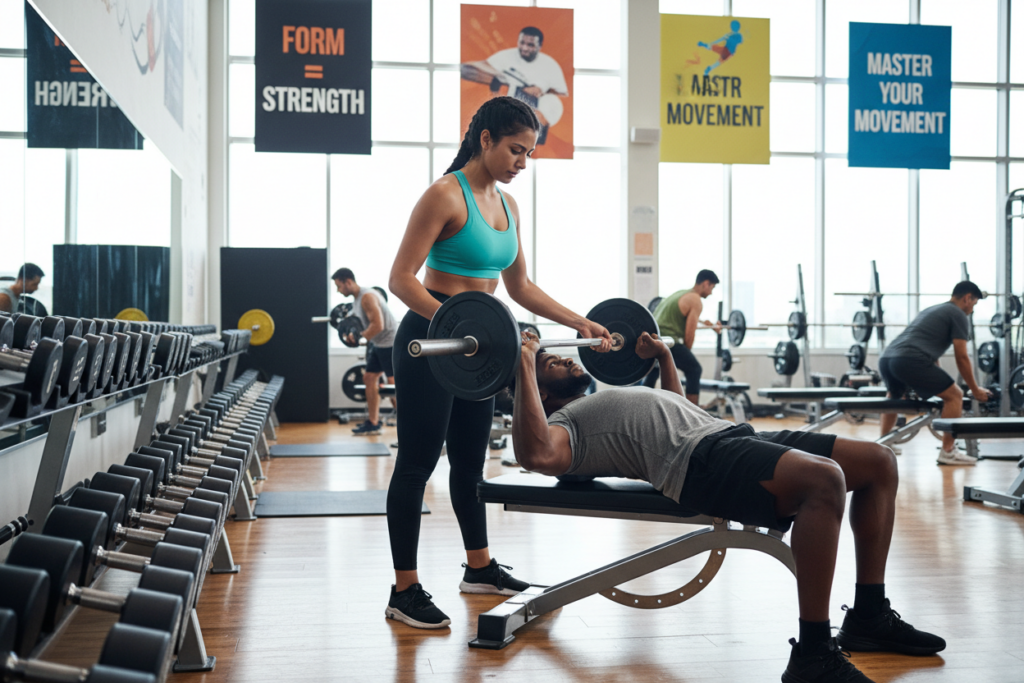
Your most powerful tool for improvement isn’t a new program—it’s your phone’s camera. Real coaching happens when you analyze what your body actually does, not what you think it does.
Learning from Real-Life Examples and Video Analyses
Study footage from experienced coaches. EliteFTS shows Mark pressing 345 pounds. His first rep is perfect—elbows under the bar, lats engaged.
The second rep reveals a common flaw. His elbows slide back. Power shifts from his triceps to his front delts instantly.
Another athlete, Sarah, flares immediately off her chest. This shows her front delts are overpowering her triceps. It’s a clear motor pattern error.
Greg Nuckols points to Jennifer Thompson. She masters the “flare and push” principle. Don’t copy her exact form. Understand the universal rule: keep the bar over your elbows.
Film your own working sets at 75-85% of your max. Your true technique lives here. Compare your first rep to your third.
Fatigue exposes weaknesses. If your elbows drift later in the set, your triceps are tiring faster. You’re compensating without realizing it.
Share your videos with trusted lifters or coaches. An external eye spots the two-inch drift costing you pounds. Revisit your footage every 4-6 weeks.
Your proprioception often lies. Video tells the truth. Use this feedback to refine your powerlifting technique systematically. Track your progress on film, not just in your head.
Essential Exercises to Reinforce a Stable Elbow Position
Real technique correction happens away from the main lift. It’s built through deliberate, focused accessory movements.
These drills target the weak links. They build the specific strength and motor control your competition press demands.
Targeted Floor Press and Dips for Tricep Strength
The floor press is a staple. It eliminates the stretch reflex, forcing your triceps to handle the entire concentric load from a dead stop.
Lower the bar until your upper arms touch the floor with control. Pause, then press up, tracking your elbows in the same path they descended.
Program it for 3-5 sets of 3-6 reps with moderate to heavy weight. Rest 2-3 minutes between sets to maintain crisp form.
Quarter dips attack the exact range where instability occurs. Lower yourself just 3-4 inches to feel tension in the lower tricep.
Perform 3-4 sets of 12-20 reps. This builds strength-endurance and tendon resilience in that critical area.
Using Bands and Other Accessories for Technique Correction
Band-resisted pushups teach acceleration with proper position. Loop a band across your back, hold the ends, and drive your elbows down toward your hips.
Close-grip bench variations shift emphasis to the triceps. This exposes control issues you might mask with a wider grip.
Incorporate these moves 2-3 times weekly. Pair them with protective shoulder exercises for a complete approach.
Track your progress on accessories just like main lifts. Strength gains here translate directly to better control under the bar.
| Exercise | Primary Benefit | Key Coaching Tip |
|---|---|---|
| Floor Press | Builds absolute tricep strength from a dead stop | Touch the floor with control, don’t crash. Feel the work in the lower part of your arm. |
| Quarter Dip | Develops stability in the exact weak-point range | Use higher reps (12-20) to build endurance where fatigue causes form breakdown. |
| Band-Resisted Pushup | Reinforces proper elbow path under acceleration | Consciously think “elbows to hips” throughout the entire movement. |
The difference between lifters who solve the problem and those who don’t is consistency with this targeted work.
Common Pitfalls and Mistakes to Avoid on the Bench
Achieving a strong, pain-free press requires you to sidestep widespread misconceptions about form. Let’s tackle the two biggest errors that derail progress.
Over-Tucking Versus Proper Flaring of the Elbows
The “tuck your elbows” cue often backfires. Greg Nuckols calls it generally bad for raw pressing. Most people over-tuck, shoving their elbows in front of the bar.
This turns the movement into a tricep-dominant grind. Your pecs can’t contribute fully. It also creates potential elbow discomfort.
The better cue is “flare and push.” Allow a natural flare as you lower the weight. This keeps your elbows directly under the bar throughout the descent.
Your forearms should stay vertical when viewed from the side. That’s the key mechanical difference.
Adjusting Your Grip and Bar Position for Better Control
Your grip width dictates your natural elbow angle. A wider grip creates more flare. A narrower one forces more tuck.
Experiment. Try index finger on the rings, then pinkies on the rings. Find where your elbows stay under the bar without forcing.
Where the bar touches your chest is critical. Too high forces excessive flare and shoulder risk. Too low demands extreme tuck.
The sweet spot for most is lower sternum to upper abs. This allows a moderate, controlled angle.
| Common Mistake | Result | Correction |
|---|---|---|
| Over-tucking elbows | Elbows drift in front of bar; pecs disengage; triceps overwork. | Use “flare and push” cue; keep forearms vertical from side view. |
| Wrong grip width | Forces an unnatural angle, causing inconsistent bar path. | Experiment with grip to find natural elbow-under-bar position. |
| Incorrect bar touch point | Touching too high or too low creates shoulder strain or poor leverage. | Aim for lower sternum/upper abs for optimal force transfer. |
Don’t change everything overnight. If you’ve over-tucked for years, shift gradually over 3-4 weeks. Reduce training weight by 10-15% to learn the new pattern safely.
Tools like chains can be excellent for this accommodating resistance training. They reward good positions as you press. The goal is your optimal angle—stable, powerful, and pain-free.
Conclusion
Consistent progress in the gym comes from respecting biomechanics and addressing weaknesses before they become injuries. Your bench press is a skill that demands attention to detail. Master the technique to control elbow flare, build supporting strength in your arms and chest, and you’ll lift more weight with less pain for years.
Listen to your body. Discomfort signals a problem needing coaching, not ignoring. Implement changes gradually over time, tracking both performance and how your joints feel.
This intelligent training transforms your lifting life. It builds resilient strength that protects your shoulders. That’s the real win—sustainable power for the long haul.
FAQ
What exactly is elbow flare, and why is it a problem?
Elbow flare is when your arms drift out to a wide angle, like a “T” shape, as you press the bar. This position places immense stress on your shoulder joint and rotator cuff, increasing injury risk. It also reduces power transfer from your chest and triceps, limiting the weight you can safely move.
Should my elbows be completely tucked against my ribs?
No, that’s a common misconception. Over-tucking creates a different set of issues and is inefficient for most lifters. The ideal position is a moderate angle—often described as a 45 to 75-degree angle from your torso. This creates a strong, stable “shelf” for the bar path and optimally engages your pectoralis major and triceps.
Can fixing my elbow position really help me lift more weight?
A> Absolutely. Proper alignment creates a more efficient kinetic chain. When your shoulders are protected and the bar path is straight, you can generate force more effectively. You’ll feel stronger off your chest and have a more powerful lockout, often leading to immediate personal records with the same training load.
What’s the fastest way to feel the correct elbow position?
Two drills deliver instant feedback. First, try a floor press—it physically stops your elbows from dropping too far and teaches the proper pressing angle. Second, use light resistance bands attached to the bar and anchored under the bench. They provide upward tension, guiding you into a stronger, safer groove from the very first rep.
How do I know if my grip width is causing the flare?
A grip that’s too wide forces your elbows out. A simple test: with your arms extended, your forearms should be perpendicular to the floor at the bottom of the movement. If your wrists are outside your elbows, your grip is likely too wide. Moving your hands in slightly can make a dramatic difference in control and shoulder comfort.
Are certain accessories, like a Sling Shot, helpful for correcting this?
Yes, tools like the Sling Shot are excellent for technique work. They reduce the strain on your shoulders, allowing you to practice the correct motor pattern with heavier loads. This builds the muscle memory and confidence needed to maintain that strong position when you go back to raw benching.