Proper Push Up Hand Placement for Chest, Shoulders, and Triceps

 0
0
 0
0 Your proper push up hand placement is the silent conductor of this entire exercise—get it wrong, and your strength means nothing. Most people struggle not from a lack of power, but because no one showed them where their hands should actually go.
This isn’t just about aesthetics. Where you place your palms dictates which muscles fire first. It determines whether you’re building balanced, resilient strength or quietly creating joint imbalances that haunt you later.
Push-ups are a powerhouse compound movement. They engage your chest, shoulders, triceps, and core simultaneously. Research even suggests they can be as effective as the bench press for building muscle—when performed with correct form.
This guide breaks down the biomechanics. You’ll learn precise techniques to target your chest, shoulders, and triceps effectively. We’ll also cover how to protect your joints, because fixing a bad habit is far harder than learning the right one from the start. For instance, emphasizing your triceps development connects directly to effective triceps workouts for stronger arms.
Key Takeaways
- Hand position is the primary lever for targeting specific upper body muscles during a push-up.
- Incorrect form can lead to muscle imbalances and increase the risk of shoulder problems.
- This exercise is a compound movement, working the chest, shoulders, triceps, and core together.
- Performed correctly, push-ups can be as effective as bench pressing for building strength.
- Learning the right technique from the beginning prevents hard-to-break bad habits.
- Your grip isn’t one rigid position but a set of principles you adjust based on your training goals.
Benefits of a Correct Push-Up Technique
Mastering your form transforms a basic bodyweight move into a powerhouse for building serious upper body strength. A 2017 study in the Journal of Exercise Science & Fitness proved this exercise matches the bench press for muscle growth and strength gains. This isn’t a compromise—it’s a legitimate way to build muscle.
Enhancing Chest, Shoulder, and Tricep Engagement
Precise form creates optimal angles for your chest. It engages your shoulders safely by positioning your scapula correctly. Your triceps get targeted work through controlled elbow movement.
This coordinated effort means you’re training these muscles as an integrated system. That strength translates directly to real-world pushing tasks.
Building Core Stability and Functional Fitness
Every rep becomes a moving plank. Your abs, obliques, and lower back must fire to keep your body straight. This builds incredible trunk stability.
The benefits extend beyond the gym. A 2019 study linked the ability to perform 40+ consecutive reps with a significantly lower risk of cardiovascular disease. Correct technique also protects your joints, letting you train consistently without injury.
| Area | Correct Technique Benefit | Incorrect Technique Risk |
|---|---|---|
| Chest Activation | Maximizes muscle fiber recruitment for growth. | Uneven development and plateaus in strength. |
| Shoulder Health | Promotes safe scapular movement, protecting rotator cuff. | Increased strain and potential for impingement. |
| Core Engagement | Forces continuous abdominal bracing, building stability. | Lower back sagging, reducing effectiveness and safety. |
| Long-Term Results | Sustainable progress and functional fitness gains. | Frustration, injury, and stalled workouts. |
Since you need zero equipment, it’s the most accessible tool for maintaining fitness anywhere. You’re not just doing an exercise—you’re investing in durable health.
Foundational Push-Up Form for Beginners
Before you press a single rep, your setup on the floor dictates everything that follows. Let’s get it right from the start.
Setting Up Your Stance and Hand Position
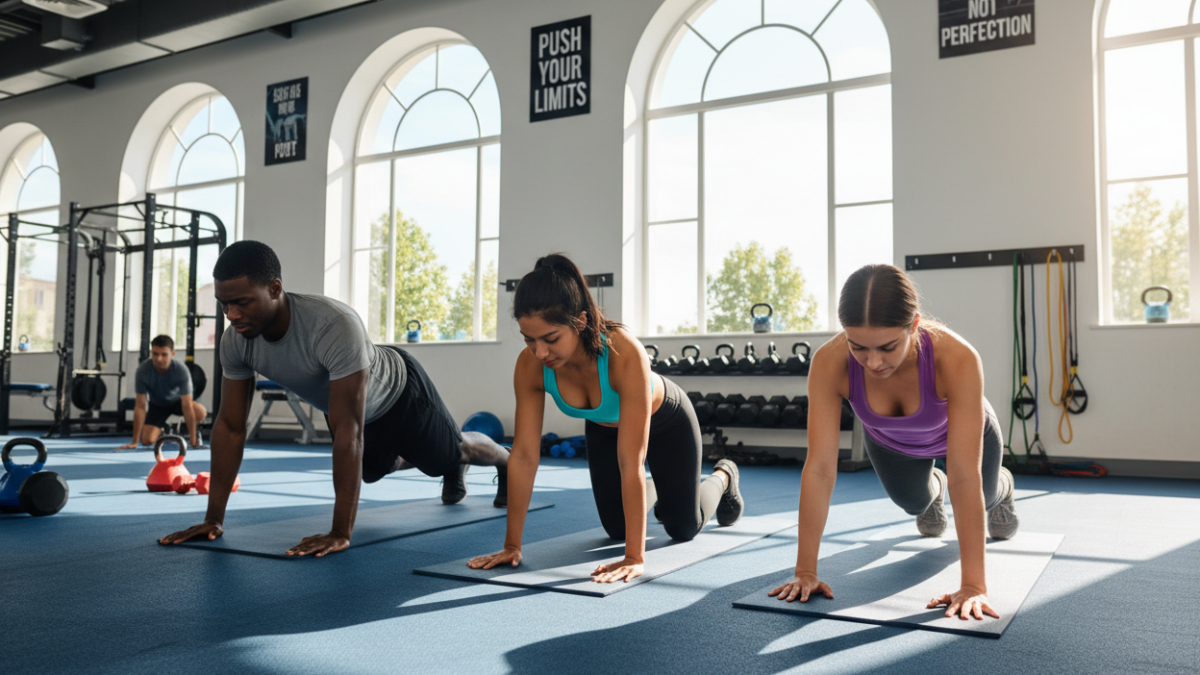
Start on all fours. Walk your hands forward until they’re just wider than your shoulders. Your fingers point ahead.
Next, extend your legs back into a high plank. Your feet should be about hip-width apart for a stable base.
Here’s the game-changer most skip. Before moving, create full-body tension. Squeeze your shoulder blades slightly. Brace your core hard. Contract your glutes. This turns a sloppy rep into a powerful one.
Key Pitfalls and How to Avoid Them
The most common error is sagging hips. If your body forms a banana shape, you’re stressing your lower back. This means you need an easier version to build strength.
Watch your elbow position. Flaring them out like wings strains your shoulders. Aim for a 45-degree angle from your torso for safety and muscle engagement.
Can’t keep a straight line from head to heels? Do an incline push-up. Place your hands on a bench. This uses less bodyweight and teaches the correct form far better than using your knees.
Proper Push Up Hand Placement: Techniques and Tips
The exact spot where your palms meet the floor is the master switch for muscle activation. Let’s lock in the techniques that make every rep count.
Aligning Your Hands Under the Shoulders
When you place your hands on the floor, set them slightly wider than your shoulders. Your thumbs should be just outside your chest. From a side view, your wrists stack directly under your shoulder joints.
This creates a stable base. Now, apply the “screw your hands into the floor” cue. Twist your right hand counterclockwise and your left clockwise. This external rotation protects your shoulders.
Maintaining a Straight Body Line
Your body must form a rigid plank from head to heels. Contract your abs and glutes hard. Look at the floor a foot in front of your hands to keep your neck neutral.
As you bend your elbows to lower down, track them at a 45-degree angle. Think 4:30 and 7:30 on a clock. This evenly works your chest, shoulders, and triceps.
| Key Cue | Correct Execution | Common Mistake |
|---|---|---|
| Hand Position | Hands just outside shoulder line, mid-chest level. | Hands too narrow or too wide, causing joint strain. |
| Elbow Path | Elbows track at 45 degrees from the torso. | Elbows flared out wide or pinned tight to ribs. |
| Body Alignment | Rigid straight line from head to heels throughout. | Hips sagging or piking up, breaking the line. |
Your ideal position might vary based on your build. The principles of shoulder stacking and 45-degree elbow tracking are non-negotiable for safety and results.
Understanding Upper Body Muscle Activation
Think of your upper body as an engine; the push-up efficiently engages all its major components in a single movement. It’s not just about pushing—it’s about precise coordination.
Targeting the Chest, Shoulders, and Triceps
Your chest muscles, the pectoralis major, deliver the main thrust. Your front shoulders, or anterior deltoids, assist powerfully. Your triceps on the back of your arms lock out each rep.
Secondary muscles play a crucial support role. Your serratus anterior along your ribcage stabilizes your shoulder blades. Your core and glutes keep your body rigid. This full-body effort is what makes the exercise so functional.
Your hand placement directly shifts the load. A wider stance increases stretch on your chest. A narrow, diamond position boosts triceps activation by up to 20%.
For balanced development, you must train all three primary groups. If your chest outpaces your shoulders and triceps, you risk shoulder misalignment. This principle is key for long-term joint health.
Understanding this lets you train smarter. Want more defined arms? Emphasize narrow-grip reps. This integrated work builds the coordinated pushing strength you use in daily life. For balanced arm development, complement your pushing with pulling movements like those in a smart bicep peak workout.
Integrating Bodyweight Training Fundamentals
Forget thinking of push-ups as a chest-only move. They demand coordinated effort from your core, glutes, and back to be truly effective. This is the paradigm shift that separates real training from just going through the motions.

Emphasizing Core, Glute, and Back Engagement
Think of each rep as a moving plank. While a static hold fights gravity, you add the challenge of pressing your body up and down. This dual demand builds true functional strength.
Your core muscles are on constant duty. The rectus abdominis prevents your lower back from sagging. Your obliques resist twisting to keep your body line straight.
Most people ignore their glutes. They must stay squeezed tight. This maintains hip extension and stops your hips from dropping toward the floor.
Your back works isometrically too. The erector spinae along your spine holds neutral alignment. This protects you from injury during the movement.
Here’s a powerful cue. Before you start, brace your entire body like you’re about to take a hit. Contract your abs, squeeze your glutes, and create full tension. This pre-sets all supporting muscles.
This integrated approach is a bodyweight exercise fundamental. It keeps your joints safe while maximizing every rep. You build strength that transfers directly to real-world tasks.
Push-Up Variations to Elevate Your Workout
Once your form is locked in, the next step is strategic variation. These exercises let you progress without weights.
Incline, Decline, and Diamond Push-Ups
Start with an incline push-up if standard reps are tough. Place your hands on a bench or box.
This reduces the load on your upper body. It trains full tension better than knee push-ups.
For a harder challenge, try decline push-ups. Elevate your feet on a bench. This shifts emphasis to your upper chest.
Bring your hands together under your chest for diamond push-ups. Your elbows stay tight to your sides.
This position boosts triceps activation by about 20%.
| Variation | Primary Target | Difficulty Shift | Best For |
|---|---|---|---|
| Incline | Chest, Shoulders | Easier | Beginners building strength |
| Decline | Upper Chest | Harder | Increasing intensity |
| Diamond | Triceps | Similar | Arm development |
| Plyometric | Power, Fast-Twitch Fibers | Advanced | Explosive strength |
Exploring Plyometric Techniques
Plyometric push-ups build explosive power. Push off the floor with enough force for your hands to leave.
This trains fast-twitch muscle fibers. Only attempt these after mastering 20+ controlled standard reps.
Choose variations based on your goals. Use the table as your guide for a smarter workout.
Adapting Technique for Safety and Optimal Performance
Sharp pain is your body’s emergency brake—ignoring it guarantees a detour to the sidelines. Distinguish between muscle burn and joint pain immediately.
Preventing Common Shoulder and Elbow Injuries
The most common shoulder issue stems from flared elbows. When your elbows point out perpendicular to your body, your rotator cuff must work overtime. This strained position invites impingement over time.
Protect your elbows by never locking them straight at the top. Maintain a slight bend to keep tension on the muscles. This simple habit shields your joints during the movement.
Wrist discomfort on the floor? You’re not weak. Limited mobility often causes it. Place your hands on dumbbells for a neutral angle. Make sure your wrists feel secure before starting.
If your form breaks down—maybe your hips sag or elbows flare—end the set. Grinding out bad reps ingrains poor patterns. It exponentially raises injury risk.
Listen closely. Fatigue is normal; sharp stabs or clicking sounds are not. Regressing to an easier variation isn’t defeat. It’s the smart move for consistent, long-term progress. Always prioritize correct form over extra reps. This protects both your shoulders and elbows, letting you train safely week after week.
Smart Progression in Push-Up Training
Getting stronger isn’t about doing more push-ups—it’s about making each rep count with a smart plan. You build strength through progressive overload. This means gradually increasing the demand on your muscles over time.
Scaling Up Repetitions and Difficulty
Start with three sets of 5-10 reps. Rest 30-60 seconds between sets. Do this 2-3 times per week on non-consecutive days.
Once you hit 15-20 perfect reps, progress to a harder variation. Endlessly adding reps shifts your training to endurance. The “one more push-up a day” method builds consistency. Just don’t sacrifice form to hit the number.
Using Modifications to Enhance Strength
Slow your tempo to increase difficulty. Take 3-4 seconds to lower, pause, then press up. This boosts time under tension.
Add a resistance band across your back for extra load. Pair your push-ups with a pulling exercise like rows. This creates balanced upper body development.
Always perform this exercise early in your workout when fresh. For plyometric ups, keep reps low (3-5) due to high fatigue. Remember, quality beats quantity every time.
Integrating Push-Ups into an Upper Body Workout Routine
Isolating push-ups as your only upper body work is a recipe for imbalance. They shine brightest when paired with complementary exercises within a smart plan.
Combining Push-Ups with Complementary Exercises
Perform your push-ups early in the workout. You need fresh muscles for optimal form. Save them for the end and your technique will suffer.
Balance is non-negotiable. For every pushing exercise like push-ups or bench press, include a pulling movement. Rows and pull-ups keep your shoulders healthy.
Short on time? Superset your push-ups with rows. Alternate sets with minimal rest. This strategy cuts your workout time nearly in half.
Push-ups fit any training split. Use them in full-body routines or on dedicated upper body days. They can be your primary chest exercise or a high-rep finisher after heavy weight training.
| Training Split | Best Placement | Primary Role | Key Pairing |
|---|---|---|---|
| Full-Body | First or second exercise | Compound pushing movement | Bent-over Rows |
| Upper/Lower | Start of upper body day | Main chest stimulus | Pull-Ups |
| Push/Pull/Legs | Early in push day | Volume builder | Face Pulls |
| Circuit Training | Station in the circuit | Bodyweight resistance | Bodyweight Rows |
Train push-ups 2-3 times per week with a day of rest between. This frequency allows for recovery and strength gains. Pair them with squats and deadlifts for full-body fitness. Choose your optimal rep range based on your specific goals for each workout.
Making Push-Ups Work for Your Goals
Your journey with push-ups begins with a simple choice: prioritize form over numbers. Where you set your hands isn’t a minor detail—it’s the lever that builds balanced upper body strength or creates joint problems.
Whether you’re struggling for your first rep or mastering advanced variations, the principles apply. There’s zero shame in starting with an incline version or even on your knees. Perfect push-ups build more real strength than sloppy push-ups.
Assess your current ability honestly. Pick a variation for 8-12 perfect reps. Implement 3 sets, 2-3 training days per week in your workout. Progress when you hit 15-20 controlled reps.
This bodyweight exercise, the push-up, is a full-body tension movement. It builds your chest, shoulders, triceps, and core muscle groups. Make sure you maintain a rigid plank position from head to feet. Serious gains unfold over months. Patient consistency with quality form delivers lasting fitness and injury-free training.
FAQ
Where should I put my hands for a push-up to work my chest more?
To emphasize your chest muscles, place your hands slightly wider than your shoulders. This position increases the range of motion for your pectorals. Just make sure your elbows don’t flare out to a 90-degree angle—keep them at about a 45-degree angle from your body to protect your shoulder joints.
How does correct form help prevent shoulder pain during this exercise?
Good technique is your best defense. When your hands are aligned under your shoulders, it keeps your joints in a stable, strong position. This proper alignment prevents excessive strain on the rotator cuff and reduces impingement risk. Think of it as building a secure foundation for every rep.
I’m a beginner and can’t do a full push-up from the floor. What’s a good modification?
Start with an incline push-up! Place your hands on a sturdy bench, table, or even a wall. This variation reduces the amount of your bodyweight you have to lift, allowing you to build essential strength in your chest, shoulders, and triceps while you master the form. It’s a smart, safe progression.
What’s the single most important form cue I should remember?
Maintain a straight line from your head to your heels. Engage your core and glutes as if you’re holding a plank throughout the entire movement. This full-body tension protects your lower back and transfers force efficiently, making the exercise more effective for building upper body strength.
Do diamond push-ups really work the triceps better?
Yes, they’re highly effective for tricep activation. By placing your hands close together under your chest, forming a diamond shape with your index fingers and thumbs, you significantly increase the demand on your triceps muscles. This variation is a powerful tool for building arm strength.
How often should I add push-ups to my workout routine?
For most people, 2-3 times per week is effective. This frequency allows for adequate muscle recovery and strength adaptation. You can integrate them into your upper body or full-body training days. Just ensure you’re not training the same movement patterns to fatigue on consecutive days.
Should my elbows be tucked in or flared out during the movement?
Keep them moderately tucked. Letting your elbows flare straight out to the sides at 90 degrees places high stress on your shoulders. Aim for a 45 to 60-degree angle from your torso. This “elbows-in” path is safer for your joints and still effectively targets the chest, shoulders, and triceps.
Related: Burpee Muscle Breakdown by Movement Phase
Related: How to Train the Pec Minor Without Shoulder Pain