Build Bigger Arms With Smarter Dumbbell Training

 0
 0
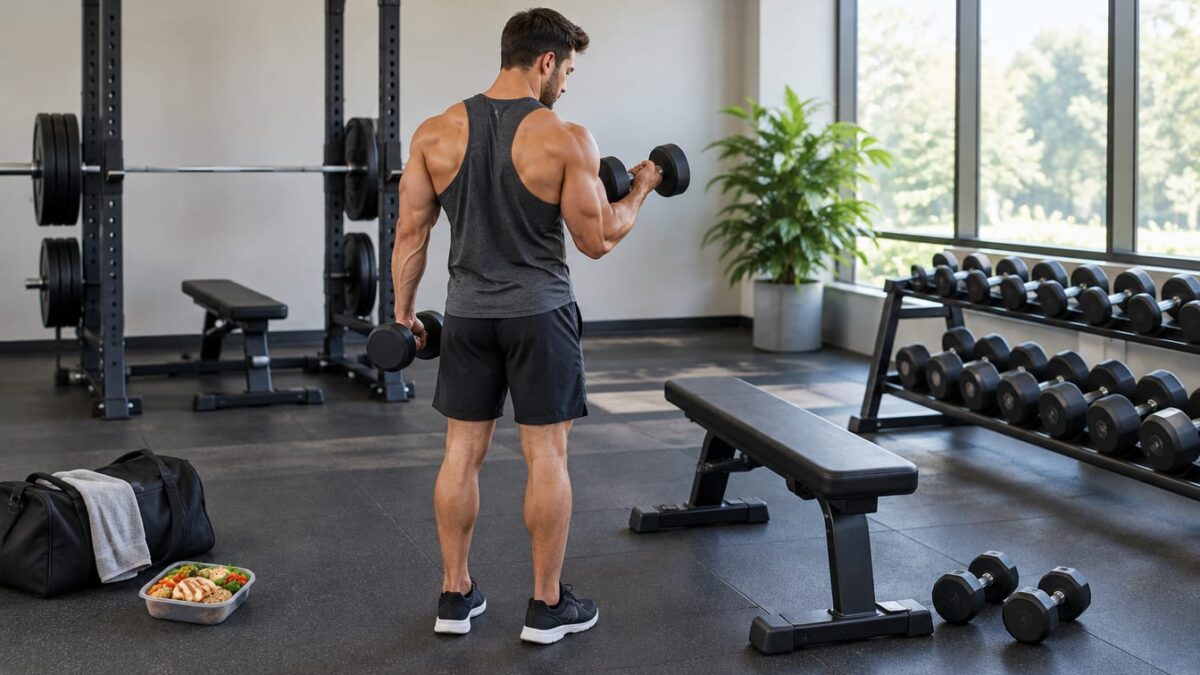
Most arm routines have too many curls and too little progress. The best arm exercises with dumbbells are the incline curl, the hammer curl, the overhead triceps extension, and the lying triceps extension. Do 2 or 3 hard sets of each, once or twice a week, and that covers every major muscle between your shoulder and wrist.
Add a lateral raise if you want your arms to look bigger from the front. Then keep the technique the same each week, add reps before weight, and let the logbook tell you when to move up.
What are the best arm exercises with dumbbells?
Pick movements that load each muscle hard and progress cleanly. Six exercises cover the whole job. However, you only need two or three of them in any single session.
| Exercise | Main target | Reps | Why it earns a spot |
|---|---|---|---|
| Incline dumbbell curl | Biceps, long head | 8-12 | Loads the biceps at a long stretch |
| Hammer curl | Brachialis and forearm | 8-12 | Thickens the arm and lets you go heavier |
| Standard dumbbell curl | Biceps | 8-15 | The simplest curl to learn and progress |
| Overhead triceps extension | Triceps, long head | 10-15 | Stretches the largest part of the triceps |
| Lying triceps extension | Triceps | 8-12 | Stable enough to train heavy |
| Lateral raise | Side shoulders | 12-20 | Wider shoulders make your arms look bigger |
Keep the incline curl and the overhead extension in every plan. Both work a muscle while it's stretched, a position worth keeping in any arm plan. The rest are solid choices you can rotate every few months.
Biceps: three curls cover it
Your biceps has a long head that crosses the shoulder joint. So the position of your arm changes how hard it works.
Incline dumbbell curl. Set a bench at a moderate incline and let your arms hang behind your body. Keep your upper arms still, curl up, and lower slowly.
Hammer curl. Hold the dumbbells with your palms facing each other. This grip shifts work to the brachialis, a muscle under the biceps that pushes it up. It also trains the forearm muscle along the thumb side.
Standard curl. Turn your palms up and keep them up for the whole rep. Hammer curls usually let you lift more. Still, this version hits the biceps most directly.
Skip the swing. If your hips or lower back start the rep, the weight is too heavy and your biceps is doing less of the work. For more ways to train the outer head, see these long head bicep exercises.
Triceps: put the long head overhead
The triceps makes up more of your upper arm than the biceps, so it deserves at least as much work. Like the biceps, its long head crosses the shoulder. As a result, raising your arm overhead stretches it.
Overhead triceps extension. Hold one dumbbell with both hands behind your head, elbows pointing up. Lower until you feel a deep stretch, then extend without letting your elbows flare wide. Sitting on a bench with back support keeps your lower back out of it.
Lying triceps extension. Lie on a flat bench with your palms facing in and lower the dumbbells beside your head. The bench gives you a stable base, so this is where you can load a little heavier.
Your joints get a vote here. If your elbows ache, lighten the load and raise the reps. Lowering the dumbbells slightly behind your head, instead of toward your forehead, also tends to feel better.
Kickbacks only load the triceps near the top of the rep. Keep them as a light finisher at most. If you can get to parallel bars, dips add heavy pressing work that dumbbells struggle to match. Here's how dips train your chest, shoulders, and triceps.
Forearms and shoulders need less than you think
Most lifters get plenty of forearm work from hammer curls, rows, and holding heavy dumbbells. So add direct work only if your grip fails before the target muscle, or your forearms clearly lag.
- Farmer carry: hold your heaviest pair at your sides and walk tall. It trains grip and your whole trunk at once.
- Wrist curl: rest your forearms on a bench and move the dumbbell with your wrists only. Use light loads and higher reps.
- Lateral raise: lift the dumbbells out to the sides to about shoulder height, elbows slightly bent. Your side shoulders aren't arm muscles. Even so, they change how wide your arms look.
Lateral raises reward patience. Use a weight you can control on the way down, because swinging shifts the work to your upper traps.
One arm or both: when to train each side alone
Dumbbells let each arm work on its own. That's their biggest advantage over a barbell, because your stronger side can't quietly cover for the weaker one.
The cost is time. One-arm sets take about twice as long. Meanwhile, alternating curls give each arm a short break between reps, so sets often end before they're hard enough to count.
Use this rule:
- Both arms together for most curls and extensions. It's faster, and every rep is a working rep.
- One arm at a time if one side is clearly smaller or weaker. Start with the weaker arm, then stop the stronger arm at the same rep count.
- One-arm overhead extensions if the two-handed version bothers your shoulders.
How heavy should your dumbbells be?
Choose a weight you can lift for the bottom of your rep range with 1 to 3 reps in reserve. Reps in reserve means the clean reps you could still do before your form breaks down. For example, if your target is 8 to 12 and you get 14, the weight is too light.
Small muscles break form early. So the dumbbell that "feels heavy" is often the one that turns a curl into a hip thrust. Good reps before more weight.
Run this check on every set:
- Your upper arm stays still on curls and extensions.
- You lower the weight slower than you lift it.
- Each rep uses the same full range as the first.
- Your torso stays quiet, with no swing or lean-back.
- The tempo looks the same as last week.
If two of these slip, drop the weight and rebuild. Logbook progress only means something if the reps look the same each week.
Small dumbbell jumps decide your progress
Dumbbells climb in fixed steps, and on a curl even the smallest step is a big share of the load.
Because of that, use double progression to earn the next increase:
- Pick a rep range, such as 8 to 12.
- Keep the same dumbbells until every set reaches the top of the range with clean reps.
- Move up to the next weight. Your reps will drop toward the bottom of the range.
- Build back up one rep at a time, then repeat.
If the next dumbbell drops you below the range, stay put. Add a set or slow the lowering phase first. Small increases add up, even when they're reps instead of pounds.
Fixed or adjustable dumbbells at home
Fixed dumbbells are fast to grab and nearly indestructible, but a full set takes real floor space. Adjustable dumbbells fit in a corner. However, check the weight steps before you buy.
The Bowflex SelectTech 552 is a common example. Each dumbbell adjusts from 5 to 52.5 pounds, or 10 to 90 pounds as a pair, and it replaces 15 sets of weights. Its settings are 5, 7.5, 10, 12.5, 15, 17.5, 20, 22.5, 25, 30, 35, 40, 45, 50, and 52.5 pounds.
That pattern matters for arms. Curls and extensions up to 25 pounds progress smoothly. Between 25 and 50, the steps are twice as big, so expect to spend longer earning each increase.
A simple dumbbell arm routine
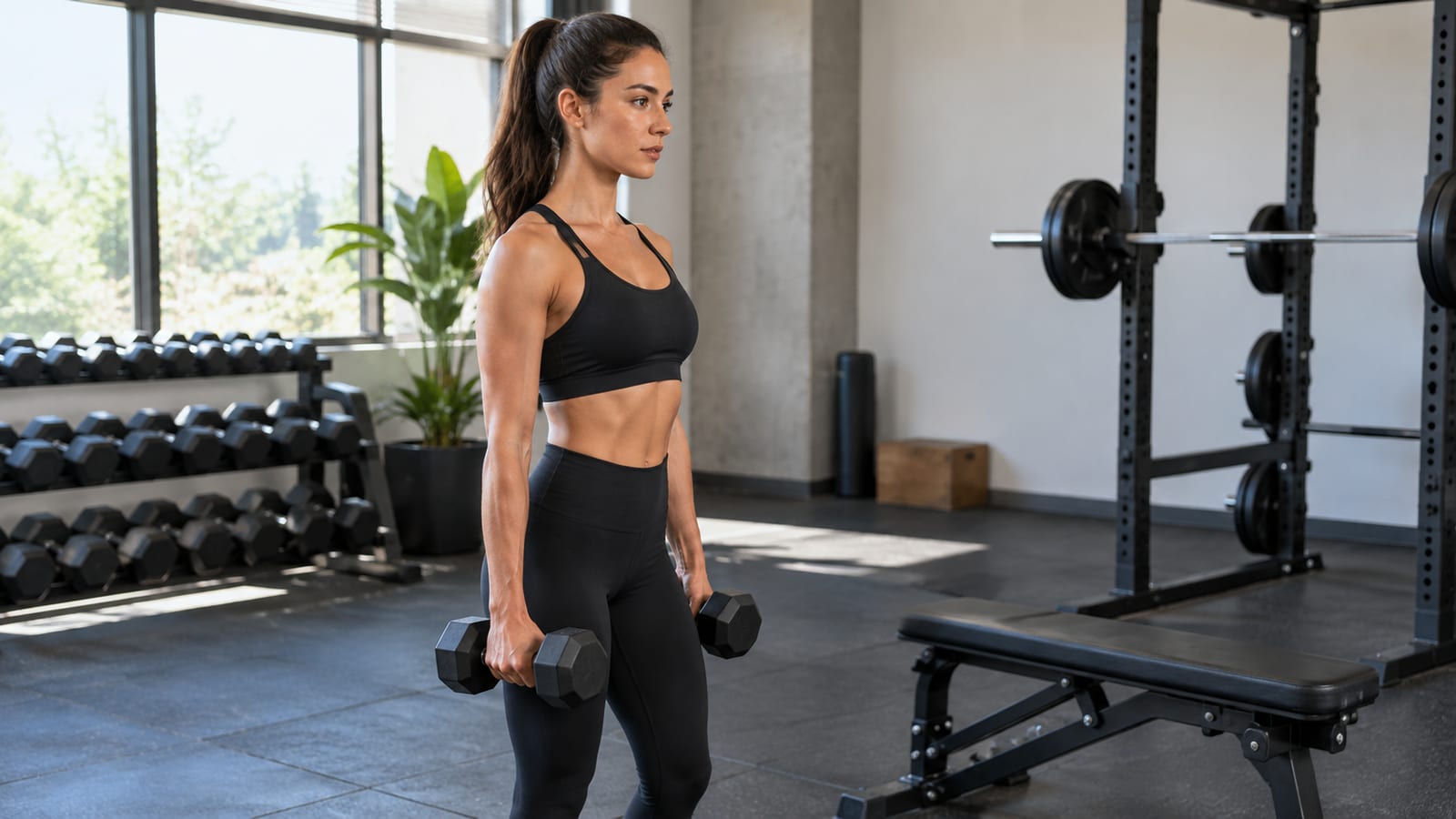
The plan has to fit your week. For most lifters, that means adding arm work to a full-body or upper-lower program rather than giving arms their own day. Your presses and rows already train the triceps and biceps, so direct work tops them up.
The American College of Sports Medicine recommends 2 to 3 sets per exercise for strength in healthy adults. That range also works well for arms. Split the work across two sessions so neither runs long.
| Session | Exercise | Sets | Reps |
|---|---|---|---|
| A | Incline dumbbell curl | 2-3 | 8-12 |
| A | Overhead triceps extension | 2-3 | 10-15 |
| A | Lateral raise | 2-3 | 12-20 |
| B | Hammer curl | 2-3 | 8-12 |
| B | Lying triceps extension | 2-3 | 8-12 |
| B | Lateral raise | 2-3 | 12-20 |
Do these after your main lifts. Rest long enough to repeat your reps on the next set. If time is tight, pair a curl with an extension and alternate between them.
Change the plan only if your logbook stalls for several weeks while your sleep and food are in order. Then add one set per exercise and watch whether your reps start climbing. Daily arm work rarely helps. For the full picture, read about training your arms every day.
Where dumbbells fall short
Arm exercises with dumbbells cover most of what you need, but they have limits. Gravity only pulls down, so a dumbbell curl is light at the bottom and top and hardest in the middle. Cables keep tension through more of the rep.
Dumbbells also make small jumps awkward, and heavy extensions can irritate elbows. If you have cable access, use both. Keep dumbbells for stretched-position work like incline curls and overhead extensions, and use cables for steady-tension finishers. This guide to cable arm workouts shows how to set up that side.
Dumbbell arm training suits:
- Home lifters with limited equipment.
- Beginners building repeatable technique on simple movements.
- Anyone fixing a size or strength gap between arms.
On the other hand, if free-weight extensions flare up your elbows every time, move your triceps work to cables or machines. Keep your curls on dumbbells.
FAQ
Can you build big arms with only dumbbells?
Yes, as long as your sets stay hard and your weights keep climbing. At home, the usual limit is running out of heavy enough dumbbells for hammer curls and lying extensions. Once that happens, slow your tempo and push your rep ranges higher until you can add heavier options.
Should you train arms before or after your main lifts?
After, in most sessions. Tired biceps weaken your rows and pulldowns, and tired triceps cost you reps on presses. If arms are your priority for a few months, put them first one day a week and accept a small drop on that day's bigger lifts.
How do you know your arms are actually growing?
Track your logbook and a tape measure together. Measure the same arm, relaxed, at the same time of day, every few weeks. Rising numbers in the log followed slowly by the tape means the plan is working.
Do women need different arm exercises with dumbbells for toning?
No. "Toning" just means building some muscle and, if you choose, losing some fat. The same curls, extensions, and progression rules apply to everyone. Only the starting weights differ.