Build Stronger Legs at Home With a Simple Plan

Leg workouts at home build real muscle when every set gets hard enough to count. That is where most home routines fail. Do this first: train your legs twice a week with single-leg squats, a hip hinge, a floor hamstring curl, and calf raises, and make each exercise harder whenever you beat your rep target. Endless easy squats will tire you out without giving your legs much reason to grow.
Do leg workouts at home actually build muscle?
Yes. Your quads cannot tell whether the resistance came from a barbell or from your own bodyweight balanced on one leg. They respond to tension and to effort close to failure.
The catch is that your legs are already strong. They carry you all day, so a two-legged bodyweight squat stops being hard for most people within a few weeks. As a result, home leg training only works if you keep finding harder versions.
Home training suits these people well:
- Beginners learning to squat and hinge before they ever load a bar.
- Busy adults who will train twice a week at home but would skip a gym commute.
- Travelers and lifters between gyms who want to hold onto their progress.
- Anyone who feels awkward in a gym and would otherwise do nothing.
It suits a lifter chasing a heavy one-rep squat or deadlift less well. You can build plenty of muscle at home. However, maximal strength on the big lifts needs a bar and plates.
Load is the limit, so change the exercise
Without plates, you add difficulty by giving one leg more of the work. Follow this ladder and move up a step when you can hit the top of your rep range on every set with clean reps:
- Bodyweight squat to a chair. Sit back until you touch the seat, then stand.
- Split squat. One foot forward, one foot back, both on the floor. Drop the back knee toward the ground.
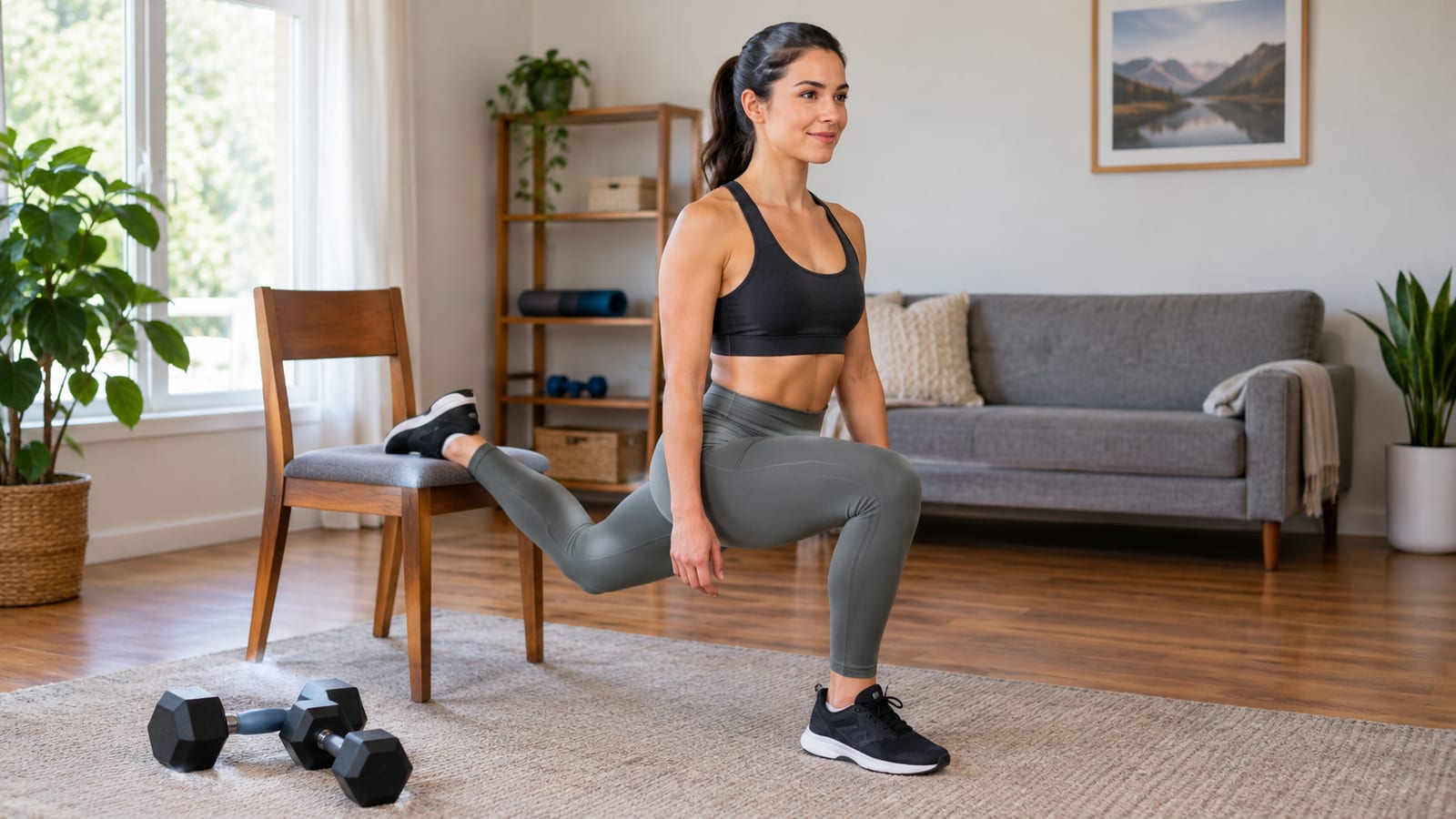
- Rear-foot-elevated split squat. The same move with your back foot on a couch or sturdy chair. This one exercise can carry your leg training for months.
- Skater squat or assisted pistol squat. Squat on one leg while you hold a door frame. Use less help from your hands over time.
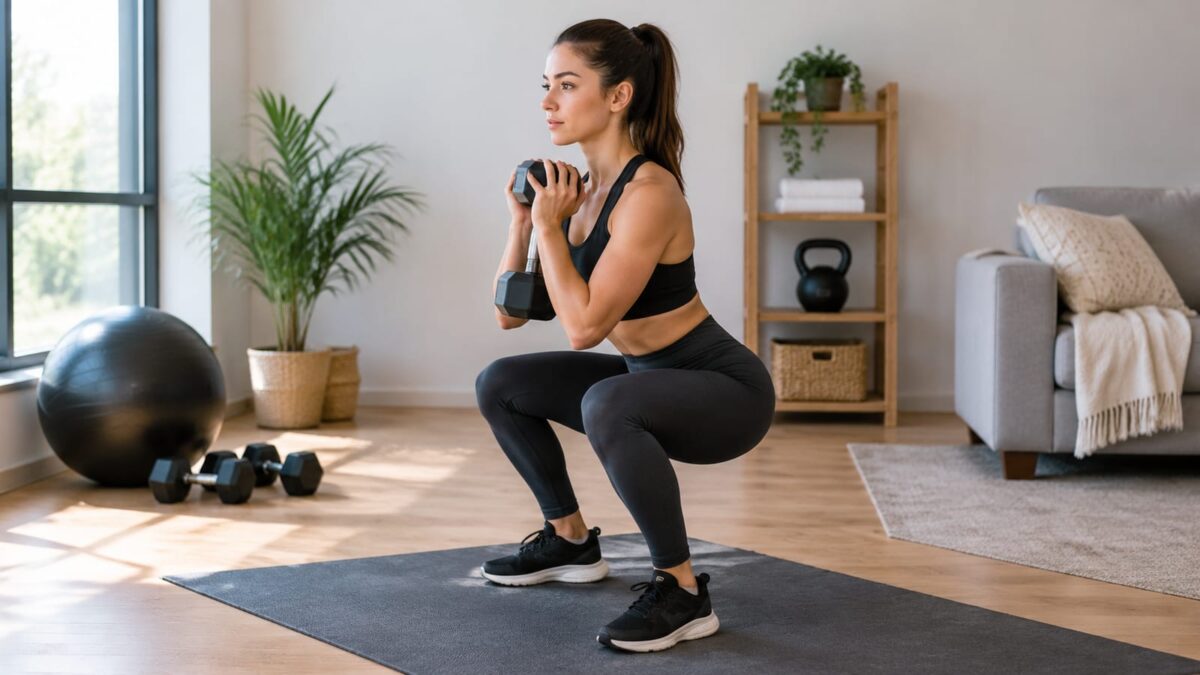
- Any of the above with a loaded backpack or dumbbells. Books, water bottles, and bags of rice all count as weight.
You have other dials too. Slow the lowering phase to about three seconds, pause at the bottom, or add reps. Change one dial at a time, because the logbook can only tell you what worked if one thing changed.
Single-leg work also exposes your weaker side. Start each set with that leg, and stop the stronger leg at the same rep count.
Cover every muscle, not just your quads
Most home leg routines are squats, lunges, and more squats. That hammers your quads and glutes while your hamstrings and calves get almost nothing. Use this table to fill the gaps:
| Muscle | Bodyweight option | Loaded option (dumbbells or backpack) |
|---|---|---|
| Quads (front of thigh) | Rear-foot-elevated split squat, step-up | Goblet squat, loaded split squat |
| Glutes | Single-leg hip thrust with shoulders on the couch | Loaded hip thrust, deficit reverse lunge |
| Hamstrings (back of thigh) | Sliding leg curl, Nordic curl | Single-leg Romanian deadlift |
| Calves | Single-leg calf raise off a step | Single-leg calf raise holding a dumbbell |
| Inner thighs | Side lunge | Wide-stance goblet squat |
Hamstrings are the hardest muscle to train at home, so give them real attention. For a sliding leg curl, lie on your back with your heels on a towel on a smooth floor. Then lift your hips and pull your heels toward you.
The Nordic curl is harder still. Kneel with your feet anchored under a heavy couch and lower your body forward as slowly as you can. At first, do only the lowering half and catch yourself with your hands.
For calves, pause at the bottom of every rep and skip the bouncing. Bouncing hands the work to your tendons.
Quads mostly take care of themselves at home. If the outer part of your thigh lags, see how to build outer-quad strength without stance tricks using exercise choice and full range of motion.
A twice-weekly home leg session
The Physical Activity Guidelines for Americans recommend muscle-strengthening activities at least two days a week. They name bodyweight squats and lunges as examples. For building leg muscle, two sessions a week is also a sensible starting point.
Run this session on two spaced days, such as Monday and Thursday:
- Rear-foot-elevated split squat: 3 sets of 8 to 15 reps per leg
- Single-leg Romanian deadlift: 2 to 3 sets of 8 to 12 reps per leg
- Sliding leg curl: 2 to 3 sets of 8 to 15 reps
- Single-leg hip thrust: 2 sets of 10 to 20 reps per leg
- Single-leg calf raise with a pause: 3 sets of 10 to 20 reps per leg
Rest one to two minutes after both legs finish a set. Brand-new lifters can swap in the chair squat and the regular split squat and start with 2 sets of each.
This session is simple on paper and demanding in practice. If you want legs to fit into a full week of upper-body work too, use this home workout plan for muscle gain without machines. If you own a pair of dumbbells, this dumbbell leg workout adds load to the same patterns.
How hard should home leg sets be?
Stop most sets with 1 to 3 reps in reserve. In plain terms, end the set when you could still do one to three more clean reps before your form breaks.
Effort matters more at home than in a gym. With lighter loads, the early reps of a set do little, and the last few hard reps do most of the work. So a set that ends long before it gets hard barely counts.
Watch your rep counts. Once you can do 30 or more reps of an exercise, move up the ladder. At very high reps your lungs and your tolerance for the burn usually give out before your muscles get their best work.
Some exercises are safe to push to failure on the final set, including calf raises, sliding leg curls, and hip thrusts. Skip failure on loaded split squats and skater squats. A rep that collapses while you balance on one leg is how people fall into furniture.
Write down your reps per leg every session. Then beat the logbook by one rep, a slower lowering phase, or a harder variation next time.
Skip the burn circuits and long warm-ups
Jump squat circuits, long wall sits, and 100-rep challenges make your legs burn and your heart pound. That feels productive. Still, the burn is a sign of fatigue building in the muscle, and it doesn't tell you the muscle got a reason to grow.
Circuits also make it hard to track progress, because rest times and form drift from week to week. Treat them as conditioning, and keep them out of your muscle-building sets.
Long activation routines fall in the same bucket. A ten-minute band sequence to "wake up" your glutes isn't needed. Your glutes are already on.
Warm up with a few minutes of easy movement, then do one or two lighter sets of your first exercise. After that, get to work.
Strength, cardio, and bone health
Home leg training builds solid single-leg strength and plenty of muscle. On the other hand, it won't build the heavy two-legged strength a loaded barbell squat does. If that matters to you, plan a move to heavier equipment later.
Leg workouts raise your heart rate, but they don't cover your aerobic fitness. The same federal guidelines advise adults aged 18 to 64 to get at least 150 to 300 minutes a week of moderate-intensity aerobic activity. Walking, cycling, or easy jogging handles that better than jumping through a squat circuit.
Loading your legs with resistance also supports your bones, and harder sets do more than easy ones. For older adults aged 65 and up, the guidelines also call for balance training. Split squats and assisted single-leg squats double as balance practice, so hold a counter until you feel steady.
When to move past home training
Buy adjustable dumbbells or join a gym when these things line up:
- You're doing the hardest variation with your heaviest backpack.
- Your reps sit near the top of the range on every set.
- Your logbook hasn't moved in several weeks even though your sleep and food are in order.
You should also move on if you want to train heavy squats and deadlifts for their own sake. Until then, effort is usually the limit, and equipment rarely is.
FAQ
Can I train legs at home every day?
You can, but you'll grow less. Hard leg sessions need a day or two before the same muscles can work hard again. If you want daily movement, walk on the off days and save the hard sets for your scheduled sessions.
Why do my knees hurt during lunges and split squats?
The usual causes are a stride that's too short, a knee that caves inward, or dropping too fast into the bottom. Lengthen your stance and lower with control. This guide to proper walking lunge form at home covers the fixes in detail. Your knees get a vote, so shorten the range until the movement is pain-free.
Are resistance bands enough for leg training?
Bands work well for side-stepping hip work and as an extra push at the top of a hip thrust. For squats they make a poor main load, because the tension disappears at the bottom where your legs work hardest. A loaded backpack gives you steadier resistance through the whole rep.
How soon will I see results?
Your rep counts usually climb within a few weeks, mostly because you get better at the movements. Visible changes in your legs take several months of steady, hard sessions. Small increases add up, so judge progress by the logbook first and the mirror second.