Build a Simple Cable Arm Workout That Progresses

 0
0
 0
0 Keep cable arm workouts simple: use a curl, a pushdown, an overhead extension, and one grip variation that suits your elbows. This comprehensive guide to cable arm workouts shows you how to set the pulley, choose attachments, train each arm muscle, and progress without turning the cable station into a circus. Cables are excellent for focused arm work, but the handle and angle only matter if your technique stays repeatable.
Last updated: 2026-08-07
What should a comprehensive guide to cable arm workouts cover?
A useful cable arm workout trains elbow flexion, elbow extension, and grip. In plain terms, you need exercises for your biceps, triceps, and the muscles around your forearms.
The biceps bend the elbow and turn the palm upward. The brachialis sits under the biceps and also bends the elbow. Meanwhile, the triceps straighten the arm, and their long head also crosses the shoulder.
That basic anatomy leads to a simple exercise menu:
| Target | Main cable movement | Useful attachment | Why it earns a place |
|---|---|---|---|
| Biceps | Standing cable curl | Straight bar or angled bar | Easy to load and track |
| Biceps at a longer position | Facing-away curl | D-handle | Places the working arm behind the torso |
| Brachialis and forearms | Hammer curl | Rope | Uses a neutral grip |
| Triceps | Pushdown | Rope, angled bar, or straight bar | Stable and simple to progress |
| Triceps at a longer position | Overhead extension | Rope | Trains with the arm overhead |
| Forearms | Reverse curl | Straight bar or angled bar | Challenges the overhand grip |
You don’t need every attachment on the rack. Pick handles that let your wrists move without strain, then beat the logbook with good reps.
Why do cables work well for arm training?
Cables pull along the line between the handle and the pulley. Therefore, you can change the resistance angle by moving the pulley or your body.
That makes cables useful for curls and extensions. A dumbbell always pulls toward the floor, while a cable can pull forward, backward, upward, or across your body.
However, “constant tension” gets oversold. A cable keeps pulling while the weight stack stays raised, but the challenge at your joint still changes through the rep. Your body position and the cable angle decide where the exercise feels hardest.
The practical benefit is simpler. Cables let you find a stable setup, keep the target muscle working, and make small improvements without balancing a free weight.
Cables and free weights serve different jobs
| Training detail | Cables | Dumbbells and barbells |
|---|---|---|
| Resistance direction | Follows the cable line | Pulls toward the floor |
| Stability | Usually easier to control | Often demands more balance |
| Setup | Requires pulley and handle changes | Usually quicker |
| Best use | Isolation work and controlled joint angles | Compound lifts and general strength |
| Progression | Limited by the machine’s stack jumps | Depends on available plates or dumbbells |
| Main drawback | Poor setup can make the movement awkward | Some exercises lose tension in parts of the rep |
Keep both if you have access to both. Use free weights and machines for demanding presses and pulls, then use cables for focused arm work.
How do you set up a cable arm exercise correctly?
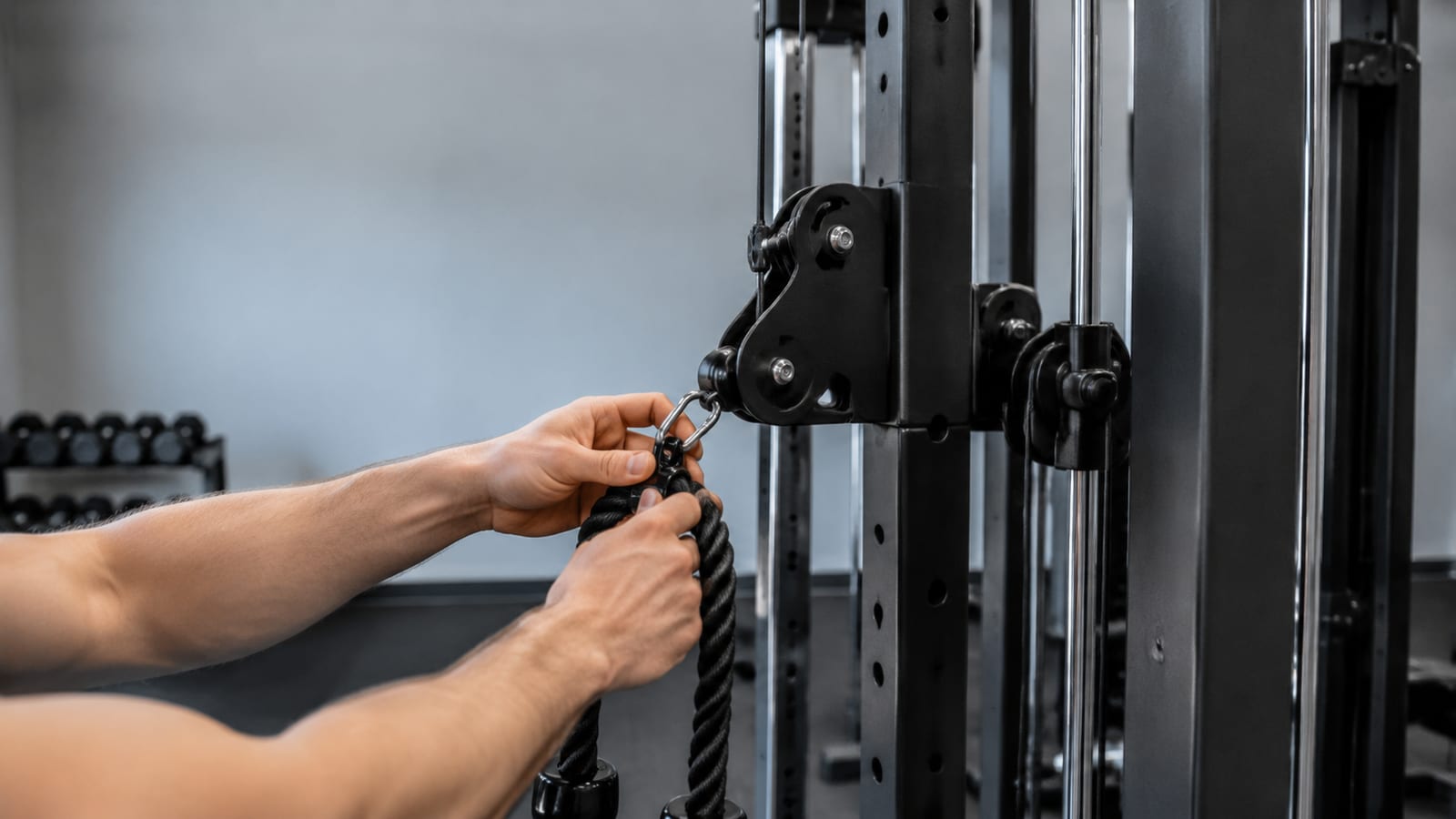
Follow the same setup process before every movement. Don’t grab a handle and hope the angle sorts itself out.
- Choose the movement first. Decide whether you’re curling, extending, or training with a neutral grip.
- Set the pulley to match the exercise. Low pulleys suit most curls. High pulleys suit pushdowns and many overhead extensions.
- Attach a handle that fits your wrists. A rope allows more freedom. A bar gives you a fixed hand position.
- Stand where the cable stays clear. Your hands, elbows, and body shouldn’t rub against the cable.
- Raise the stack before starting the rep. The plates should remain slightly separated during the working range.
- Test the movement with an easy load. Check your elbow path, wrist position, and balance before adding resistance.
- Adjust your stance before the weight. A small change in body position often fixes an awkward exercise better than another attachment.
Also, check that the pin is fully inserted and the attachment clip is closed. A cable machine is controlled equipment, not foolproof equipment.
Which cable exercises build the biceps?
Start with a standing cable curl. It’s stable, easy to learn, and simple to measure. Most lifters need that more than another elaborate curl variation.
Standing cable curl
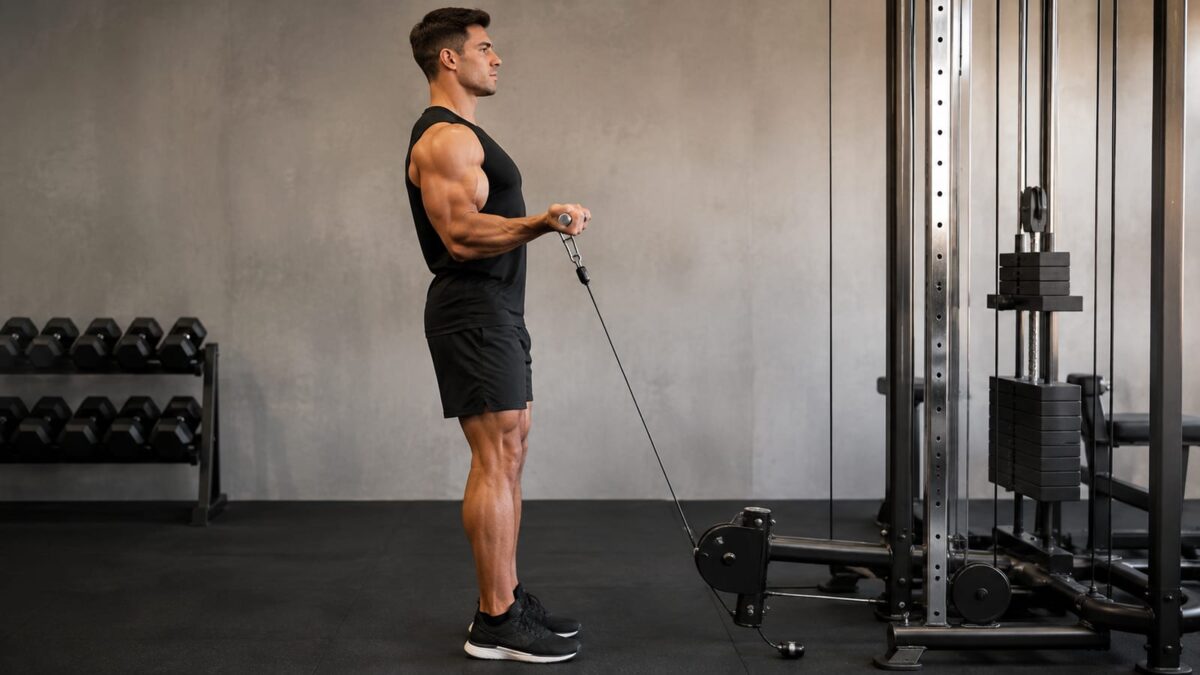
Attach a bar to the low pulley. Stand tall with your upper arms close to your torso, then curl without pushing your hips forward.
Lower the bar under control until your elbows straighten comfortably. If your shoulders roll forward or your body rocks, the load is too heavy.
Facing-away single-arm curl
Attach a D-handle to the low pulley and face away from the machine. Step forward until the cable gently pulls your working arm behind your torso.
Curl while keeping the shoulder steady. This variation trains the biceps in a longer position, but don’t force the arm farther back than your shoulder allows. Your joints get a vote.
If you want more detail on shoulder position and biceps emphasis, use this guide to long-head biceps exercises. You can shift emphasis, but you can’t carve one part of the biceps with a special handle.
Rope hammer curl
Attach a rope to the low pulley and hold it with your palms facing each other. Curl without turning the wrists or throwing the elbows forward.
Hammer curls train the elbow flexors and ask more from the forearms. Keep them if the neutral grip feels good and your regular curls have already covered palm-up work.
Which cable exercises build the triceps?
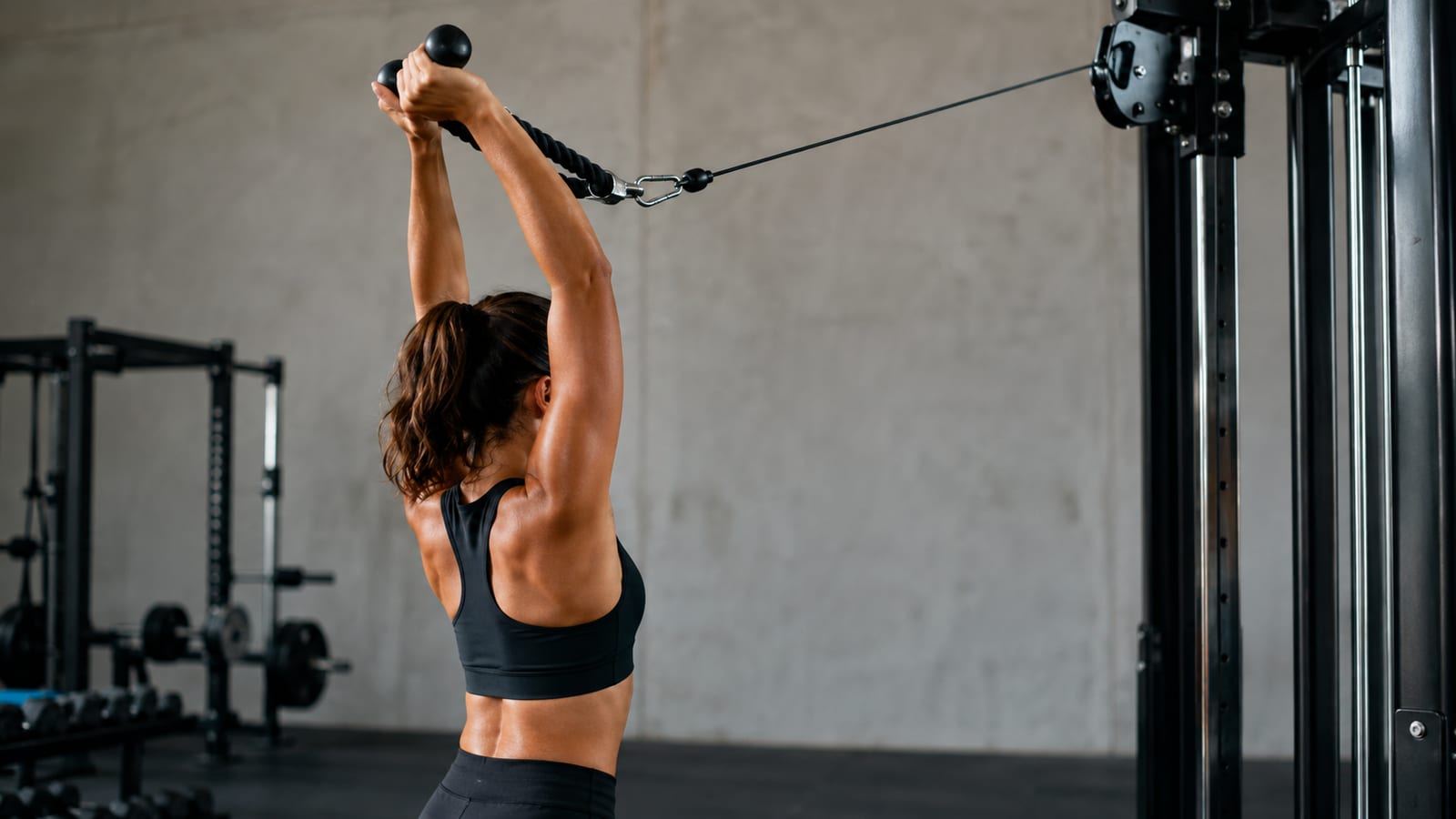
Use a pushdown and an overhead extension as your base. They train the triceps from different shoulder positions without requiring a long list of near-identical exercises.
Cable pushdown
Set the pulley high and attach a rope or bar. Hold your upper arms beside your torso, then straighten your elbows without leaning your whole body onto the handle.
Let the elbows bend fully on the return, but keep your shoulders from drifting forward. The rep should come from the elbows, not from a standing crunch.
A rope allows your hands to separate near the bottom. However, pulling the ends far behind your hips adds little and often turns the finish into shoulder movement.
Overhead cable extension
Use a high pulley with a rope, then face away from the machine. Brace your torso and extend your elbows while your upper arms remain near your head.
The long head of the triceps works from a more stretched position here. Still, don’t chase a deep stretch by flaring the ribs or forcing the shoulders.
You can also perform this exercise with a low pulley. Use whichever setup keeps the cable clear and lets you hold a stable stance.
Single-arm cross-body extension
Set the pulley above shoulder level and pull the handle across your torso by straightening the elbow. This setup often feels better than a fixed bar because each wrist can find its own path.
Keep it if it gives you clean reps without elbow irritation. Skip it if the setup takes longer than the useful work.
How should you train your forearms with cables?
Hammer curls and reverse curls cover most forearm needs inside an arm workout. You don’t need a separate collection of wrist exercises unless grip or forearm growth is a clear priority.
For reverse curls, attach a bar to the low pulley and use an overhand grip. Curl with your wrists straight and your elbows quiet.
Use less resistance than you use for palm-up curls. If your wrists fold or the bar slips into your fingers, the target muscles have stopped controlling the movement.
Grip work also comes from rows, pulldowns, and neutral-grip pulling. A neutral-grip pull-up can support arm development while also training your back.
How do you build a complete cable arm workout?
Build the session around movements you can repeat and progress. The plan is simple on paper, but the working sets still need to be hard enough to count.
- Start with a basic curl. Use a bar or comfortable handle and record the load and reps.
- Follow with a pushdown. Choose the attachment that keeps your wrists and elbows comfortable.
- Add a lengthened biceps movement. A facing-away curl works well if your shoulders tolerate it.
- Train the triceps overhead. Use a rope and keep your ribs under control.
- Finish with optional forearm work. Pick hammer curls or reverse curls, not every variation available.
- Stop before technique breaks. Finish most sets while you still have clean reps available.
- Progress one thing at a time. Add reps first, then increase the load when you reach the top of your chosen range with repeatable technique.
A practical session looks like this:
| Order | Exercise | Main focus | Coaching check |
|---|---|---|---|
| First | Standing cable curl | Biceps | No hip drive |
| Next | Cable pushdown | Triceps | Upper arms stay quiet |
| Then | Facing-away curl | Biceps in a longer position | Shoulder remains controlled |
| Then | Overhead extension | Triceps in a longer position | Ribs stay down |
| Optional finish | Hammer curl or reverse curl | Forearms and elbow flexors | Wrists remain firm |
Perform a few productive sets for each main movement. Use a moderate rep range that lets you feel the target muscle, control the return, and add weight or reps over time.
Where should cable arm work fit in your week?
For most lifters, cable arm work belongs after presses, rows, pulldowns, and other larger movements. Those exercises already train the biceps and triceps, so direct work should finish the job rather than bury it.
You can also run a separate arm session if your main workouts are already crowded. However, the plan has to fit your week and leave enough recovery for pressing and pulling.
Don’t train arms again just because the soreness has faded. Watch your performance instead. If reps improve, elbows feel good, and larger lifts remain steady, your current schedule is doing its job.
If you’re tempted to repeat direct work every day, read the practical limits of training arms daily before adding more. Extra sessions only help when you can recover and come back stronger.
How do you progress cable arm workouts?
Use a rep range and earn the next increase. Keep the load unchanged until you can perform more quality reps with the same setup and technique.
Then move the pin by the smallest practical amount. Cable stack jumps can feel large on curls and extensions, so you may lose reps after an increase. That’s normal.
Don’t change the handle, pulley height, stance, and load at the same time. The logbook can’t show progress if you keep changing the exercise.
Progress can also mean:
- More controlled reps with the same resistance
- A fuller comfortable range of motion
- Less body movement
- Better control during the lowering phase
- The same work with less joint strain
Add weight or reps when performance supports it. Don’t reward sloppy reps with a heavier stack.
Which cable arm workout mistakes slow progress?
Most cable mistakes come from chasing load or novelty. Fix the setup first, then make every set serve a purpose.
- Standing too close to the pulley: The cable can lose useful tension near the end of the rep. Step back until the stack stays raised.
- Using body swing: Hip drive turns a curl into a whole-body pull. Reduce the load and keep your torso still.
- Pinning the elbows to an unnatural spot: Your elbows may move slightly as the arm bends. Control them rather than forcing them into a painful position.
- Letting the stack crash: Dropping the plates removes control and makes the next rep harder to set.
- Cutting the range short: Use the largest comfortable range you can control. Forced depth is no better than half reps.
- Collecting attachments: A new handle doesn’t replace progression. Keep the few options that fit your joints.
- Turning every set into a grind: Routine breakdown adds fatigue and irritates elbows. Leave clean reps in reserve on most work.
- Ignoring wrist position: Bent wrists leak force and often cause discomfort. Keep the hand in line with the forearm.
Also, don’t confuse a strong muscle sensation with proof of a better exercise. A movement earns its place by producing good reps, measurable progress, and manageable recovery.
FAQ
Can a cable-only arm workout build muscle?
Yes. Cables provide enough resistance to build the biceps, triceps, and forearms if your sets are challenging and your performance improves over time.
However, cable arm work shouldn’t replace all pressing and pulling. Compound exercises train more muscle and give your program a stronger base.
Is a rope better than a bar for cable exercises?
Neither attachment wins every exercise. A rope gives your wrists more freedom, while a bar provides a stable grip that’s easy to repeat.
Choose the attachment that keeps the movement comfortable and lets you apply force without twisting your wrists. Keep that setup long enough to judge progress.
Why does the same weight feel different on another cable machine?
Cable machines use different pulley arrangements, cable paths, and stack designs. As a result, the label on one machine may not feel like the same load on another.
Record the machine and setup you used. Don’t treat stack labels from different gyms as direct comparisons.
Can I pair cable curls and pushdowns in the same set?
Yes. Alternating a curl with a pushdown can save time because one movement trains the biceps while the other trains the triceps.
Still, don’t rush. Take enough time to keep your reps strong, especially once fatigue starts changing your technique.
What should I do if cable exercises hurt my elbows?
Stop using the painful setup and lower the resistance. Then try a rope, a single handle, or a different pulley angle that allows a more natural wrist path.
If discomfort remains or affects daily movement, get it assessed by a qualified medical professional. Training through persistent joint pain isn’t productive effort.