Build a Full-Body Strength Plan With Bands

 0
 0
Bands build real strength when you use them for the basics: the banded squat, Romanian deadlift, row, chest press, overhead press, glute bridge, and face pull. Those strength training exercises with resistance bands cover every major movement pattern, so you don't need a wall of variations. Add tension or reps once you earn it, keep your technique controlled, and stop each set with a rep or two left. Skip the circuits that treat a workout like a pain-tolerance test.
Bands build strength when the progression is real
Your muscles can't tell a barbell from a strip of latex. They respond to hard sets, repeated for months, with enough food and sleep behind them. Bands can deliver all of that.
Most band routines stall for a duller reason. The band never gets harder, so your body has no reason to change. Strength comes from sets that are hard enough to count and a plan that asks a little more over time.
What's the catch?
A band gets harder the farther you stretch it. As a result, tension is light at the start of a rep and heavy at the end. That suits rows and presses well. However, squats and hinges get little tension at the bottom, which is exactly where a dumbbell would challenge you most.
Bands also make load hard to measure. One brand's heavy band can feel nothing like another's, and tension changes with where you stand. So log the band, your foot position, and your reps every session.
Who should train with bands
Bands fit home trainees, beginners, and anyone coming back after a layoff. They also pack into a suitcase, which makes them a natural partner for this hotel gym workout routine for travelers.
Stronger lifters will outgrow band-only leg work sooner, so add load there when you can. If you already train with a barbell, bands work well as an add-on. Here's how to add bands or chains without losing barbell skill.
What are the best strength training exercises with resistance bands?
The best ones train a basic movement pattern you'll use for years. Pick one exercise per pattern and stop shopping for more.
- Squat: banded squat for quads and glutes.
- Hinge: banded Romanian deadlift for hamstrings and glutes, with the banded glute bridge as a joint-friendly option.
- Horizontal push: banded chest press for chest, front shoulders, and triceps.
- Horizontal pull: banded row for upper back, lats, and biceps.
- Vertical push: banded overhead press for shoulders and triceps.
- Core: the Pallof press. You hold a band straight out from your chest and refuse to let it twist you.
- Upper-back accessory: banded face pull for rear shoulders and the muscles between your shoulder blades.
That's the whole menu. It's simple on paper and demanding in practice. If a new exercise doesn't train a pattern better than the one you already do, skip it.
For a longer program that mixes bands with bodyweight work, see this home workout plan for muscle gain without machines.
How to do the core band exercises
Each exercise below covers the setup, the cues that matter, the usual mistake, and an easier version. Good reps before more weight, every time.
Banded squat
This is the best lower-body starting point. The pattern is simple, repeatable, and easy to progress.
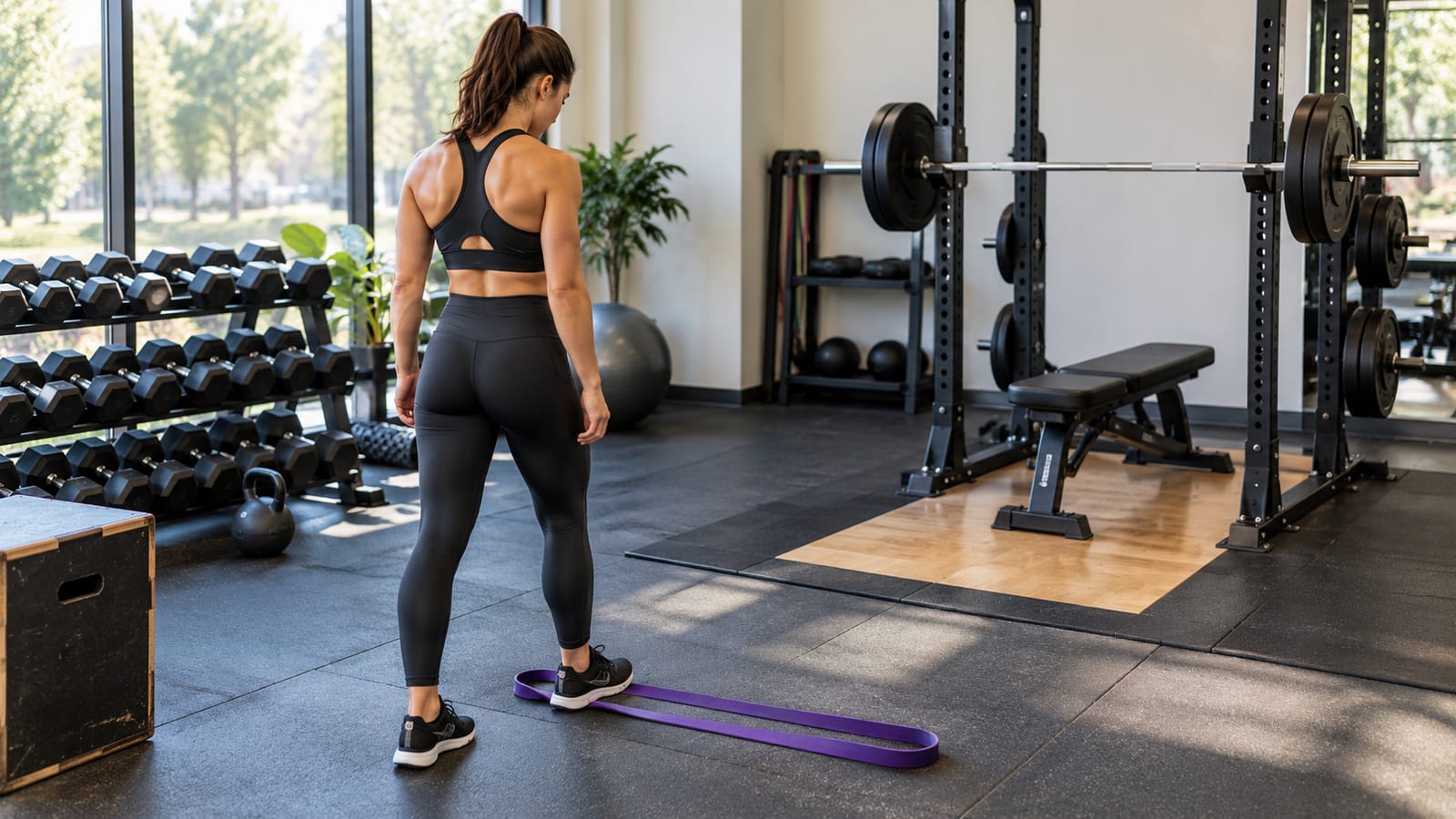
- Setup: Stand on the middle of a long loop band with feet about shoulder-width apart. Loop the top across your upper back, or hold tube handles at your shoulders.
- Do it: Brace your midsection and sit down between your heels. Then drive through your whole foot to stand tall.
- Works: Quads and glutes.
- Watch for: Knees caving in or heels lifting. Push your knees out over your toes.
- Easier version: Squat down to a chair and stand back up.
Banded Romanian deadlift
This is the highest-value hinge you can do with a band. It trains your hamstrings and glutes and teaches you to bend at the hips.
- Setup: Stand on the band with feet hip-width apart and hold the ends at your thighs.
- Do it: Keep a soft bend in your knees and push your hips back. Lower until you feel a stretch in your hamstrings, then squeeze your glutes to stand.
- Works: Hamstrings, glutes, and the muscles along your spine.
- Watch for: Rounding your back to reach lower. Your range ends where your back stops staying flat.
- Easier version: Lower only to your knees until the position feels steady.
Banded row
Every band routine needs this pull. It trains your upper back and arms with an easy setup.
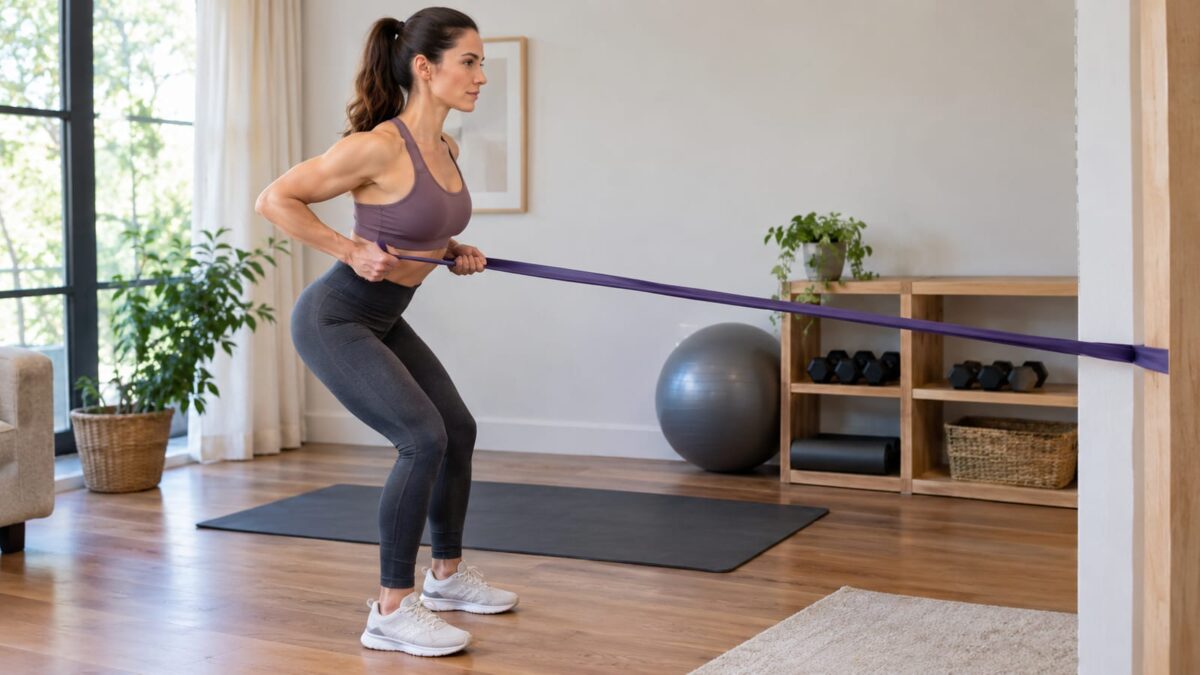
- Setup: Anchor the band at chest height to a sturdy post or a door anchor. Alternatively, sit with legs straight and loop the band around your feet.
- Do it: Pull your elbows back along your ribs and squeeze your shoulder blades together. Then let the band return slowly.
- Works: Upper back, lats, rear shoulders, and biceps.
- Watch for: Leaning back to finish the rep. Your torso should stay still.
- Easier version: Step closer to the anchor so the band starts with less stretch.
Banded chest press
This is your main home press, as long as you have a stable anchor behind you.
- Setup: Anchor the band at chest height behind you, or wrap it across your upper back and hold the ends. Take a staggered stance.
- Do it: Press your hands forward until your arms are straight. Keep your shoulders down, then return slowly.
- Works: Chest, front shoulders, and triceps.
- Watch for: The band pulling you backward. Brace hard and lengthen your stagger.
- Easier version: Step closer to the anchor, or do push-ups with your hands on a counter.
Banded overhead press
This builds shoulder strength, provided you can press without pinching, shrugging, or arching your lower back.
- Setup: Stand on the band and hold the handles at shoulder height.
- Do it: Squeeze your glutes, keep your ribs down, and press straight up until your arms finish beside your ears.
- Works: Shoulders and triceps.
- Watch for: Leaning back to finish. That shifts the work into your lower back.
- Easier version: Press one arm at a time while kneeling on one knee. If the top still pinches, stop short of it. Your joints get a vote.
Banded glute bridge
This is a joint-friendly way to load your hips. It suits beginners and anyone returning to training.
- Setup: Lie on your back with knees bent and feet flat. Place a small loop band just above your knees, or hold a long band across your hips with your hands pinned to the floor.
- Do it: Drive through your heels and lift until your body forms a straight line from knees to shoulders. Pause, then lower.
- Works: Glutes and hamstrings.
- Watch for: Arching your lower back at the top. Lift with your hips and keep your ribs down.
- Easier version: Drop the band and hold the top briefly.
Banded face pull
This is a smart accessory for the upper back and rear shoulders. Do it after rows and presses, because it rounds them out and can't replace them.
- Setup: Anchor the band at face height and hold an end in each hand, palms down.
- Do it: Pull toward your forehead with elbows high and hands spreading apart. Finish with your hands beside your ears.
- Works: Rear shoulders and upper back.
- Watch for: A band so heavy that you lean back and yank it.
- Easier version: Use a lighter band and slow down.
A full-body band workout for a busy week
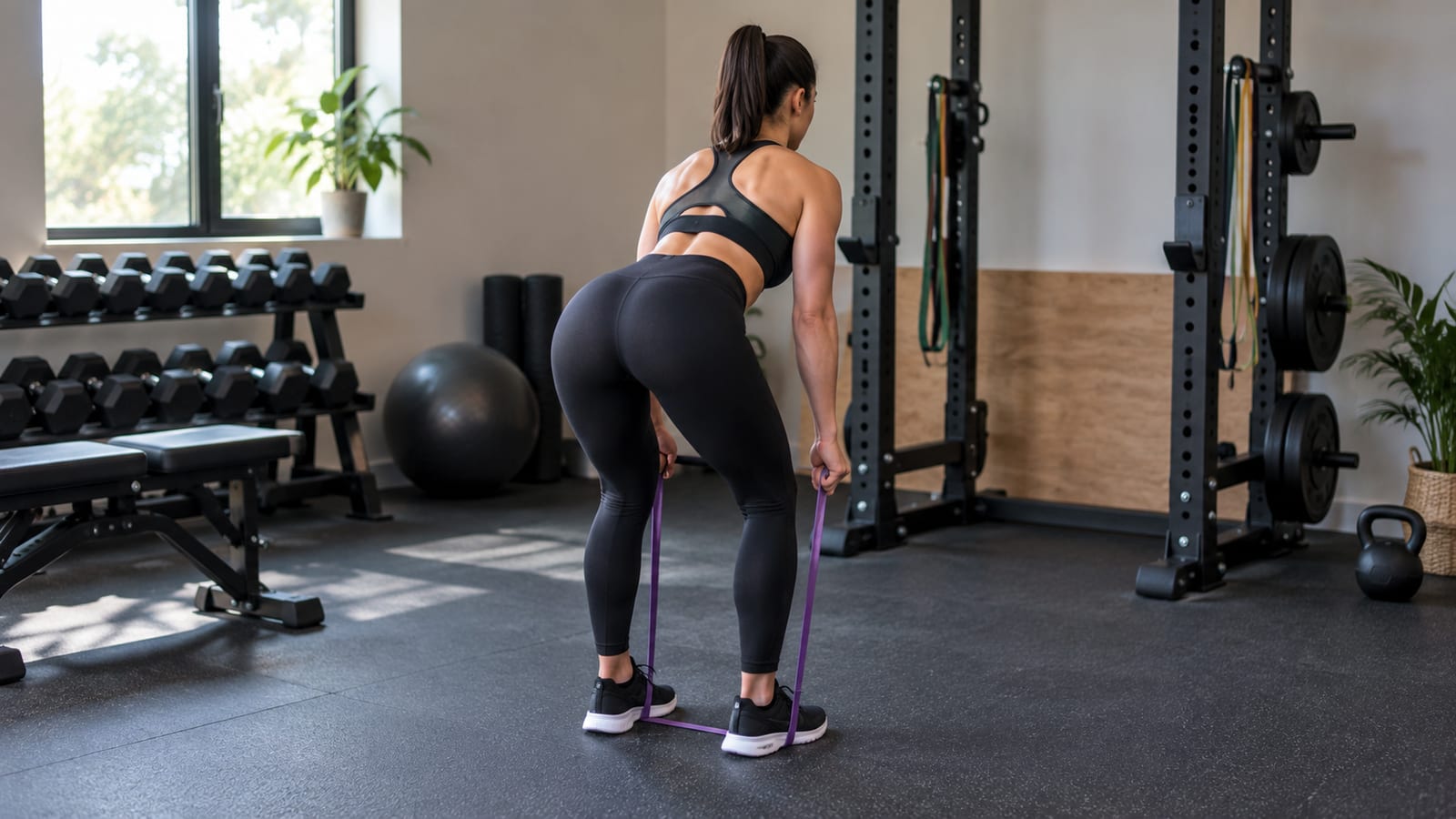
Alternate Workout A and Workout B on 2 non-consecutive days a week, such as Monday and Thursday. Do the exercises in the order listed. Because each session covers the whole body, a missed day costs you less.
Workout A
| Exercise | Sets | Reps |
|---|---|---|
| Banded squat | 2 | 8 to 12 |
| Banded row | 2 | 8 to 12 |
| Banded chest press | 2 | 8 to 12 |
| Banded glute bridge | 2 | 8 to 12 |
| Banded face pull | 2 | 8 to 12 |
Workout B
| Exercise | Sets | Reps |
|---|---|---|
| Banded Romanian deadlift | 2 | 8 to 12 |
| Banded overhead press | 2 | 8 to 12 |
| Single-arm banded row | 2 | 8 to 12 per side |
| Banded squat with a pause at the bottom | 2 | 8 to 12 |
| Pallof press | 2 | 8 to 12 per side |
The HHS Physical Activity Guidelines for Americans count 1 set of 8 to 12 repetitions as the minimum that qualifies as muscle strengthening. Treat that as a floor. Two working sets give you more room to progress without dragging the session out.
Rest a minute or two between sets. Take longer on squats and hinges if your breathing hasn't settled. To save time, pair the row with a press and alternate sets between them.
Stop every set with a rep or two left in reserve, and keep each rep looking like the last one. When you reach 12 clean reps on both sets, make that exercise harder next session.
If you also own dumbbells, this minimal-equipment full-body strength plan uses the same structure with free weights.
How do you make band exercises harder?
Change one variable at a time and write down what you changed. That way the logbook tells you what actually improved. Work through these in roughly this order:
- Reps: Add a rep per set until you hit the top of your range.
- Tempo: Lower slowly instead of letting the band snap you back.
- Pauses: Hold briefly where the band is most stretched.
- Range of motion: Go a little deeper or pull a little farther with the same clean form.
- Band length: Step farther from the anchor, widen your stance on the band, or choke up on it. A shorter band means more tension.
- Band tension: Move up to the next band, or stack two bands together.
- Sets: Add a set to any exercise where a muscle has stalled.
Mark your foot position with a strip of tape. Then "one step back" means the same thing every week, and you can't fool yourself.
Progress also counts when the same set looks cleaner or takes less effort. Small increases add up across months. That's how you earn the next increase without guessing.
Band exercises by muscle group
Most people can train every major muscle with the main exercises below. Use the right-hand column only when a muscle is clearly lagging and your recovery is already in order.
| Muscle group | Main band exercise | Add if needed |
|---|---|---|
| Quads | Banded squat | Banded split squat |
| Glutes | Banded glute bridge | Banded Romanian deadlift |
| Hamstrings | Banded Romanian deadlift | Lying banded leg curl |
| Chest | Banded chest press | Push-up with a band across your back |
| Back | Banded row | High-anchor banded pulldown |
| Shoulders | Banded overhead press | Face pull or lateral raise |
| Arms | Rows and presses | Banded curl and triceps pushdown |
| Core | Pallof press | Dead bug |
Rows and presses already work your arms hard. Add direct curls and pushdowns once the big movements are progressing and you still have time left in the session.
Bands help flexibility and everyday strength too
Strength through a full range is flexibility you can use. A slow Romanian deadlift stretches your hamstrings while they work, so they learn to produce force in that long position. Holding a stretch on the floor does little for strength there.
The patterns also carry straight into daily life:
- Hinge: picking a box up off the floor.
- Squat: climbing stairs and getting up from a low chair.
- Row: pulling open a heavy door or starting a lawnmower.
- Press: lifting a suitcase into an overhead bin.
After a couple of months of steady training, those tasks should feel easier. If they don't, check whether your bands and reps have moved in the logbook.
Joint pain calls for a different standard
Bands suit sore joints because the tension is smooth and easy to dial down. However, the goal changes. A good session leaves the joint no worse the next day, even if the work felt easy.
Adjust in this order:
- Use a lighter band and do more controlled reps.
- Shorten the range to the part that feels comfortable.
- Slow the tempo so nothing jerks or bounces.
- Use short holds at a comfortable point, such as pausing halfway through a row.
Mild achiness that eases as you warm up is often fine. Stop and get assessed by a physical therapist or doctor if you notice any of these:
- Sharp or stabbing pain during a rep
- Swelling, heat, or a joint that gives way
- Numbness, tingling, or pain that travels down a limb
- Pain that is worse the next morning or keeps getting worse week to week
Many physical therapists now offer video sessions, which work well for checking your band setup at home. Pushing through warning signs doesn't make you tougher. It makes the next month of training worse.
Safe setup beats fancy variations
A snapped band or slipped anchor can hit you in the face. Run through these checks before every session:
- Inspect the band. Look for nicks, cracks, thin spots, or sticky patches. Replace it if you find any.
- Anchor it properly. Loop the band around a sturdy post or rail, or use a door anchor in a solid door. Close the door so it swings away from you. That way your pull drags it shut.
- Keep it off sharp edges. Rough brick, metal corners, and rings can nick the band. Small nicks grow into tears under tension.
- Control the return. Never let go of a stretched band. Walk it back to slack before you release your grip or step off it.
- Keep it clear of your face. Set your anchor and stance so the band's path stays away from your eyes, especially on face pulls and presses.
- Store it out of heat and sunlight. Latex breaks down faster in a hot car or a sunny window.
A band that fails mid-rep ends the session and can hurt you. A quick check before each workout keeps that risk low, so you can recover and come back stronger next time.
FAQ
Can I train with bands more than twice a week?
Yes. The adult guidelines call for muscle-strengthening work that hits all major muscle groups on 2 or more days a week, so two sessions are the starting point. A third day is fine if your joints feel good and your reps keep climbing. Leave a rest day before you train the same muscles again.
Will bands build muscle size, or just strength?
Both, as long as the sets end close to your limit. Muscle grows from enough hard work, enough protein and total food, and steady progress over months. Bands can supply the work. Size usually shows up more slowly than strength, so judge it by your logbook and measurements over several months.
Which type of band should I buy first?
Start with long loop bands in a few tensions plus a door anchor. Loops handle squats, deadlifts, rows, and presses, and you can stack them as you get stronger. Tube bands with handles feel more comfortable in the hands for presses and curls. A small loop band is a cheap extra for glute bridges.
Is it ever okay to take a band set to failure?
Occasionally, on the final set of a simple accessory like a face pull or curl. The risk is low because the band lightens as you shorten it. Keep squats, Romanian deadlifts, and overhead presses short of failure, since that's where form slips first and fatigue costs you the most.