Bench Press Setup Changes to Ease Shoulder Pain

 0
 0
Shoulder pain on the bench is usually fixable, and you rarely need to quit the lift. To bench press without shoulder pain, lock your upper back into the bench before you unrack. Use a medium grip with your wrists stacked over your elbows. Lower the bar under control to your lower chest. If it still hurts, cut the load or range, check your shoulder rotation, and build your upper back and rotator cuff. Stop on sharp, worsening, or lingering pain and get it checked.
Keep the bench press. Most lifters with cranky shoulders don't need to quit it. They need to stop pressing through a position their shoulder can't hold yet.
Set a pain rule before you touch the bar
Do this first: decide what counts as acceptable before you start a set. Effort in your chest, triceps, and front delts is normal. A mild, dull stiffness that fades as you warm up is usually fine too.
Keep training when you feel:
- Dull muscular effort that builds with the set and fades when you rack the bar
- Mild stiffness that eases during warm-up sets and doesn't get worse from set to set
- No change in the shoulder the next morning
Stop and change something when you feel:
- Sharp or pinching pain, usually at the bottom of the rep
- Clicking or catching that comes with pain
- A sense that the shoulder is slipping or unstable
- Pain, numbness, or tingling that travels down the arm
- Pain that's worse the next day or keeps building week to week
If a set crosses into the second list, end it. Re-rack, then drop the load or shorten the range and try again. If the pain still shows up, skip pressing for the day. Your joints get a vote. Grinding through a pinch to finish the written sets is how a cranky shoulder becomes a layoff.
How do you bench press without shoulder pain?
Start with the setup, because a lot of shoulder trouble is decided before the first rep. Your legs, upper back, and the bench should form the base. That way the shoulder joint isn't doing all the stabilizing alone.
- Lie down with your eyes under the bar. Too close to the hooks and you'll clip them on the way up. Too far down the bench and the unrack pulls your shoulders forward.
- Plant your feet and push. Flat feet or toes are both fine, so pick one and repeat it every set. Push your feet into the floor as if you're sliding yourself toward the head of the bench.
- Pull your shoulder blades back and down. Squeeze them together, tuck them toward your back pockets, and set your upper back hard into the pad. You should feel pinned to the bench.
- Use a modest arch. Keep your upper back and butt on the bench. A slight arch lifts your chest to meet the bar. That shortens the range a little and puts the shoulder in a less cranked position. You don't need a competition-style arch.
- Unrack with straight arms. Take a handoff or pull the bar out with locked elbows, then bring it over your shoulders. Pause there and check that your shoulder blades are still set.
A sloppy unrack lets the shoulder blades drift forward, and then the set is lost before the first rep. So practice this sequence with the empty bar until it looks the same every time. It's simple on paper and demanding in practice, which is exactly why it pays off.
Use a grip and elbow path your shoulders can own
A medium grip suits most shoulders. Viewed from the front, your forearms should look close to vertical when the bar touches your chest. Wider grips shorten the range but load the front of the shoulder harder. Very narrow grips shift the work to your triceps and often bother wrists and elbows.
Next, stack your wrists. Set the bar low in your palm, over your forearm bones, with the wrist close to straight. A wrist bent far back pulls the bar off its line and makes the whole press less stable.
Your elbows should sit somewhere between flared and tucked. Elbows pointing straight out to your sides crowd the front of the shoulder at the bottom. Pinning them to your ribs causes its own problems. It drags the bar too low and strains the shoulder at a different angle.
Aim for a comfortable middle angle where the bottom of the rep feels strong. If your elbows drift outward as the set gets hard, our guide on fixing elbow flare on the bench press covers the drills in detail.
To test this, use the empty bar. Press with your normal grip, then move each hand in slightly, then out slightly. Keep whichever width feels strongest and pain-free at the bottom.
Lower to the lower chest and press back up
Touch the bar lower than most people expect. For most lifters, that's around the lower chest or the bottom of the sternum. Lowering to the upper chest or neck flares your elbows and loads the front of the shoulder hard.
Run each rep the same way:
- Breathe and brace before the bar moves.
- Lower under control. Aim for the same spot on your chest every rep.
- Touch lightly. Don't bounce, because a bounce drives the shoulder forward at its weakest point.
- Press up and slightly back. The bar travels from your lower chest toward your shoulders. It finishes over the shoulder joint, right where you unracked it.
- Keep your shoulder blades pinned at lockout. Don't reach your shoulders toward the ceiling at the top of each rep.
That slight back-and-up path keeps your elbows under the bar and your shoulder in a stronger line. If your bar path wanders toward your belly or your face, film one set from the side. The video will show you more than any cue can.
Cut load and range before you drop the bench
A painful bench rarely means pressing is off the table for good. More often, today's version is too heavy, too deep, or too fast for your shoulder. Learning how to bench press without shoulder pain often starts with a smaller version of the lift.
Work down this list in order, starting at the top. Stop at the first option that's pain-free and run it for a few weeks before you step back up. Jumping straight to the bottom row usually costs you more pressing than you needed to give up.
| Option | What it changes | Use it when |
|---|---|---|
| Lighter load, more reps in reserve | Less stress on every rep | Pain shows up only on heavy sets |
| Fewer hard sets | Less total weekly stress | The shoulder aches the day after pressing |
| Slow, controlled lowering | More control at the bottom | The bottom feels loose or you bounce |
| Paused bench | Removes the bounce and teaches the bottom position | Pain hits at the turnaround |
| Board press or pin press | Shortens the range | Only the deepest part of the rep hurts |
| Floor press | The floor stops your elbows | Same as above, with no boards available |
| Neutral-grip dumbbell press | Palms face each other, and hands can rotate freely | The barbell hurts at any depth |
Should you switch to dumbbells or a machine?
Dumbbells deserve a real look. They let each shoulder find its own path, so many lifters can press them pain-free when the barbell hurts. Our comparison of dumbbell press vs. bench press explains how to swap one for the other without losing progress. A machine press is another solid option, and our list of the best chest machines at the gym covers which ones to use.
Once the modified version has stayed pain-free for a while, work back toward the full bench one step at a time. Add range first, then load.
Keep the warm-up short and specific
Your warm-up should take a few minutes and get you ready to press. Long mobility circuits rarely fix bench pain, and they eat into the time your working sets need.
- Arm circles and band pull-aparts to loosen up and wake up your upper back.
- Light band external rotations. Keep your elbow at your side and rotate your forearm outward, slowly.
- One set with the empty bar, rehearsing your full setup and bar path.
- Ramp-up sets. Climb toward your working weight over several sets, using fewer reps as the weight rises. Stay well short of fatigue.
- Check the bottom position on your last warm-up set. If it pinches there, switch to a regression for the day.
Pay attention if your shoulder still feels off after the ramp-up sets. That tells you something useful, so change the lift today rather than forcing it.
Is your shoulder internal rotation actually limited?
Internal rotation means turning your upper arm inward, like reaching behind your back to tuck in a shirt. One physical therapy clinic's guidance for lifters puts it bluntly: "Shoulder pain while bench pressing usually stems from one core issue: You don’t have enough internal rotation at the shoulder to safely get into a bench press position." That makes it worth checking before you blame the lift.
The same guidance describes a simple wall test:
- Stand side-on next to a wall.
- Raise your elbow to shoulder height.
- Place your forearm and wrist, around where a watch sits, against the wall.
- Gently push downward.
- Compare both sides.
Look for a clear difference between your shoulders. If one rotates noticeably less, or the test brings back your bench pain, that limit may be part of the problem.
A small difference means little, because almost nobody is perfectly even. Also, a single test can't diagnose anything. Use it as a baseline you can retest, and if the test itself hurts, treat that as a reason to get assessed.
Use the lacrosse ball briefly, then retest
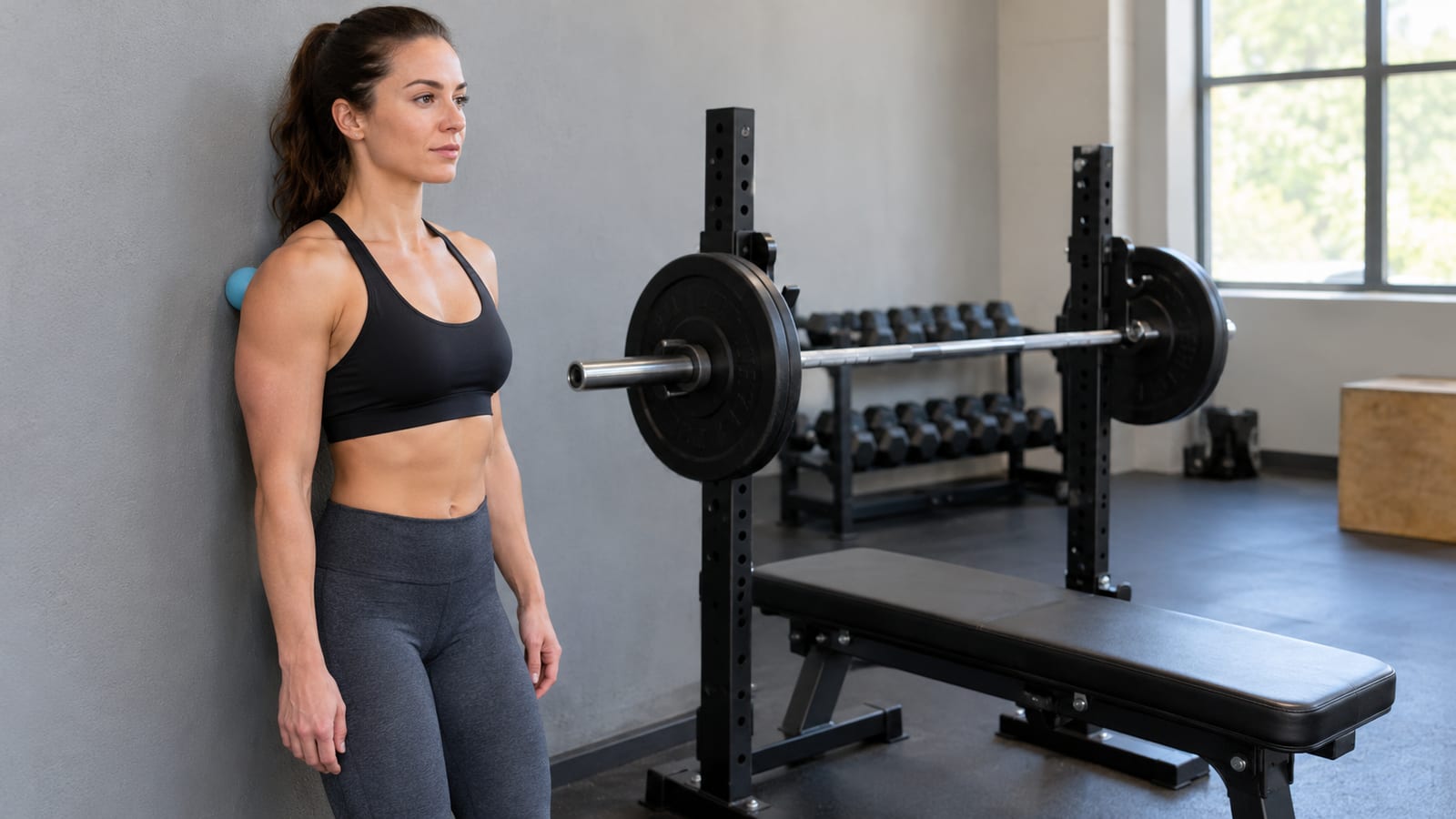
Keep it, but keep it short. That same clinic rates lacrosse-ball soft tissue work highly. It calls rolling the back of the shoulder one of the simplest and most effective ways to improve shoulder mobility before benching. Its guidance suggests spending 3 to 5 minutes rolling the back of the shoulder and focusing on tender spots.
Here's how to do it without overdoing it:
- Lean the back of your shoulder into a wall with the ball between you and the wall.
- Move slowly, and pause on tender spots until they ease a little.
- Keep the pressure tolerable. Discomfort is fine, but sharp pain or tingling means move off that spot.
- If you like, spend a short time on the upper back between your shoulder blades and on the chest muscle near the armpit.
- Stay off bony points and the front of the shoulder joint.
Then retest. Repeat the wall test, take the empty bar, and see whether the bottom of the press feels better. If it does, keep the routine before pressing days. If nothing changes after a few sessions, drop it and spend the time on your warm-up sets instead.
Rolling harder or longer won't give you more. The goal is a better press.
Build the upper back and rotator cuff
Most lifters press far more than they pull. As a result, the muscles that hold the shoulder blade and the ball of the arm in place get left behind. Your rotator cuff is a group of small muscles that keeps the top of your upper arm centered in the shoulder socket.
Add these in small doses:
- Rows. Chest-supported rows and cable rows let you focus on the upper back without your lower back taking over. Do at least as much rowing as pressing each week.
- Rear-delt work. Reverse flyes and face pulls train the back of the shoulder that pressing ignores.
- External rotations. Use a band or cable, light weight, and a slow tempo. Heavy, swinging reps hand the work to bigger muscles and miss the point.
- Controlled pressing. Push-ups let your shoulder blades move freely, and dumbbells let each arm find its own path. Both build pressing strength a cranky shoulder usually tolerates well.
This is a minimum effective dose job. A few sets of external rotations and rear-delt work at the end of upper-body days covers most lifters. Train these small muscles hard enough to count, with quality reps instead of heaving momentum.
Progress with effort you can recover from
Once the bench feels good, progress it slowly. Your shoulder handles loads it has been built up to, and it complains about sudden jumps.
- Pick a rep range and stay in it.
- Add reps first at the same weight, staying pain-free and leaving reps in reserve.
- Earn the next increase. When every set hits the top of your range with clean reps, add the smallest jump your gym allows.
- Step back if pain returns. Go back to your last pain-free load and rebuild from there.
Watch for grinders, the slow reps where the bar nearly stalls. One now and then is fine. A grinder every session means the load has outrun your recovery.
Food and sleep matter here too. Tendons and muscles adapt between sessions, so short sleep and a steep calorie deficit make every set harder to recover from. Eat enough protein and total food to support training, then recover and come back stronger.
The plan has to fit your week. Small increases add up, so beat the logbook by a rep, not by a grinder.
When should you see a clinician?
Technique cues fix technique problems. They won't fix a torn tendon or an irritated nerve. Knowing how to bench press without shoulder pain also means knowing when to stop trying.
Get assessed promptly if:
- The pain started with a fall, a pop, or one specific bad rep
- You've lost strength lifting your arm, or can't lift it at all
- The pain shows up at night or wakes you
- You have numbness, tingling, or pain running down the arm
- The shoulder feels like it slips or partly comes out of the socket
- You see swelling, bruising, or a change in the joint's shape
- The pain hasn't improved after a few weeks of sensible changes
Shoulder pain that comes with chest pressure, sweating, or shortness of breath needs emergency care. It can signal a heart problem. The MedlinePlus guide to shoulder pain lists other warning signs worth reading.
A sports physical therapist or sports medicine doctor can find what's irritated. They can also tell you which pressing variations are safe in the meantime. Meanwhile, keep training your legs and pulling movements if they don't aggravate the shoulder.
FAQ
Why does the front of my shoulder hurt at the bottom of the bench?
Front-of-shoulder pain at the bottom is the most common bench complaint. The usual causes are shoulder blades that drift off the pad, elbows that flare hard, or a bar that touches too high. Each one shoves the top of the arm bone forward in the socket. Fix the setup before you write off the exercise.
Is incline or decline pressing easier on the shoulders?
Neither angle is easier on everyone's shoulders. Some lifters press a slight decline or low incline comfortably, while a steep incline loads the front of the shoulder more. Try each with light weight and judge it by your pain rule. Keep the angle that lets you train hard without symptoms, and leave the others alone.
Should I use a thumbless grip to take pressure off my shoulder?
Skip it. Wrapping your thumb around the bar stops it from rolling out of your hands and onto your chest. No comfort gain is worth that risk. If your wrists or shoulders feel better with a different hand position, adjust grip width or switch to dumbbells.
How long before I can bench normally again?
That depends on how irritated the shoulder is and how long it's been bothering you. Mild cases often settle within a few weeks of smarter loading, while pain that's lingered for months usually takes longer. Let a string of pain-free sessions set the pace. Add back range and weight only when the current level feels easy on the joint.