The Best Machines for Building a Bigger Chest

 0
0
 0
0 Start with a converging chest press machine, then add an incline press if you need more upper-chest work. For most natural lifters, these are the best chest exercises machines offer because they provide stability, clear progression, and hard sets without wasting effort on balance. Use cables or a fly machine after pressing, not instead of it. Your chest will grow from repeatable technique, enough food, recovery, and a logbook you can beat.
Last updated: 2026-08-17
Which chest machines are actually worth using?
A good chest machine lets you do five things well:
- Keep your body stable.
- Use repeatable technique.
- Add weight or reps in small steps.
- Finish hard sets without your balance becoming the limiter.
- Train hard enough to count without crushing recovery.
That standard removes much of the clutter. A machine does not earn a place because it looks advanced or has a large frame. It earns a place because you can use it well for months.
For most lifters, a press machine ranks above a fly machine. Pressing lets you use more load and train the chest, shoulders, and triceps together. A fly gives you a useful shortened-position contraction, but it is harder to make the main strength movement.
A converging press is usually the best overall choice. The handles move slightly inward as you press, which follows a natural pressing path for many lifters. A flat chest press is just as useful if it fits your shoulders better or is easier to load consistently.
The best machine is the one that lets you keep your shoulder position, control the lowering phase, and add reps over time. If the machine forces your shoulders forward or gives you a poor range of motion, your joints get a vote.
What are the best chest exercises on gym machines?
The main chest machines at a gym each have a use. They do not all deserve equal time.
| Machine or exercise | Best use | Main advantage | Main limitation | Verdict |
|---|---|---|---|---|
| Converging chest press | Main chest movement | Stable and easy to progress | Some machines have poor handle or seat positions | Best overall |
| Flat chest press | Simple strength and muscle work | Easy to measure and repeat | May feel less comfortable for some shoulders | Best basic choice |
| Incline chest press | Upper-chest emphasis | Adds direct work for the upper pecs | Usually handles less load than flat pressing | Worth adding |
| Decline chest press | Comfortable lower-chest pressing | Often feels easy on the shoulders | Lower priority for most lifters | Useful, not necessary |
| Single-arm chest press | Side-to-side balance | Adds trunk and shoulder stability demands | Takes more time | Good accessory |
| Cable chest press | Adjustable angles and resistance | Flexible setup | More setup and less stability | Useful secondary option |
| Cable fly or crossover | Finishing work | Strong contraction with adjustable angles | Poor choice for heavy loading | Use sparingly |
Converging chest press machine: best overall
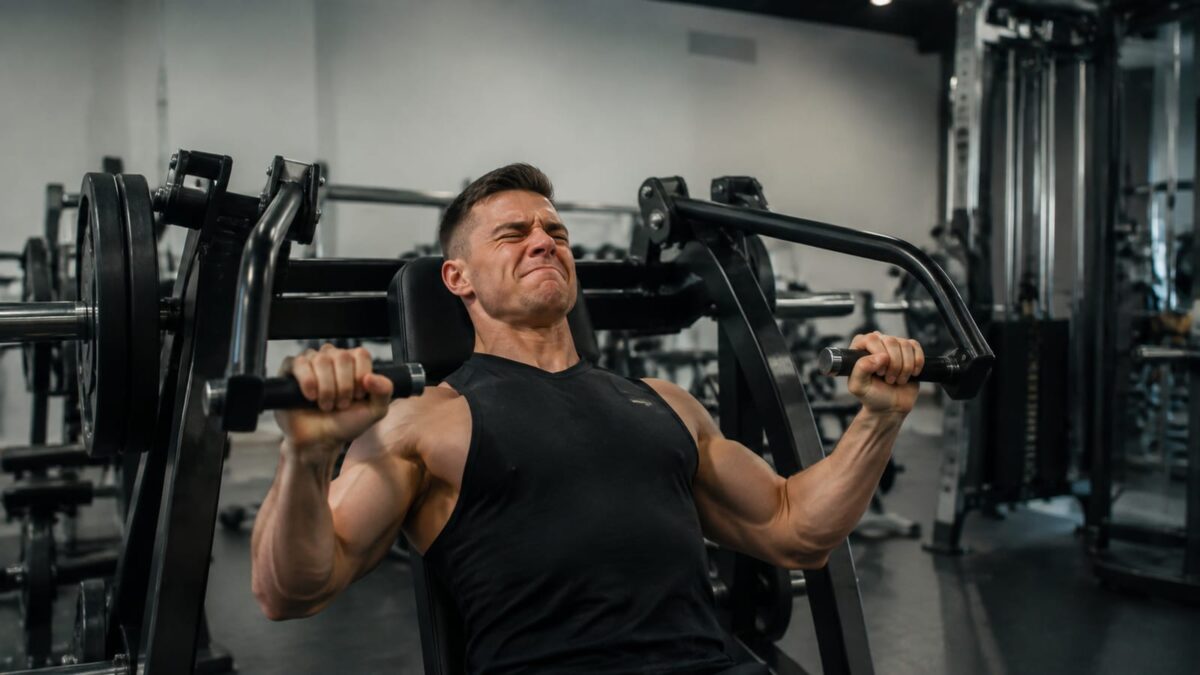
Use the converging chest press as your default if the seat and handles fit you well. It gives you a stable base, a clear pressing path, and enough loading potential for measurable progress.
You can focus on driving the handles forward instead of managing balance. That matters when time is limited and every set needs to serve a purpose.
Keep this as your main machine chest exercise. Work in a moderate rep range, record every set, and earn the next increase instead of changing machines every week.
Flat chest press machine: best basic choice
The flat chest press machine is the best basic choice for most lifters. Use it as the measurable centerpiece of a simple chest workout machine routine.
It trains the chest through a strong horizontal press and usually allows steady increases. The machine does not need a special label or a complicated movement path. It needs to fit your body and let you use quality reps.
Choose this over a more unusual machine if you can keep your shoulder blades steady and reach a comfortable depth. Simple on paper is demanding in practice.
Incline chest press machine: best upper-chest option
Use the incline chest press after your flat or converging press when you want more work for the clavicular head of the pectoralis major, which is the upper portion of the chest.
It is useful for lifters who want more upper-chest development or who feel flat pressing mostly in the middle and lower chest. However, it usually gives you less loading potential than a flat press.
Do not make incline pressing your only chest movement unless it clearly suits your shoulders better. Start with your strongest repeatable press, then add the incline when you can recover from the extra work.
Decline chest press machine: useful but lowest priority
A decline chest press can train the lower portion of the chest comfortably. Some lifters also find the angle easier on their shoulders.
Still, most natural lifters should choose flat or incline pressing first. The decline machine adds another variation, but it rarely solves a problem that a well-performed flat press cannot address.
Keep it if it feels good and helps you train hard. Skip it if your gym time is tight or your chest already grows from flat and incline work.
Single-arm chest press machine: worthwhile accessory
A single-arm press can show you if one side contributes less than the other. It also makes your trunk resist rotation while you press, which adds a stability demand.
That does not make it a better main press. Alternating arms takes longer, and the load is often limited by balance or setup rather than chest strength.
Use it after your main press for a few controlled sets. Start with the weaker side, then match its reps on the stronger side. Do not let the stronger arm sneak in extra work.
Cable chest press: useful for adjustable resistance
The cable chest press lets you change the handle height and pressing angle. That makes it useful when a fixed machine bothers your shoulder or when you want a shorter pressing variation after heavier work.
However, the cables demand more control. Your trunk and shoulder position must stay steady while the handles pull you backward and outward.
Use a cable press when the adjustable setup solves a real problem. If a fixed chest press feels good and progresses cleanly, it is usually the simpler tool.
Cable fly or crossover: a good finishing exercise
Cable flyes and crossovers train the chest through a wide arc and give you a strong contraction when your hands come together. They work well after pressing.
They are not primary strength movements. The cable setup can also tempt you to use excessive weight, shorten the range, and turn the exercise into a shoulder swing.
Keep the load light enough for controlled reps. Let your arms move through a comfortable stretch, then bring your hands together without slamming the handles.
For more cable programming ideas, see this guide to building a simple cable arm workout. The same rule applies here: use cables to add targeted work, not to create a crowded session.
Which gym machines for chest should a natural lifter choose first?
Start with one chest press machine gym station. Add a second press only when you have a reason.
Use this priority order:
- Converging chest press: Choose it first if the handles follow a comfortable path.
- Flat chest press: Use it as the default if it is easier to load and repeat.
- Incline chest press: Add it for more upper-chest work.
- Cable fly or pec deck: Use it for controlled finishing work.
- Single-arm press: Add it for side-to-side differences or trunk control.
- Decline press: Keep it for comfort or preference, but treat it as optional.
This order works because the first movements give you the most productive pressing work. The later movements add detail without taking over the session.
If you train twice each week, one press may be enough. If you train chest more often and recover well, use a flat or converging press in one session and an incline press in another.
The best gym equipment for chest is not the equipment with the most settings. It is the equipment your calendar can support and your logbook can measure.
How should you perform a chest press machine correctly?
Set the machine before you worry about the weight. A poor seat position can turn a chest press into a front-shoulder exercise.
Use this setup:
- Adjust the seat height. Put the handles around the middle of your chest. If the handles sit too high, your shoulders may dominate. If they sit too low, your elbows may flare and your range may suffer.
- Plant your feet. Keep both feet on the floor and your hips against the seat.
- Set your shoulder blades. Pull them gently back and down against the pad. Do not force an exaggerated arch.
- Check the starting position. Your elbows should sit slightly behind your torso if that position feels comfortable. Do not chase a deep stretch that creates shoulder pain.
- Press smoothly. Drive the handles forward while keeping your wrists straight.
- Control the return. Let the weight come back under control. Do not allow the stack or plates to slam.
- Keep the elbows in a natural path. Avoid pinning them tightly to your sides or flaring them straight out.
Your hands do not need to touch at the end of a machine press. Finish where the chest is still doing the work and your shoulders remain stable.
Use a full range of motion that you can repeat. A shorter rep with more weight is not progress if the machine moves your shoulders instead of your chest.
Train most sets with 1 to 3 reps in reserve. In plain terms, stop when you could still perform one to three clean reps before technique breaks down.
What is the simplest beginner chest machine workout?
Do this first if you are new to machine training:
- Flat or converging chest press: Perform 2 working sets of 8 to 12 reps.
- Incline chest press: Perform 2 working sets of 8 to 12 reps if you want extra upper-chest work.
- Cable fly or pec deck: Perform 1 to 2 working sets of 10 to 15 reps.
Train this workout once or twice each week, depending on your full routine. Leave at least a day between demanding sessions for the same muscles.
For the first month, stop each set with about 2 to 3 good reps left. You are learning repeatable technique and building a baseline you can beat. You are not trying to turn every session into a recovery problem.
If you already train shoulders and triceps hard, start with the press and one small accessory. Your chest workout machine plan has to fit the rest of your week.
You can also compare this setup with dumbbell pressing versus bench pressing if you use both machines and free weights.
Should you use flat, incline, or decline chest machines?
Use the angle that improves your training without weakening your whole session.
| Pressing angle | Emphasis | Loading potential | Best choice when |
|---|---|---|---|
| Flat | General chest and horizontal pressing | Usually highest | You need a strong main movement |
| Incline | More upper-chest involvement | Usually lower than flat | You need targeted upper-chest work |
| Decline | More lower-chest involvement | Often comfortable | Flat pressing bothers your shoulders or you prefer the angle |
Flat pressing should usually come first because it gives you the clearest all-purpose chest work. It also makes progress easy to track.
Incline pressing earns its place when your upper chest needs more direct attention. Keep the angle moderate enough that your chest still works hard. A steep setup can shift the work toward your front shoulders.
Decline pressing is optional. Keep it if it feels strong and comfortable, but do not assume your chest is incomplete without it.
You do not need all three angles in one workout. Pick one main press and add another only if it improves your results.
When is a single-arm chest press machine useful?
Use a single-arm chest press when one side clearly lags or when you want more control over your torso.
Press one side at a time with your ribs and hips square to the pad. Do not twist toward the working arm to finish the rep. That movement hides the weakness you are trying to correct.
Start with the weaker side. Match its reps and load with the stronger side, even if the stronger side could do more.
Single-arm work is still an accessory for a lifter with limited time. It takes longer and usually does not provide the same total loading as a bilateral press.
Use it for a short block when you need it. Then return to your main press and check whether both sides now move more evenly.
Are cable machines good for chest exercises?
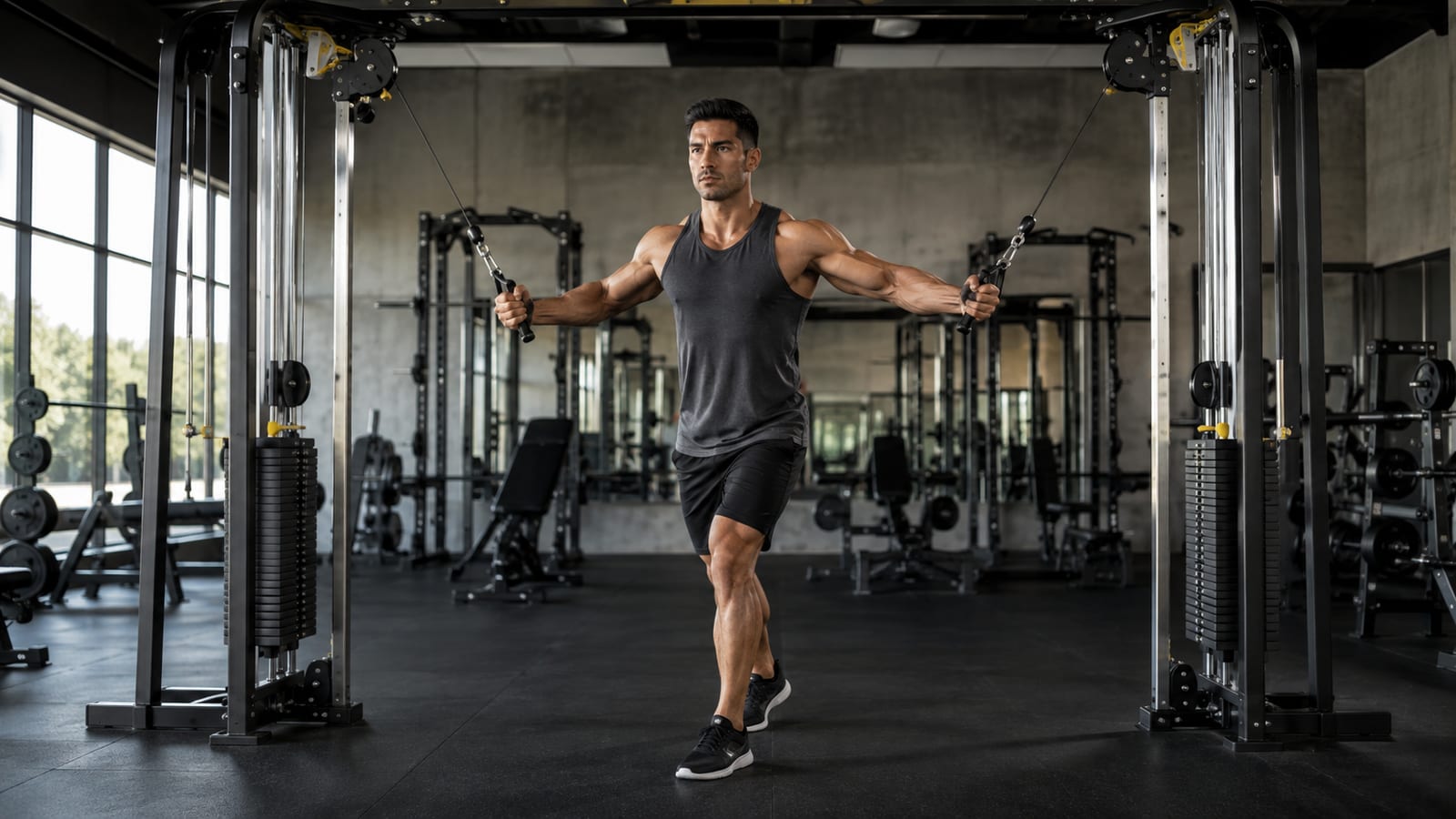
Yes. Cable machines are good for chest exercises when adjustable resistance improves your position or gives you a useful finishing movement.
Use these options:
- Standing cable press: Set the handles around mid-chest height. Stagger your stance and keep your ribs down as you press.
- Low-to-high cable press: Press upward and inward for more upper-chest emphasis.
- Cable fly: Keep a soft bend in your elbows and move from the shoulder joint.
- Cable crossover: Bring the handles together slightly across your body for a strong shortened contraction.
Cable presses are the best cable choice when you want adjustable resistance and several pressing angles. Still, a fixed chest press is easier to stabilize and repeat for most main sets.
Cable flyes and crossovers belong near the end of the workout. They are useful for adding chest work without loading the joints as heavily, but that does not make endless sets productive.
If your cable setup takes longer to adjust than the exercise takes to perform, use the fixed machine instead. The plan has to fit your week.
Can chest machines train the serratus as well as the chest?
Chest machines can involve the serratus anterior, a muscle along the upper ribs that helps move and control the shoulder blade. Pressing with a controlled reach can increase its contribution.
Do not force your shoulders forward during every rep. Keep your shoulder blades stable through the main press, then allow a small natural reach at the end if the machine and your shoulders permit it.
Cable presses can also involve the serratus when you reach slightly forward without twisting your torso. Use a light enough load to keep your ribs and pelvis controlled.
The serratus is a useful secondary target, not the main reason to abandon chest progression. Build your press first. Add reach and cable angles only when they improve control without reducing chest work.
For more on the smaller chest muscles, read why a dedicated pectoralis minor workout usually falls short.
How should you progress a chest machine workout?
Use double progression. Pick a rep range, keep the same load, and earn the increase.
For example, use 3 sets of 8 to 12 reps. Keep the load until you can complete 12, 12, and 12 with about 1 to 2 reps in reserve and consistent technique. Then add the smallest practical amount and build the reps again.
Progress can also mean:
- Adding one clean rep.
- Controlling the lowering phase better.
- Using a slightly longer comfortable range.
- Keeping the same load with less effort.
- Matching your previous work with better shoulder control.
Change one variable at a time. Otherwise, your logbook cannot tell you what improved.
Keep most working sets 1 to 3 reps from failure. You can occasionally take the final set of a cable fly or pec deck close to failure. Avoid routine failure on heavy pressing if the fatigue disrupts your next sessions.
Food and recovery still matter. Eat enough to support training, get regular sleep, and leave room between hard chest sessions. Machines reduce balance demands, but they do not remove the need to recover and come back stronger.
If your performance stalls for several weeks, check your food, sleep, effort, and technique before adding more sets. More work is not the automatic answer.
What chest machine mistakes waste the most time?
These mistakes appear often in chest machines at the gym:
- Using too many variations: One main press and one accessory can cover most needs.
- Skipping the seat adjustment: The wrong height shifts work toward the shoulders or limits your range.
- Changing machines every workout: You lose the stable setup needed to measure progress.
- Shortening every rep: Moving the handles only a small distance does not make the load more effective.
- Letting the shoulders roll forward: Keep your chest and shoulder blades controlled against the pad.
- Using momentum: If your torso rocks, the load is too heavy for the target movement.
- Flaring the elbows: Use a natural path that keeps your shoulders comfortable.
- Chasing the deepest stretch: A bigger stretch is not useful if it causes joint pain.
- Taking every set to failure: Productive sets become recovery-crushing sets when technique falls apart.
- Ignoring the logbook: If you cannot see added reps, load, or better control, you are guessing.
The fix is direct. Set the machine, choose a repeatable load, use clean reps, and record the work.
Which chest machines should you choose first?
Choose the converging chest press as the best overall chest machine when it fits your body. It gives you stability, a natural pressing path, and a simple way to add weight or reps.
Choose the flat chest press as the best basic and best budget choice in a gym setting. It needs no special setup, supports measurable progress, and works as the centerpiece of a short machine chest workout.
Add an incline machine when upper-chest work is a clear need. Use decline pressing, single-arm pressing, and cables as supporting options rather than collecting every variation.
That is enough for most natural lifters. Focused work, good reps, and small increases add up.
FAQ
Are chest machines better than free weights for building muscle?
Neither wins in every situation. Chest machines are often easier to stabilize and push close to technical failure, while free weights demand more balance and coordination. Use the tool that lets you train the chest hard, progress clearly, and recover for your next session.
How many chest machine exercises should you do in one workout?
Most lifters need one main press and one accessory. Add a second press only when you can recover from it and have a clear reason, such as more upper-chest work.
Can you build a bigger chest using only machines?
Yes. Use a press with consistent technique, train close enough to failure, and add reps or load over time. Your food intake and recovery still set limits, so the machines cannot carry the whole plan.
Should beginners use a pec deck or a chest press first?
Start with the chest press. It teaches a useful pressing pattern and gives you more room to build strength. Add the pec deck after pressing when you can control the stretch and contraction.
Why do chest machines hurt my shoulders?
The seat may be too high or low, the handles may start too far behind you, or your elbows may flare. Adjust the setup, reduce the load, and use a comfortable range. If pain continues, stop that movement and choose a machine that fits your joints better.