How to Add Russian Twists to an Abs Workout

 0
0
 1
1 Keep the Russian twist as a small accessory in your abs workout, but don’t let it run the session. Build your core around controlled anti-extension and anti-rotation work first, then use twists for pain-free rotational control. Quality reps matter more than a heavy object swinging from side to side.
Last updated: 2026-08-10
Should Russian twists be in your abs workout?
Yes, with limits. The Russian twist trains your trunk to control movement while your torso rotates. That makes it a useful accessory for some lifters, athletes, and people who want more variety in their core work.
Russian twists can fit in an abs workout as optional rotational work. They should follow more stable core exercises, and you should skip them if your back or hips take over.
However, it’s a poor choice for building an entire abs routine. The movement can become a fast hip-flexor drill with your lower back taking the load. A time-strapped natural lifter gets more from a small group of exercises that cover flexion, anti-extension, anti-rotation, and loaded bracing.
Build the routine around:
- One controlled flexion exercise
- One anti-extension exercise, such as a dead bug or plank
- One anti-rotation exercise, such as a Pallof press
- A carry when your workout has room for it
- Russian twists only if you can rotate without pain or loss of control
This gives your core more useful work than doing endless side-to-side reps. Keep the twist if it improves your training. Skip it if it only makes your lower back tired.
Muscles worked by Russian twists
The obliques do most of the turning, but the rest of your trunk has to hold the position. Each area has a clear job.
| Muscle or area | Main job during the movement |
|---|---|
| Obliques | Help rotate and resist unwanted torso movement |
| Rectus abdominis | Braces the trunk and helps control the seated position |
| Transverse abdominis | Creates deep abdominal tension during bracing |
| Hip flexors | Help hold your torso and legs in position |
| Shoulder stabilizers | Keep the hands or weight controlled as it moves |
The obliques handle much of the visible side-to-side work. Your rectus abdominis helps keep your ribs and pelvis connected while you sit back. The transverse abdominis contributes to abdominal bracing, but you shouldn’t treat it as a separate switch you can isolate perfectly.
Your hip flexors also work hard. That isn’t automatically a problem. It becomes a problem when they hold you up while your abs stop controlling the movement.
The shoulder stabilizers have a supporting role. They keep your arms and load in position, but this isn’t a shoulder exercise. Keep the movement coming from your trunk instead of reaching with your hands.
There’s also a difference between bracing and true rotation. Holding your torso steady is an isometric demand. Turning your rib cage from side to side adds rotational work. A good Russian twist uses both without letting your lower back collapse.
The real benefits
Russian twists can improve your ability to coordinate trunk rotation. You must brace, turn, return through center, and control the next side. That sequence has value if your sport, work, or other training includes rotation.
They can also build trunk endurance. The exercise asks you to maintain a seated position while your torso keeps moving. As a result, your abs and obliques must keep producing tension instead of relaxing between every rep.
Still, don’t confuse a burning midsection with a better result. Russian twists don’t remove belly fat, reveal a six-pack, or replace enough food quality and total activity. If visible abs are your goal, use the advice in this guide to get abs and keep your expectations tied to the whole plan.
Use the exercise to improve control and add manageable work. Don’t use it as punishment for eating or as a shortcut around progressive training.
Sound Russian twist form
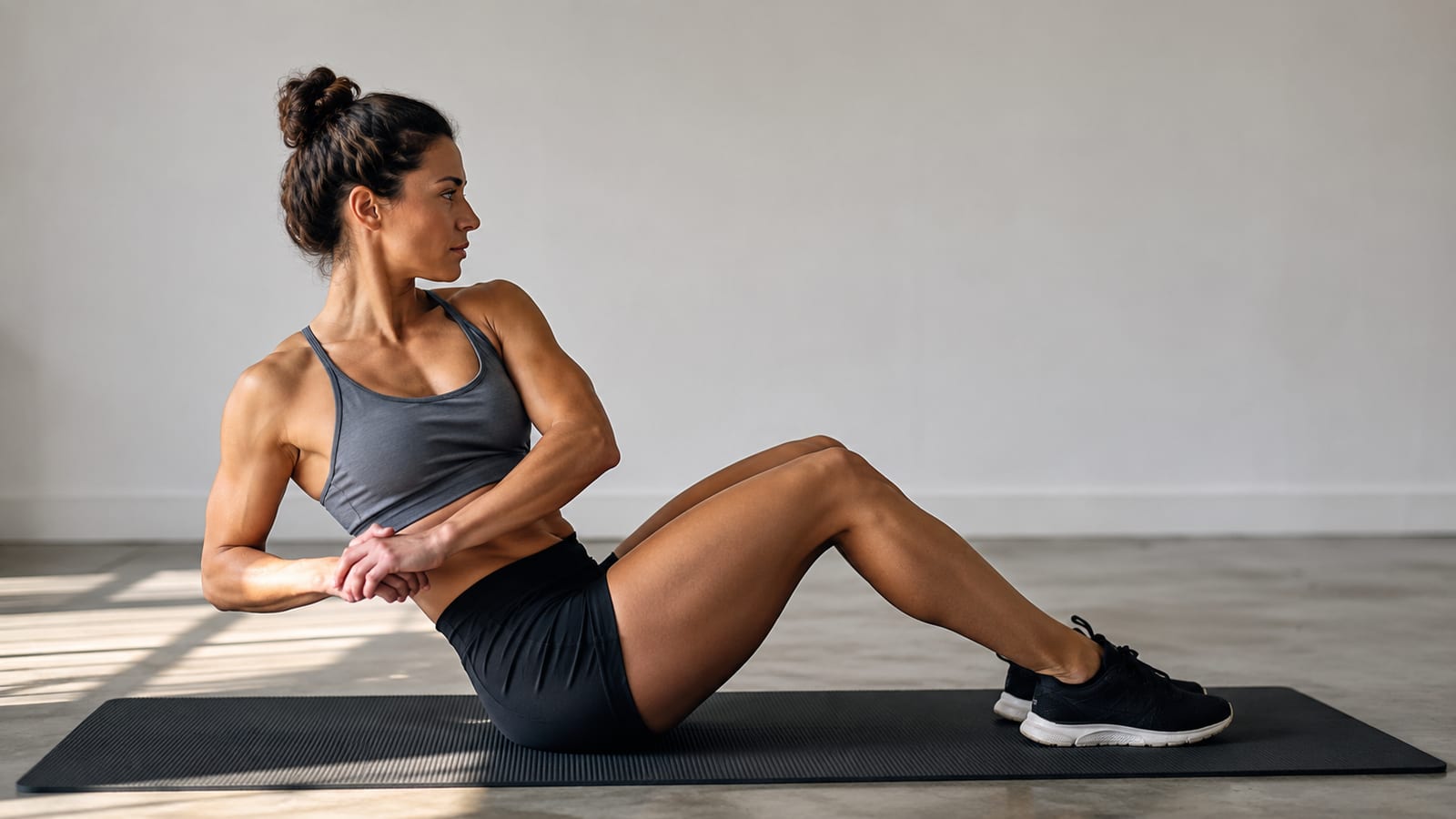
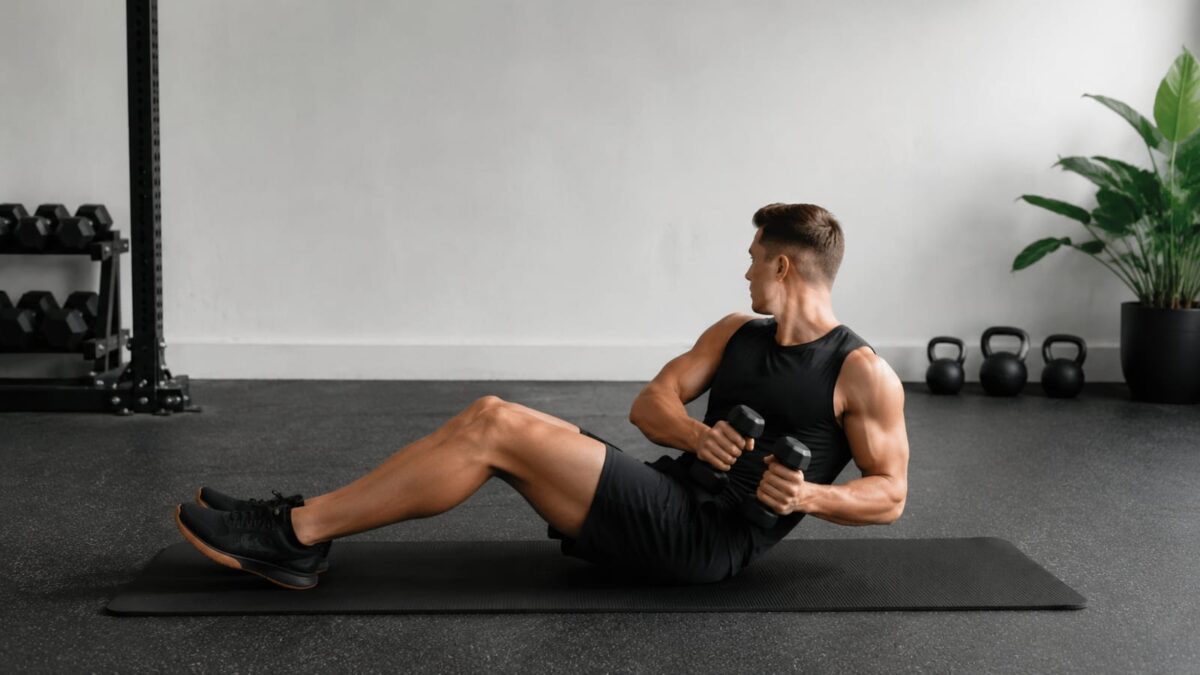
The Russian twist should look simple from the outside. The hard part is keeping the pelvis, ribs, and shoulders under control while you rotate.
For the unweighted Russian twist described here, the required equipment is a Stability Ball. Use it to support the movement setup, then choose a range that lets you keep your trunk steady. If you’re using a floor-based version, treat that as a variation and keep the same control standards.
- Sit with your torso tall and your feet planted firmly.
- Brace your abs as if you’re preparing for a light punch.
- Lean back slightly while keeping your chest open and your lower back controlled.
- Hold your hands together or use a light object.
- Rotate your torso to one side, moving the weight across your body in a controlled arc.
- Rotate back through center and continue to the opposite side in a smooth, continuous motion.
- Keep your feet stable unless the elevated-leg version is already easy and controlled.
- Exhale during the twist and inhale while returning to the center.
Move slowly enough to see whether your ribs, pelvis, and shoulders stay organized. Your hands should follow the torso. They shouldn’t swing first and drag your trunk after them.
Use a repeatable range of motion. Touching the floor on each side isn’t required if doing so forces your back to round or your shoulders to reach. Stop the turn before your position changes.
Start with a modest amount of controlled work. Leave a few clean reps in reserve, then record the variation and load in your logbook. The set counts only if the last reps look like the first ones.
Protecting your back
Most back problems with Russian twists come from losing position and forcing range. The answer isn’t to grit through it. Fix the setup or choose another exercise.
Keep your pelvis steady and your ribs stacked over it. A slight lean is fine, but don’t fold into a deep rounded position as fatigue builds. Your lower back shouldn’t be doing all the movement.
Make these adjustments before adding load:
- Keep both feet down for more stability.
- Reduce the amount you turn.
- Hold no weight until control is reliable.
- Move through a slower arc.
- Keep the object close to your chest.
- Stop the set when your hips shift or your back rounds.
- Use a lighter variation after a hard leg or back workout.
Your joints get a vote. If the exercise causes sharp pain, spreading symptoms, or back irritation that lasts after training, stop it. Muscle effort is acceptable. Pain that changes your movement is a clear reason to change the plan.
A dead bug, side plank, Pallof press, or carry may train your trunk better with less irritation. The right exercise is the one that lets you train with intent and come back ready for the next session.
Mistakes that waste the set
Rushing is the most common mistake. Fast reps hide poor control and turn the movement into momentum. Slow down until you can tell what your trunk is doing.
Yanking with the arms causes the same problem. Your hands may travel far, but your torso may barely rotate. Keep the load close and let your chest and ribs lead.
Collapsing through the lower back is another common error. It often appears after the abs fatigue. End the set there instead of trying to rescue it with more speed.
Watch for these breakdowns:
- Twisting farther than your hips and back can control
- Using a weight that pulls you out of position
- Letting your feet slide or bounce
- Treating a deep burn as proof of good technique
- Chasing more reps after your range starts shrinking
- Turning every set into a test of suffering
A fatigued muscle doesn’t prove that the target muscle did useful work. Check your position, breathing, and tempo first. If those fail, the set is finished.
Bodyweight and weighted variations
Start with the easiest version that allows clean rotation. More load doesn’t automatically mean more abdominal progress.
| Variation | Best use | Clear judgment |
|---|---|---|
| Feet-down bodyweight | Learning the movement | Best starting point for most people |
| Feet-elevated bodyweight | Adding balance and bracing demand | Use only after the feet-down version is stable |
| Plate or dumbbell | Measurable resistance | Keep the load light and close |
| Medicine ball | Smooth, easy-to-hold resistance | Useful if it doesn’t encourage throwing |
| Cable rotation | Adjustable resistance and standing control | Often a better choice for controlled rotational work |
The feet-down bodyweight version gives you the most room to learn. Keep it if you’re still losing balance or rounding your back.
Feet-elevated twists make the position harder, but they also increase the chance that your hip flexors take over. Don’t use them just because they look advanced. A controlled feet-down set beats a shaky elevated set.
A plate, dumbbell, or medicine ball gives you a simple way to track resistance. Hold it close to your chest first. Moving it farther away increases the challenge without changing the number on the weight.
Cable rotations can offer more consistent resistance through the turn. They’re a strong alternative if the seated twist bothers your back or feels difficult to measure.
For a broader comparison of loading choices, see this guide to weighted ab training.
Progress without punishment
Progress in a fixed order. Make the movement better before you make it harder.
- Master the feet-down, bodyweight version.
- Add controlled reps within your chosen range.
- Improve your tempo and range without losing position.
- Raise the feet only if your pelvis stays steady.
- Add a small amount of load.
- Build the same clean reps before adding more resistance.
Change one variable at a time. If you add weight and speed at once, your logbook won’t tell you what improved.
Keep the object close to your body until the basic version is easy. Then move it slightly farther away if your technique stays repeatable. That changes the mechanical advantage without forcing a large jump in load.
Stop progression when your lower back, hips, or breathing takes over. Return to the last version you could control and earn the next increase there.
Placement in a simple abs routine
Put Russian twists after your main core work. They’re an accessory, so they shouldn’t drain the trunk before heavy lifting or demanding carries.
Build a simple abs routine with:
- A flexion movement, such as a controlled reverse crunch
- An anti-extension movement, such as a dead bug or rollout regression
- An anti-rotation movement, such as a Pallof press
- A carry or side plank
- Russian twists as optional finishing work
Train your abs often enough to improve, but keep the plan recoverable. You don’t need a long circuit full of similar movements. A few focused exercises will beat a crowded routine you skip or rush.
If your Russian twist in your abs workout leaves your back tired before the rest of your training, move it later or remove it. If it gives you controlled rotational work without disrupting recovery, keep it.
Your routine should fit your week. The minimum effective dose is better than a perfect plan you cannot repeat.
Reasons to skip the movement
Skip Russian twists if they cause pain, worsen an active back irritation, or make you lose control before the set is done. You don’t need to force a movement that your joints clearly reject.
Choose another exercise if you cannot keep your pelvis stable. Also skip the movement for now if you need to swing your arms, bounce your feet, or rush the turn to finish the set.
Use the substitution that solves the actual problem:
- Dead bugs if you need to learn abdominal bracing
- Side planks if you need lateral trunk endurance
- Pallof presses if you want anti-rotation without repeated twisting
- Carries if you want full-body bracing under a simple load
- Cable rotations if you want more controlled rotational resistance
The Russian twist in your abs workout is optional. Your core can get stronger without it, and many lifters will progress faster by mastering simpler patterns first.
If you return to the exercise, start with the easiest version and test your control. Pain-free, repeatable technique earns the next step.
FAQ
Can Russian twists replace planks?
No. Planks train you to hold a stable trunk, while Russian twists add rotation. Pick the exercise that addresses your weak point, or use both in separate slots.
Should you do Russian twists before squats or deadlifts?
Usually not. Save your best bracing for the heavy compound lift instead of tiring your trunk first. Put Russian twists afterward or on a separate core-focused day.
Why does one side feel stronger during Russian twists?
Uneven hip position, shoulder reach, or trunk control can make one side take over. Cut the range and slow each rep until both sides match. If the difference stays large or causes pain, switch to a supported anti-rotation exercise.
Can Russian twists improve sports performance?
They can help you control trunk rotation, but they don’t replace practice or basic strength work. Keep them only if they support your sport training without adding fatigue that gets in the way.
Related on this blog