Plyometrics vs Isometrics: The Key Difference

 0
0
 0
0 False. Plyometrics are not isometric exercises. Plyometrics use a rapid stretch-shortening cycle, where an eccentric action is followed quickly by a powerful concentric action. Isometric exercises produce force while the muscle length and joint angle stay nearly unchanged. The two methods can both improve strength qualities, but they train different actions.
Is plyometrics an isometric exercise?
No. Plyometrics are dynamic and explosive, while isometric training holds a position or pushes against an object that does not move.
The confusion usually comes from the brief pause between landing and takeoff. That pause may be short enough to look static, but your joints and muscles are still absorbing, storing, and redirecting force. A moment of reduced movement does not turn a jump into an isometric exercise.
Plyometrics are built around speed. Isometrics are built around force production without meaningful movement.
What is an isometric exercise?
An isometric exercise develops tension while the muscle length and joint angle remain nearly unchanged. You produce force, but the resistance does not move through a normal range of motion.
Common examples include:
- Planks
- Wall sits
- Paused holds in a squat or split squat
- Holding the top of a pull-up
- Pushing against an immovable bar or rack
- Paused overcoming holds
A plank challenges your trunk muscles while your spine and hips stay in a fixed position. A wall sit does the same for your legs. An overcoming hold asks you to push or pull as hard as possible against an object that cannot move.
Isometric training can help you build strength at a specific joint position. However, that strength may not transfer equally through your entire range of motion. Your body gets good at the position you train.
You can read more about applying static tension in isometric bicep curls. Keep the effort controlled, choose a position that makes sense, and give your joints a reason to tolerate the work.
What is a plyometric exercise?
A plyometric exercise is a fast movement that uses an eccentric loading phase followed quickly by a concentric action. The eccentric phase lengthens the working muscles while they absorb force. The concentric phase then produces force to jump, bound, throw, or rebound.
Examples include:
- Squat jumps
- Countermovement jumps
- Box jumps
- Depth jumps
- Bounding
- Hops
- Skater jumps
- Medicine-ball throws
- Explosive push-ups
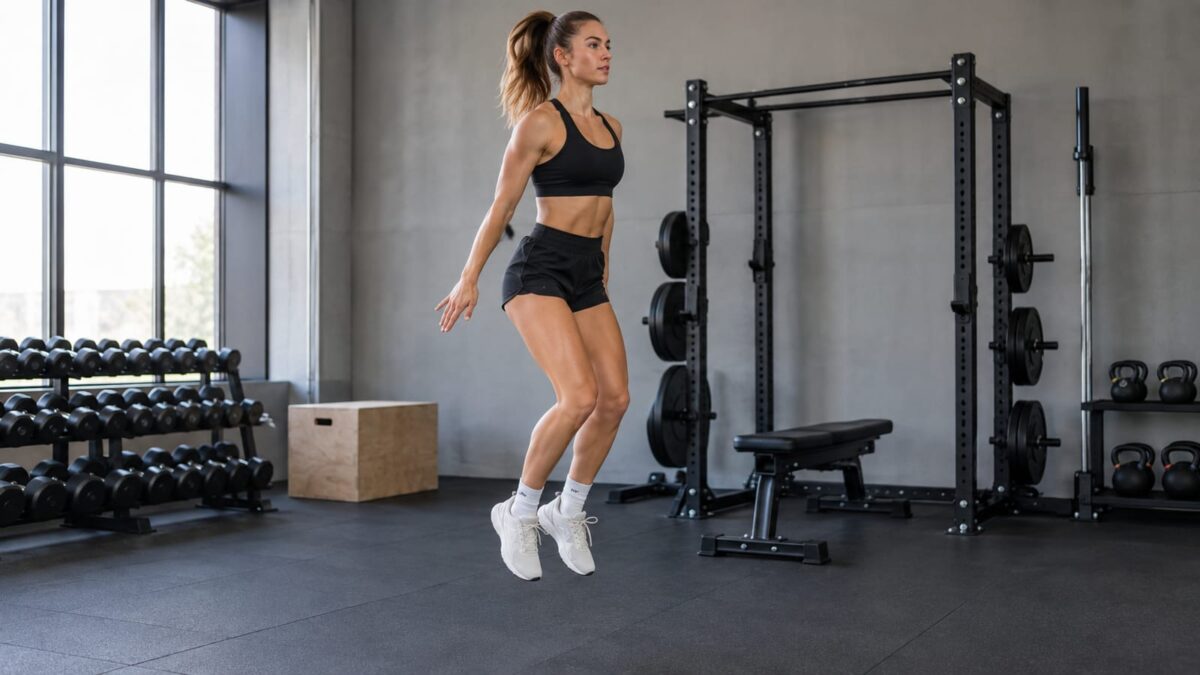
A countermovement jump shows the pattern clearly. You dip down, load the legs, and reverse direction into takeoff. The movement depends on timing, coordination, and fast force production.
A published depth-jump protocol described by Dr. Natalia Verkhoshansky used a 75 cm drop height. That is a specific depth-jump protocol, not a sensible starting point for everyone. Depth jumps create high landing forces and demand more control than ordinary jumps.
Start with a jump you can land quietly and repeat. Height comes later.
How do muscle length and joint angle separate the two techniques?
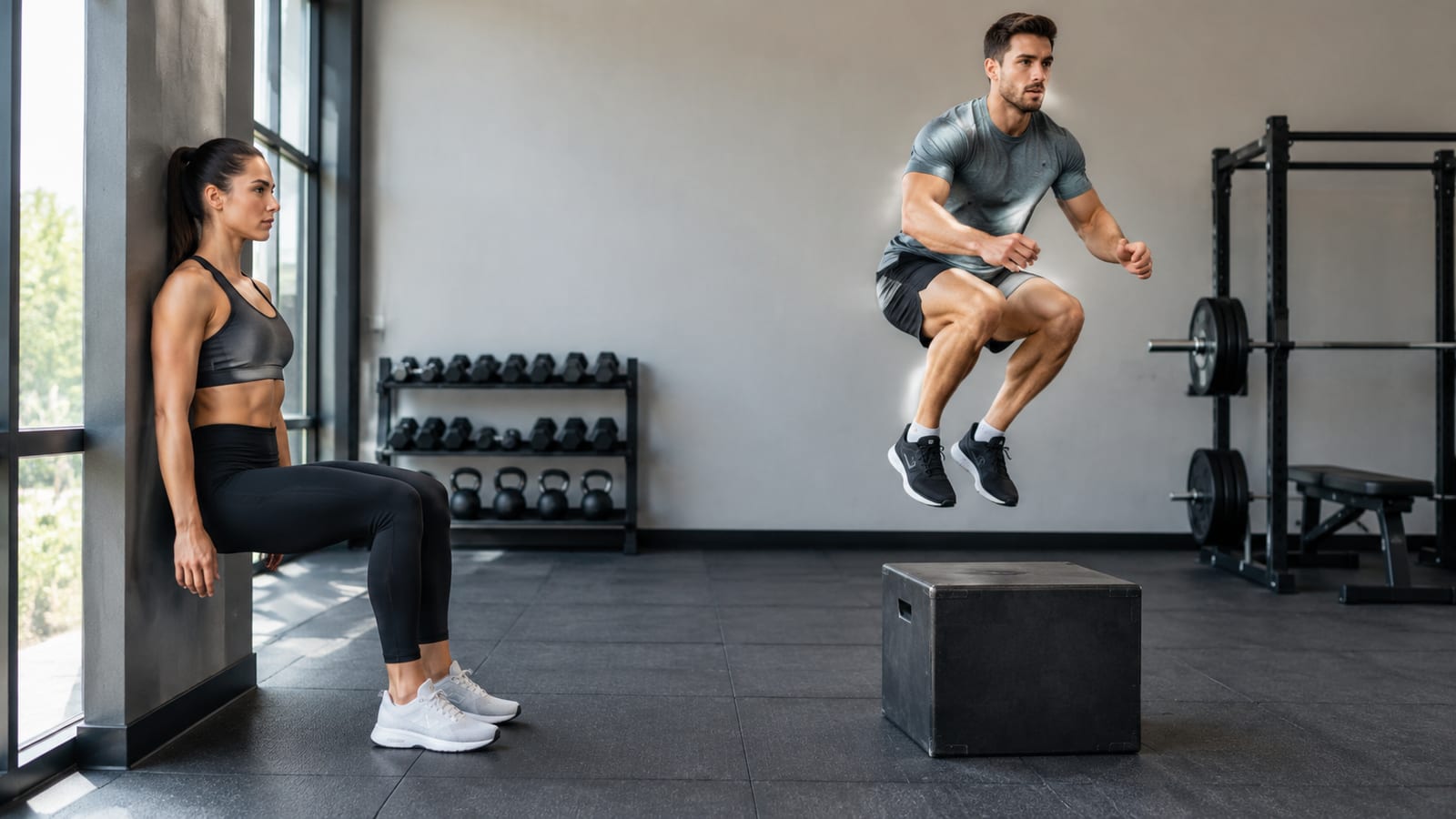
Isometric exercises limit visible joint movement. Your muscles still create tension, and small changes can occur under load, but the goal is to hold the position rather than travel through it.
Plyometrics deliberately change joint angles and muscle lengths. Your ankles, knees, hips, shoulders, or elbows move as you absorb and produce force.
| Feature | Isometric exercise | Plyometric exercise |
|---|---|---|
| Main action | Force without meaningful movement | Fast eccentric action into concentric action |
| Joint angle | Held near one position | Changes rapidly |
| Muscle length | Stays nearly fixed | Changes during loading and takeoff |
| Main quality | Static strength and position control | Explosiveness, timing, and rapid force |
| Examples | Plank, wall sit, overcoming hold | Jump, hop, bound, medicine-ball throw |
| Main risk | Fatigue at the trained position | Poor landings, excessive impact, rushed volume |
This distinction matters for exercise selection. Use an isometric when you need position-specific strength or a controlled way to train around a painful range. Use a plyometric when you need to practice producing and absorbing force quickly.
Neither method earns extra credit for feeling miserable.
How do eccentric and concentric contractions drive plyometrics?
The eccentric phase starts the job. Your muscles lengthen while braking your body or an object. In a jump, the legs absorb force as you dip and prepare to reverse direction.
The concentric phase follows. Your muscles shorten as you push into the ground, leave the floor, or launch the medicine ball.
The faster and cleaner that transition becomes, the more useful the movement is for power. However, speed without control is just a bad landing performed quickly.
You need three things:
- A controlled loading phase. Absorb force through the hips, knees, and ankles without collapsing.
- A short transition. Reverse direction without sinking into a long pause.
- A forceful finish. Jump, throw, or push with intent while keeping the movement organized.
A deep, slow squat followed by a lazy jump is not automatically good plyometric training. The transition must be fast enough to match the goal, and your technique must survive the speed.
Warm up before explosive work with warm-up sets for better performance. Use simpler jumps first, then move to harder variations only when your landings stay quiet and repeatable.
Can plyometrics improve rate of force development?
Yes. Plyometrics can improve your rate of force development, which means your ability to produce force quickly. That quality matters when you need to jump, sprint, change direction, or move a load fast.
Strength gives you a larger force base. Plyometrics teach you to access that force under time pressure. A stronger muscle is useful, but it still has to act quickly when the ground is moving under you.
The best progression keeps the movement simple:
- Start with low-impact jumps, hops, or medicine-ball throws.
- Use a height and distance that let you land or release the implement under control.
- Keep each repetition crisp.
- Stop when jump height, distance, or landing quality drops.
- Record a basic result, such as jump height or completed quality repetitions.
- Progress one variable at a time.
You can add a little height, distance, speed, or complexity after your current version looks the same from start to finish. Do not increase all of them together.
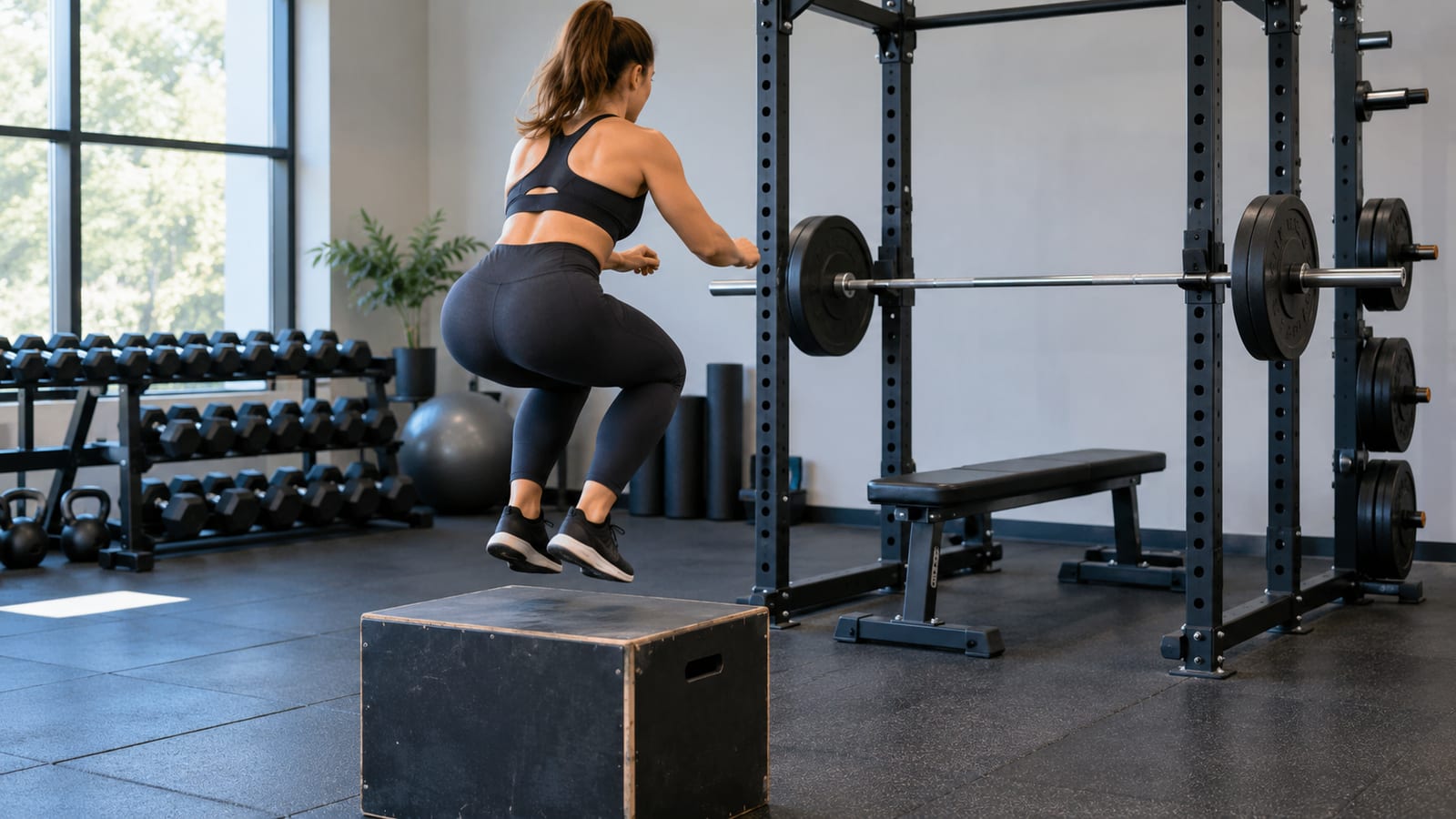
A box jump can hide a weak jump because the box gives you a higher landing target. Jumping onto a taller box does not always mean you produced more force. Sometimes you simply pulled your knees higher. Start low: in Does Box Height Matter?, a study of 31 recreationally active college students by dos Santos and colleagues, the warm-up was two sets of five submaximal countermovement jumps onto 6-inch (15.24 cm) and 12-inch (30.48 cm) boxes. Those were warm-up heights, not the heights the study tested.
Use the simplest measure that matches your goal. If the logbook shows lower jumps and rougher landings, reduce the dose and recover before adding more.
Does tendon stiffness support plyometric force transfer?
Tendons connect muscle to bone and help transmit force across a joint. During fast movements, they can store and release energy as part of the stretch-shortening cycle.
Plyometric loading can improve how efficiently that system handles force. A stiffer tendon can transmit force quickly, while the muscle contributes active force and control. Still, tendon stiffness is not a score you should chase with endless jumping.
The useful question is whether your movement improves. Can you land with control, reverse direction faster, or produce the same jump with less wasted motion? Those changes matter more than repeating the word “stiffness” in a program description.
Your tendons also need time to adapt. Sudden increases in jumping, sprinting, or depth-jump work can irritate the ankles, knees, feet, or Achilles tendon. Your joints get a vote, especially when the surface is hard or your lower-body strength is limited.
Skip advanced rebound work if you cannot control basic landings. Build capacity with strength training, low-impact jumps, and sensible exposure before adding more impact.
How should a natural lifter use plyometrics?
Use repeatable strength basics for your main progress. Add a small, recoverable dose of plyometrics when you need power, faster movement, or better athletic coordination.
A practical session can follow this order:
- Warm up with easy movement and specific practice.
- Perform a few crisp jumps, hops, or throws.
- Complete your main strength exercises.
- Record the variation, result, and how your landings felt.
- Leave enough recovery before repeating hard impact work.
Plyometrics usually belong early in a session because speed drops as fatigue builds. Heavy squats, deadlifts, and presses can wait until after explosive practice.
Keep the exercise matched to your goal:
- For general power: Use jumps or medicine-ball throws you can repeat cleanly.
- For upper-body explosiveness: Use medicine-ball throws or explosive push-up variations.
- For landing control: Use low-height jumps and stick the landing.
- For static strength: Use planks, wall sits, or position-specific holds.
- For strength through a weak joint angle: Use an isometric hold at that position.
- For muscle growth: Keep progressive resistance training as the foundation.
Plyometrics are dynamic. The claim that plyometrics is an isometric exercise confuses a fast movement with a static contraction.
Choose the tool that matches the quality you need. Use isometrics for controlled tension at a position, and use plyometrics for fast force production. Simple on paper, demanding in practice.
What are the main plyometric trade-offs?
Plyometrics can improve speed and power, but they cost more coordination and impact tolerance than ordinary strength work.
The main benefits are:
- Faster force production
- Better jumping and throwing ability
- Improved braking and landing practice
- More efficient use of the stretch-shortening cycle
- A useful bridge between strength and sport movement
The main costs are just as clear:
- More stress on feet, ankles, knees, and tendons
- Greater need for sound technique
- Faster fatigue when the movement is intense
- Less room for sloppy volume
- Limited value if your basic strength and movement control are poor
Do not add plyometrics because a program labels them advanced. Add them because they solve a problem in your training.
If your goal is muscle gain, keep your productive strength work, food, sleep, and progression in place first. If your goal is power, add explosive work that you can measure and recover from. If your joints stay sore or your performance falls, the dose is too high.
FAQ
Can an isometric exercise become plyometric?
No. Holding a position remains isometric, even if the hold is difficult. It becomes plyometric only when you add a rapid eccentric-to-concentric movement, such as dipping and jumping.
Are plyometrics useful for beginners?
Beginners can use simple plyometrics after learning basic landing mechanics. Start with low-impact jumps, small hops, or medicine-ball throws before attempting depth jumps or complex bounds.
Should you do plyometrics before or after weight training?
Do plyometrics before demanding weight training if power is the main goal. Speed and coordination decline with fatigue, so heavy lifting first can turn explosive work into slow, poorly controlled repetitions.
Can plyometrics replace strength training?
No. Plyometrics train rapid force and coordination, but they do not replace a steady plan of squats, presses, pulls, hinges, and other strength movements. Build the force base, then teach yourself to use it quickly.
Are explosive push-ups plyometric exercises?
They can be, if your hands leave the floor and the movement includes a rapid loading and pushing phase. A slow push-up with a hard pause is closer to standard resistance work with an isometric pause.
Related on this blog