The Best Dumbbell Leg Workout: 4 Moves, Sets and Reps

 0
0
 0
0 A simple dumbbell leg workout built around squats, hinges, split-leg work, and calf raises is the best choice for most natural lifters with limited time. Train hard with clean technique, add weight or reps gradually, eat enough to support growth, and recover between sessions. You don’t need a circus of exercises to build strong legs. You need productive sets you can repeat and improve.
What is the best dumbbell leg workout?
Use this full-leg session once or twice each week:
| Exercise | Sets | Reps | Rest |
|---|---|---|---|
| Dumbbell goblet squat | 3 | 8-12 | About 2 minutes |
| Dumbbell Romanian deadlift | 3 | 8-12 | About 2 minutes |
| Dumbbell Bulgarian split squat | 2 | 8-12 per leg | About 90 seconds |
| Dumbbell calf raise | 3 | 10-20 | About 60-90 seconds |
This dumbbell leg workout should fit into a focused session when you train with intent. Use a load that leaves 1 to 3 clean reps in reserve on most sets.
Start with the goblet squat and Romanian deadlift while your legs and trunk are fresh. Then use the Bulgarian split squat for single-leg strength. Finish with controlled calf raises.
A pair of dumbbells and a little clear floor are enough to train every major muscle in your legs. That makes this plan useful at home, in a small gym, or during a busy week.
The major leg muscles this workout trains
The workout covers the main muscles that produce lower-body strength:
- Quadriceps: Straighten your knee during squats and split squats.
- Hamstrings: Extend your hips and control the lowering phase of Romanian deadlifts.
- Glutes: Drive hip extension during squats, hinges, and single-leg work.
- Adductors: Help pull your legs together and stabilize your pelvis during squats and split squats.
- Calves: Push your body away from the floor during calf raises and help control your ankle.
- Trunk muscles: Keep your ribs, pelvis, and spine stable while you hold the dumbbells.
The goblet squat gives your quads and glutes a clear starting point. The Romanian deadlift shifts more work toward the hamstrings and glutes. The split squat adds a single-leg demand that exposes balance and strength differences.
Your trunk also works throughout the session. Holding dumbbells creates a stability demand, but it does not turn the workout into a direct abdominal routine. Add separate trunk work if that is one of your goals.
For more hamstring exercise options, see this guide to hamstring exercises. Keep the extra work separate from this session unless your recovery supports it.
The core dumbbell leg exercises
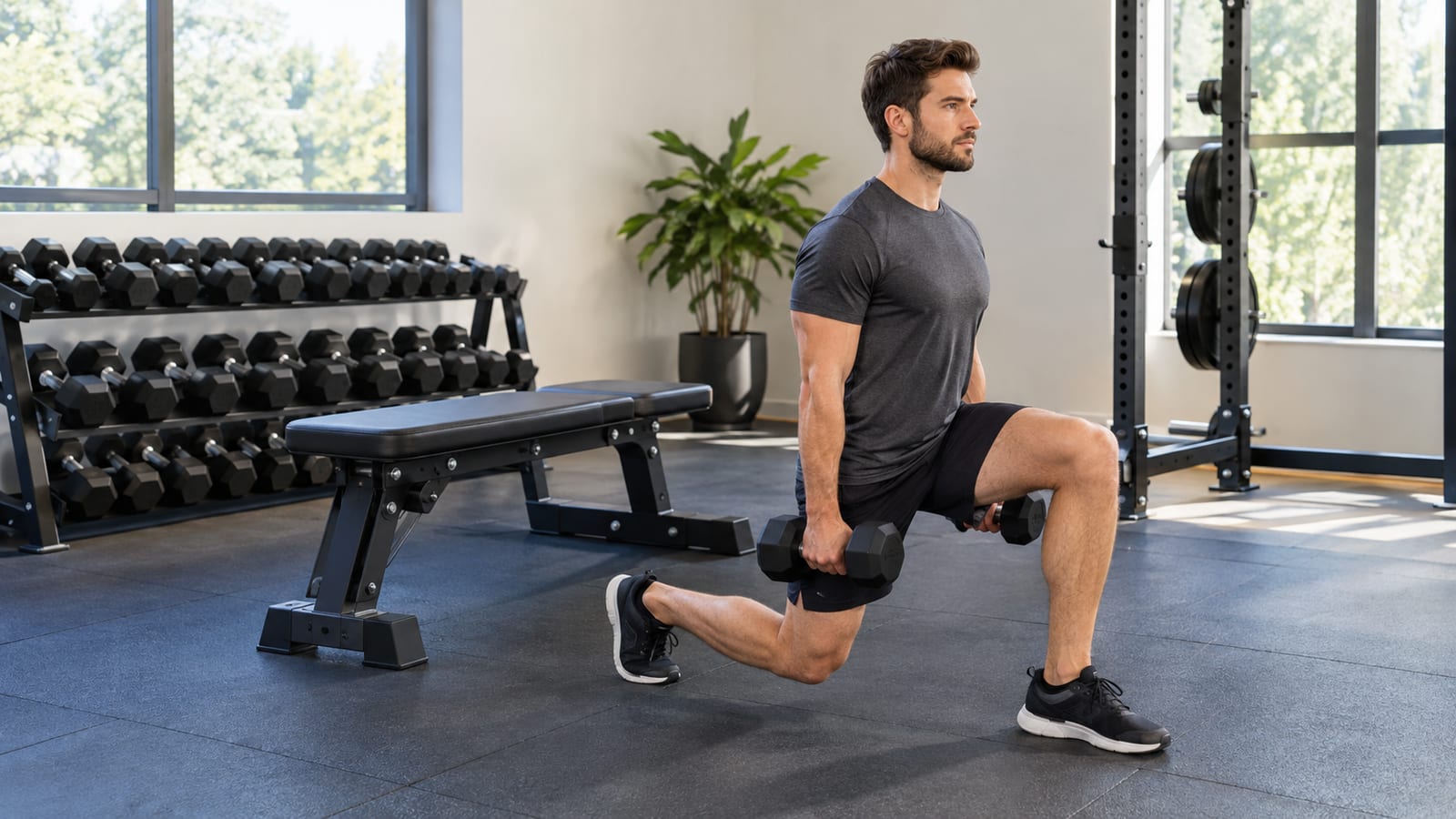
You don’t need every variation in one workout. Each exercise below has a job. Use the right one, then give it enough time to improve.
Dumbbell goblet squat
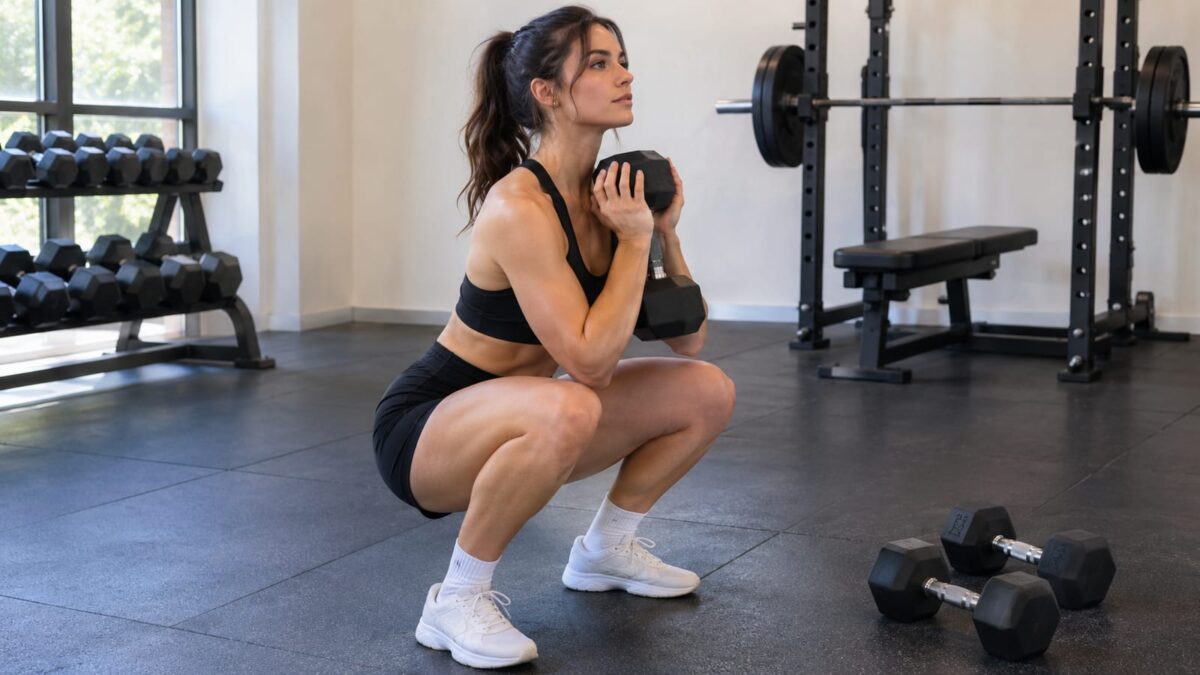
Hold one dumbbell against your chest with both hands. Sit down between your hips while keeping your whole foot connected to the floor.
The goblet squat is the best beginner-friendly squat pattern for most people. The front-loaded position makes depth and torso control easier to learn. It also gives you a simple way to train the quads and glutes without managing a barbell.
Use the deepest range you can control without your heels lifting or your lower back losing position. If the dumbbell becomes too light, slow the lowering phase or move to a heavier squat variation. Don’t turn every set into a balance drill by using an unstable stance.
Dumbbell Romanian deadlift
Hold the dumbbells near your thighs. Push your hips back while keeping the weights close to your legs, then stand by driving your hips forward.
The dumbbell Romanian deadlift is the essential hinge for loading the hamstrings and glutes. Your knees should bend slightly, but they should not keep moving forward like a squat.
Stop the descent when your hamstrings are loaded and your back position is still stable. A deeper stretch is useful only if you can control it. The floor is not the target. Tension and repeatable technique are the target.
Dumbbell Bulgarian split squat
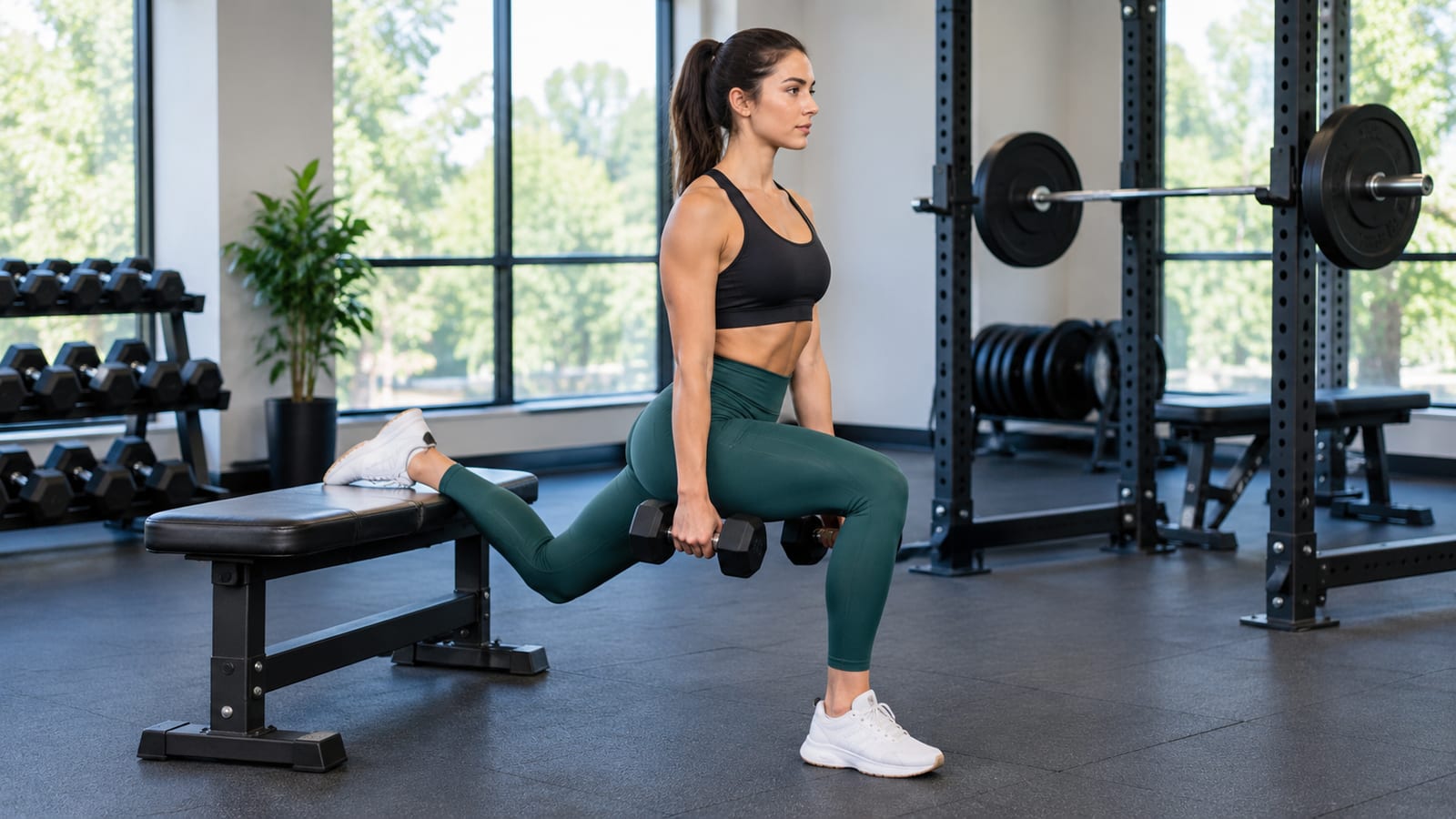
Place your rear foot on a stable bench or platform. Keep most of your pressure through the front foot and lower under control.
The Bulgarian split squat is the strongest unilateral choice for building each-leg strength, balance, mobility, and substantial quad and glute development. It also makes weak positioning obvious. That is useful, but it can make the exercise demanding.
Start with body weight or light dumbbells until your front foot stays planted. Keep your front knee tracking in line with your toes. If balance limits the set before your leg does, hold onto a rack with one hand.
Dumbbell reverse lunge
Step backward, lower your rear knee toward the floor, and push through the front foot to return. Alternate legs or finish one side at a time.
The reverse lunge trains the quads and glutes with less forward momentum than a forward lunge. Many lifters also find it easier on the knees and balance. That makes it a practical single-leg exercise for home training.
Use it instead of the Bulgarian split squat if the rear-foot position bothers you. You can also use it in a second weekly session to change the balance demand without changing the main goal.
Dumbbell step-up
Place one foot on a stable step or box. Drive through that foot until you stand tall, then lower under control.
The step-up trains single-leg force production, balance, coordination, and work capacity. It has useful carryover to stairs, hills, and other tasks that require you to produce force from one leg.
However, it should follow squats and hinges rather than replace them for most lifters. Choose a step height that lets you keep control. A high box does not make the exercise more athletic if you have to jump off the floor or twist your hips.
A box step-up format can use three sets of 20 repetitions, with 10 on each leg. That format belongs to the step-up itself. Don’t copy it automatically if your balance or conditioning breaks down first.
Dumbbell sumo squat
Take a wider stance and turn your toes out slightly. Hold one dumbbell between your legs and squat while keeping your knees in line with your toes.
The sumo squat is a worthwhile secondary variation for the glutes, adductors, and inner-thigh strength. It is useful after your basic squat is already progressing.
Don’t force a wide stance because it looks more advanced. Your hips, knees, and feet should agree with the position. If your knees collapse inward or your feet lose contact, narrow the stance and rebuild control.
Dumbbell calf raise
Hold dumbbells at your sides and rise onto the balls of your feet. Pause at the top, lower under control, and allow your heels to drop through a comfortable range.
The dumbbell calf raise is the simplest direct way to train the gastrocnemius and soleus. Use a stable surface if you want a longer range of motion, but don’t chase a deep stretch that makes your ankle unstable.
Calf training rewards consistency. Keep the movement slow enough that your calves do the work instead of bouncing through the bottom.
Warm up before dumbbell leg training
A warm-up should prepare you to lift. It should not become a second leg workout.
Use this sequence:
- Walk, cycle, or perform another easy full-body movement until you feel warmer.
- Perform controlled bodyweight squats, hip hinges, and alternating reverse lunges.
- Move your ankles through comfortable knee-over-toe positions.
- Complete lighter practice sets for the goblet squat and Romanian deadlift.
- Add load only when your range of motion and balance feel consistent.
The first few repetitions should tell you how your joints and muscles feel that day. If your squat depth suddenly feels restricted, reduce the load and investigate your stance, ankle movement, or fatigue.
Skip long, tiring stretches before heavy work. Readiness comes from movement and gradual loading. It doesn’t come from exhausting the muscles before the first working set.
How to perform each exercise safely
Good technique starts with pressure through the foot. Keep the heel, base of the big toe, and base of the little toe connected to the floor when the exercise allows it.
Brace your trunk before each demanding repetition. Think about keeping your ribs stacked over your pelvis rather than flaring your chest or overextending your lower back.
Use these standards:
- Squat: Keep your knees tracking with your toes. Lower as far as your balance and spine position allow.
- Romanian deadlift: Push your hips back. Keep the dumbbells close and stop before your back rounds.
- Split squat: Keep pressure through the front foot. Let the front knee move naturally instead of forcing it behind the toes.
- Lunge: Step far enough to keep control. Push through the front leg without rushing the return.
- Step-up: Put the whole working foot on the platform. Avoid jumping from the trailing leg.
- Calf raise: Pause at the top and lower through a controlled range.
Use a steady tempo, especially during the lowering phase. You don’t need to count every second. You do need to avoid dropping, bouncing, or changing position halfway through a rep.
Pain that changes your movement deserves attention. Reduce the range or load first. If the problem remains, choose another variation and get professional advice when needed.
Unilateral exercises for each leg
Single-leg exercises reveal differences that two-leg movements can hide. One side may balance poorly, lose pressure through the foot, or finish several clean reps before the other.
Start each set with the weaker side. Match that side on the stronger side, even if it could do more. Otherwise, you keep rewarding the imbalance.
Use these choices:
- Bulgarian split squat: Best for high tension and substantial quad and glute work.
- Reverse lunge: Best for a simpler setup and controlled stepping pattern.
- Step-up: Best for single-leg force production, coordination, and practical balance.
Single-leg work also builds local endurance. That matters during long walks, stairs, sport, and tasks that shift your weight from one side to the other.
Still, unilateral exercises demand more balance and concentration. If your trunk twists before your leg works hard, hold onto support or reduce the dumbbell weight. Stability is part of the exercise, but it should not hide the target muscle.
How to progress dumbbell weights as a beginner
Use double progression. Pick a rep range, keep the same weight, and add reps before adding load.
For example, use 8 to 12 reps on the goblet squat. Stay with the same dumbbell until you can complete the top of the range on every set with stable technique and 1 to 2 reps in reserve. Then add the smallest practical amount and build the reps again.
Follow these rules:
- Record the exercise, load, reps, and any technique problem.
- Add a rep when the previous performance was controlled.
- Add weight only after you reach the top of the range across your sets.
- Reduce the load if your depth, balance, or bracing changes.
- Change one variable at a time.
Dumbbells often jump in large increments. If the next pair is too heavy, add reps, improve control, or use a longer range of motion first. You can also add a set later, but only if your progress has stalled and your recovery is still good.
Your goal is to earn the next increase. More weight is useful only when the target muscles and movement pattern remain under control.
Training effort, recovery, and food
Train most working sets with 1 to 3 reps in reserve. Stop when you could complete only a small number of clean reps before your technique breaks down.
You can occasionally take the final set of calf raises or another stable isolation exercise close to failure. Routine failure on split squats, Romanian deadlifts, and squats creates fatigue quickly. The last ugly rep usually costs more than it gives back.
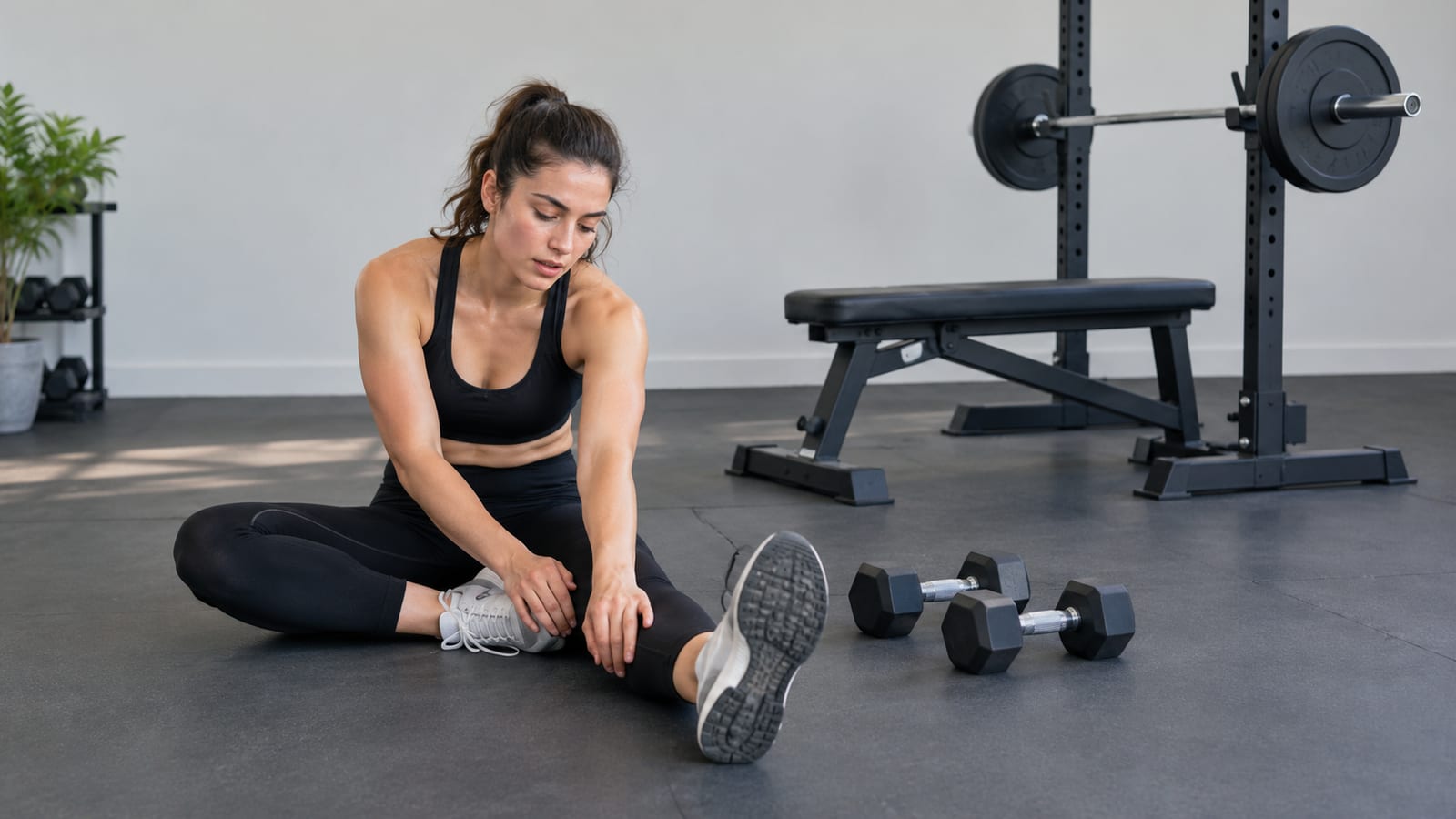
Rest between lower-body sessions so your performance can recover. If your legs still feel weak, sore, or uncoordinated when the next session arrives, reduce the work or add another recovery day.
Sleep adequately and eat enough total food. Protein supports muscle repair, while carbohydrates can help you train with better effort. No meal can rescue a program that gives you too much work and too little recovery.
The Physical Activity Guidelines for Americans support regular muscle-strengthening activity as part of a complete health plan. For building stronger legs, the useful test is simpler: your reps should improve over time, and you should return ready to train.
How dumbbell leg training improves strength and athletic performance
Dumbbell leg training improves force production because you must move your body and the external load through a controlled range. Squats train force from a stable two-leg position. Split squats and lunges add balance and coordination under load.
The training also improves deceleration. Lowering into a squat, catching the bottom of a lunge, and controlling a step-down all require you to absorb force without collapsing.
That does not make a dumbbell workout a replacement for every sport drill. Athletic performance also depends on speed, skill, practice, and the demands of your sport. A slow split squat will not teach sprint mechanics by itself.
It will still build useful strength, balance, and work capacity. Those qualities support stairs, lifting objects, hiking, carrying bags, and changing direction in daily life. Build the base first, then add specific practice if your activity demands it.
Common dumbbell leg-training mistakes
Using too many exercises
A long list creates fatigue and makes progression harder to track. Start with one squat, one hinge, one unilateral exercise, and calves.
Add variety only when the current plan stops serving its purpose. Your logbook should show progress before you earn more complexity.
Taking every set to failure
Failure training feels productive because it is uncomfortable. That does not make it the best default.
Keep most sets close to failure without reaching it. Leave a small number of quality reps in reserve, especially on movements that challenge your balance and trunk.
Rushing repetitions
Fast repetitions often hide poor control and shortened range of motion. Lower the weight if you cannot pause briefly in the positions that matter.
Your joints get a vote. If speed makes your knees cave, your back round, or your feet shift, the set has already become too heavy.
Using poor range of motion
A shallow squat may be useful in a specific situation, but cutting every rep short avoids the hardest part of the movement. Use the deepest range you can control.
For Romanian deadlifts, forcing the dumbbells toward the floor creates a different problem. Stop when your hamstrings are loaded and your back position stays reliable.
Loading one side unevenly
Holding a dumbbell only on one side can train the trunk, but it changes the exercise. Use symmetrical loading for the main workout unless the uneven position has a clear purpose.
For single-leg movements, the working leg should still do most of the work. Don’t push off the floor with the trailing leg during lunges or step-ups.
Progressing without recovery
Adding weight while your reps and technique worsen is not progress. Check sleep, food, stress, and session spacing before adding more work.
Sometimes the correct move is to repeat the same load. Sometimes it is to reduce the load briefly and rebuild. The plan has to fit your week.
A simple weekly schedule
Train the workout once weekly if you already perform several lower-body exercises elsewhere. Place it after a rest day or an easier training day when possible.
For twice-weekly dumbbell leg training, use a heavier and lighter emphasis:
| Day | Main work |
|---|---|
| Monday | Goblet squat, Romanian deadlift, Bulgarian split squat, calf raise |
| Thursday or Friday | Sumo squat, reverse lunge or step-up, Romanian deadlift, calf raise |
Keep the second session slightly easier if the first session leaves you highly fatigued. You can use fewer sets, lighter dumbbells, or a different unilateral exercise.
If you follow a push-pull-legs plan, place the workout on your leg day and keep the other lower-body work focused. This push-pull-legs workout routine can help you organize the rest of your week without adding random exercises.
If your schedule changes often, train the session whenever you have enough recovery since the last hard leg workout. Consistency matters more than a perfect weekday.
FAQ
Can dumbbells build leg muscle without a barbell?
Yes. Dumbbells can provide enough resistance for squats, hinges, split squats, lunges, step-ups, and calf raises. The main limit is often the dumbbell load you can hold, not the exercise itself.
Use single-leg exercises when two dumbbells become too light for a two-leg movement. Keep adding reps, load, or controlled range of motion as your strength improves.
Should you train legs with one dumbbell or two?
Use one dumbbell for goblet squats, sumo squats, and some lunges when you’re learning. Use two dumbbells when your grip, trunk, and leg strength can handle more total load.
The best choice lets you keep your balance and technique stable. More equipment in your hands does not automatically mean more useful work.
Are dumbbell leg workouts good for home training?
Yes. They require little space and can train the entire lower body. A stable floor and enough room to step backward or sideways matter more than a large equipment collection.
If you train near furniture, clear the area before using lunges or step-ups. A preventable collision is a poor substitute for training intensity.
What should you do if your legs stay sore after the workout?
Wait until your movement and strength feel ready before repeating hard lower-body work. Then check whether you used too much volume, trained too close to failure, or changed several exercises at once.
Keep the next session easier if needed. Sustainable progress depends on recovering and coming back stronger.
Related on this blog