Simple Home Workouts Perfect for Fitness Beginners

 0
0
 0
0 simple home workouts for beginners can change how you move, feel, and fit exercise into busy days.
You’ll get a repeatable plan that builds strength with bodyweight moves and improves aerobic fitness without gear. A short, focused workout of about 15-20 minutes can start real progress and fit into your weekly time goals.
What to expect: clear steps on space, warm-up, routines, an exercise library, cardio and HIIT options, how to add weight, a weekly schedule, progression tips, recovery, tracking, and motivation. We set a realistic baseline: consistency beats perfection.
Start by learning movement and control first, then add intensity as you gain confidence. If you feel pain, dizziness, or have medical concerns, check with a clinician before pushing harder.
Key Takeaways
- Follow a short, repeatable plan that builds strength with bodyweight moves.
- A 15–20 minute circuit can be effective and fits into busy schedules.
- Focus on movement quality first, then increase intensity safely.
- The guide covers warm-ups, routines, progression, and recovery.
- Consistency a few times weekly beats a perfect plan you skip.
What makes a home workout “beginner-friendly” (and actually effective)
A beginner-friendly workout focuses on clear steps, easy scaling, and enough rest so you learn good form. It uses a few repeatable patterns you can practice until they feel natural. That builds confidence and reduces injury risk.
Bodyweight training basics that build strength and muscle without a gym
Why bodyweight training works: you still load your muscles using leverage, tempo, and range of motion instead of machines. Small changes — slower reps, deeper range, or a different angle — create meaningful overload.
That kind of training grows muscle and builds practical strength you use every day. Think: lifting grocery bags, rising from a chair, climbing stairs, or carrying a child without straining your back.
How home workouts improve endurance, balance, and everyday movement
Endurance is simply how long you can keep moving without getting gassed and how quickly you recover between efforts. Short circuits and steady-paced sets improve that fast.
Balance and coordination come from controlled moves that challenge stability, like single-leg exercises or slow planks. They train the nervous system, so your body feels steadier in ordinary tasks.
- Beginner-friendly = clear form goals, easy scaling, and planned rest.
- Bodyweight work builds strength and muscle without needing a gym.
- Expect early wins as movements feeling easier before big visual change.
These choices make training sustainable, private, and flexible — so you actually keep doing the workouts and make steady progress in movement and strength.
Quick safety check before you start moving at home
Start each session with a few safety habits so movement stays sustainable and safe. A short check takes less than a minute and protects your long-term health.
How to lower injury risk with form-first training and sensible pacing
Pre-workout checklist — scan these fast before any workout:
- Ask: pain vs. effort? If it’s sharp pain, skip that move.
- Clear floor space and remove trip hazards.
- Supportive shoes, or barefoot only if your surface is stable.
- Water nearby and devices set so you won’t rush between exercises.
Form-first: do fewer controlled reps rather than chasing numbers with sloppy technique. For example, choose half the reps with perfect squat depth and spine control over more reps that round your back.
Pacing rules: stop a set when your form breaks, not when you hate the time or feel you must finish. Treat rest as training—short pauses help build strength and reduce injury.
Red flags to pause: sharp pain, joint pinching, numbness or tingling, dizziness. If your knee or back objects, reduce range of motion, use a chair for support, or pick an alternate exercise until discomfort eases.
Set up a tiny home workout space you’ll realistically use
Pick a tiny space you’ll actually use and make starting less of a decision. One small change removes a lot of friction and makes the first step automatic.
How much room you really need
Minimum viable space is modest: enough to lie flat, extend your arms, and step back into a lunge without hitting furniture. That fits in many apartments or a garage patch.
Simple cues that make consistency easier
Choose one repeatable spot — a rug corner, bedroom edge, or living-room patch — so starting feels automatic. Keep a mat or towel rolled there and a water bottle in reach.
- Lay out workout clothes the night before as a visual reminder.
- Use a calendar alert or a timer on your phone to mark the routine.
- Pair a session with a podcast you enjoy to make the way to exercise pleasant.
- Store small equipment in one basket so it’s visible but tidy.
Tip: aim for the same time of day when you can, but allow flexibility so a missed slot doesn’t break the habit. Privacy helps too — you can practice new movement without feeling watched, which speeds learning and builds confidence.
Equipment-free first, then smart add-ons when you’re ready
Training without equipment still gives meaningful strength and conditioning if you know how to progress. Start with bodyweight patterns that cover all movement bases: squat, hinge/bridge, push, core stability, and a short cardio finisher.
You can make exercises harder without gear. Try slower tempo, controlled pauses, deeper range, single-leg or one-arm versions, and extra reps. These tweaks add time under tension and force new adaptation.
Zero-equipment options that still challenge your whole body
- Squat pattern: slow tempo squats or chair-to-stand repeats.
- Hinge/bridge: single-leg bridges and hip thrust holds.
- Push: incline or decline push variations using stairs or a counter.
- Core: timed planks, dead bugs, and bicycle variations.
- Cardio finisher: jump or march intervals for 30–60 seconds.
Beginner upgrades: resistance bands and dumbbells that don’t take over your home
Resistance bands are the first low-cost upgrade. They add tension for glutes, back rows, and shoulder-friendly presses while stashing easily in a drawer.
Dumbbells come next when you want clear, measurable weight progression. One light-to-moderate pair is enough to start. Add small increments as strength grows so you avoid guessing your next step.
| Upgrade | Best use | Storage | Why choose it |
|---|---|---|---|
| Resistance bands | Glute bridges, band rows, shoulder work | Drawer or pouch | Cheap, versatile, low impact |
| Adjustable dumbbells | Weighted squats, presses, rows | Under bed or bench | Clear progression with small weight jumps |
| Single fixed pair | General strength, unilateral work | Corner shelf or under furniture | Simple, durable, easy to store |
Keep purchases pragmatic: buy only what fills a clear training gap. If you want a guided plan that leans on bodyweight and bands, see this calisthenics plan to get started: calisthenics plan.
Warm up in minutes so your workout feels better and safer
Spend five to ten minutes priming your body so your session feels easier and safer. A short warm-up turns the “rusty hinge” feeling into smoother movement and better control.
A repeatable 5–10 minute flow you can do any day
Follow this order: breathing + light cardio + mobility. Do each step with calm intent and stop if anything hurts.
- 30 seconds deep breaths and shoulder rolls to wake the upper body.
- 1 minute of gentle marching or jog-in-place to raise time and pulse.
- 30 seconds arm circles and standing twists to free the shoulders and spine.
- 1 minute of hip hinges and slow lunges to prep the hip and knee.
- 30 seconds ankle rocks (lift toes, point and flex) to prime walking and squats.
Joint-friendly tweaks and why it helps
If you have sensitive knees or back, reduce range of motion and move slower until joints feel ready. You should finish warmer, not wiped out.
| Area | Move | Why it helps |
|---|---|---|
| Shoulder | Shoulder rolls, arm circles | Improves range and reduces pinching during presses |
| Hip | Hinges, slow lunges | Prepares glutes and hip flexors for squats and lunges |
| Ankle | Ankle rocks | Boosts balance and squat depth with less knee stress |
Quick note: a good warm-up often means better form and fewer mystery aches after training. It’s a small time investment that protects your body and improves performance.
Reps, sets, rest, and intensity without the confusing gym jargon
Clear rules on reps, sets, and rest make training less confusing and more useful.
Reps are how many times you do an exercise. Sets are how many rounds of those reps you complete.
Reps vs. sets — a real example you can copy
Try this: 2 sets of 10 chair squats. That means do 10 slow, controlled reps, rest, then do 10 more.
Choose a rep count that lets you keep good form while feeling challenged by the last few reps.
Rest times that match your goal
- If you want muscle and strength, use fewer reps with heavier weight and longer rest.
- If you want endurance or general fitness, use more reps, lower weight, and shorter rest.
- As a guideline, beginners can rest 30 seconds to 1 minute between sets.
| Goal | Reps | Rest |
|---|---|---|
| Strength | 4–8 | 1.5–3 minutes |
| Endurance | 12–20 | 15–45 seconds |
| General fitness | 8–12 | 30–60 seconds |
Intensity made simple: stop 1–3 reps before your form breaks. That rule keeps progress safe and steady.
Remember: your right rest time changes by sleep, stress, and schedule. Trust how you move today and adjust the routine as needed.
simple home workouts for beginners: a repeatable 20-minute full-body routine
This 20-minute circuit packs balanced moves into a routine you can do in your living room. It’s quick, clear, and built so you repeat it three times a week without fuss.
How to run the circuit: sets, reps, and 30-60 seconds rest
Structure: pick 6 moves. Do 10–15 reps (or 30–45 second holds), rest 30–60 seconds, then repeat for 2 rounds. Total time: about 15–20 minutes.
- Squat pattern: chair squat — 10–15 reps (leg focus).
- Push: knee pushup — 10–15 reps (arms/chest).
- Hinge: glute bridge — 12–15 reps (strength for hips).
- Lunge: stationary lunge — 10 each side.
- Core: forearm plank or plank variation — 30–45 seconds.
- Stability: bird dog — 8–12 each side.
How to scale up or down without changing the whole workout
Scale down: cut reps to 6–8, extend rest to 90 seconds, use chair support or knee variants, or shorten holds to 20 seconds.
Scale up: add a third round, shave rest to 30 seconds, slow the lowering phase, or increase range of motion on squats and lunges.
| Goal | Adjustment | Effect |
|---|---|---|
| Beginner recovery | Fewer reps, more rest | Less fatigue, better form |
| Build strength | Third round, slower tempo | More time under tension |
| Cardio boost | Shorter rest, timed rounds | Higher heart rate, more endurance |
Form reminder: consistency beats intensity. Aim to finish feeling capable, not crushed. Track reps and progress a little each week.
Beginner bodyweight exercise library with form cues you can trust
This compact exercise library gives clear cues so you can master core moves with confidence. Each entry includes simple setup, a quick cue, and a common mistake to avoid.
Chair squat and bodyweight squat — legs, glutes, everyday strength
Use a chair as a depth guide. Feet shoulder-width, sit back then stand. Drive through the heels to recruit glutes and leg muscles.
- Key cue: chest proud, knees track over toes.
- Common mistake: letting knees cave inward — slow the descent and widen stance slightly.
Bridge — glutes, core, and lower-back support
Lie on your back, feet flat, lift hips by squeezing glutes. Brace your core; avoid over-arching the lower back at the top.
Knee pushup to standard pushup — chest, shoulders, arms
Keep a straight line from head to knees. Elbows at about 45 degrees. Progress by moving hands and feet closer to a full plank position.
Stationary lunge and forward/backward lunge — lower body stability
Step with control. Keep torso upright and front knee behind toes. Forward and backward lunges build balance across the lower body.
Forearm plank and variations — core strength and posture
Hold a neutral spine and breathe. Short, perfect holds win over long sagging attempts. Try knee-supported planks if hips drop.
Bird dog — balance and back-friendly core control
Reach slowly, square the hips, and keep the neck neutral. Pause at full extension to challenge stability without strain.
Side-lying hip abduction — hip strength after long sitting
Stack hips, lift with control, and avoid rolling the top hip back. This targets hip muscles that support walking and posture.
Superman — strengthen the backside
Lift arms and legs a few inches with control. Pause briefly, then lower. Keep the neck neutral to protect the spine.
Bicycle crunch and dead bug — controlled ab training
Move with intention. Keep the low back pressed to the floor and avoid fast, momentum-driven reps. Quality reps build real core strength.
Cardio at home that doesn’t require machines
You can raise your heart rate and feel fitter with a few focused movements in a small space. Cardio should leave you breathing heavier but still able to talk in short phrases. That’s the sweet spot for building endurance without going too hard.
Low-impact choices when your knee or joints need a break
Gentle options: marching drills, step-ups onto a sturdy step, and brisk walking around the house or yard. These protect joints while improving heart health and daily function.
Quick higher-energy moves if your body feels ready
Pick stairs intervals, fast marching, or short bursts of jumping jacks scaled to comfort. Do 30–60 second efforts with equal or slightly longer recovery if you want intervals.
- Steady option: 10–20 minutes of continuous movement at a moderate pace.
- Interval option: 6–10 rounds of 30s on / 30–60s off for variety and faster results.
- Mix with strength: add a 5–10 minute cardio finisher after resistance work to boost calorie burn without doubling your time.
| Style | Example | Joint Load | Best when |
|---|---|---|---|
| Low-impact steady | Brisk walk or marching | Low | You want steady endurance and low knee stress |
| Stair intervals | 1 min up, 1 min easy | Moderate | Your knees feel good and you need a challenge |
| Short bursts | 30s jumping jacks or fast march | Variable (can be low) | You have limited time or need variety |
Practical tip: choose the option you’ll repeat next week. Consistency beats perfection—pick a time of day that fits your schedule and aim for short, regular sessions that build lasting fitness.
A beginner HIIT option for days you want a shorter, sweaty session
On days you’re tight for time, a focused burst-style session can deliver real fitness gains without a long commitment. HIIT here means short, higher-effort periods with built-in recovery so you don’t need much time to work your body and raise your heart rate.
How intervals work: work periods, active recovery, and staying in control
Pick an effort you can repeat each round. The key safety rule: choose an intensity you can sustain for every set, not just the first. If form falters, slow down or rest.
Always warm up and cool down. Hydrate and listen to breathing and joint signals.
- Starter template: 20 seconds work / 40 seconds easy marching — 6 rounds.
- Progression: move toward 30 seconds work / 20 seconds active recovery as endurance improves.
- Beginner-friendly moves: bodyweight squats to a chair, incline pushups, marching high knees, step-ups.
- Active recovery: keep moving lightly so your heart rate drops steadily — don’t stop cold.
| Template | Work | Recovery |
|---|---|---|
| Gentle start | 20s | 40s (marching) |
| Intermediate | 30s | 20s (light step) |
| Rounds | 6–8 | Adjust to feel challenged but controlled |
Reality check: HIIT only helps when you move with control. If your technique breaks, drop intensity. For guidance on balancing cardio and strength, see this take on cardio vs weights.
Strength training at home when you’re ready to add weight
When you’re ready to add weight, a clear plan keeps progress safe and measurable. Start light, focus on clean technique, and treat each increase as a test you pass before moving on.
How to choose a starting weight and progress gradually
Starting rule: pick dumbbells you can control for every rep across all sets without swinging, shrugging, or holding your breath.
If you can finish your target reps with perfect form and still feel like you had more in the tank, it’s time to add load. Progress like this:
- Add 1–2 reps first.
- Then increase weight in the smallest available jump.
- If needed, add a set before raising the weight again.
When dumbbells help most: legs, arms, back, and core moves
Dumbbells shine because they’re compact and versatile. They let you load single-leg and single-arm patterns that fix imbalances and build real strength.
| Area | Move | Why it helps |
|---|---|---|
| Leg | Goblet squat | Safe front-loaded squat that improves depth and bracing |
| Back | One-arm row | Targets lats and posture without a machine |
| Arms | Presses & curls | Direct loading for arm strength and stability |
| Core | Loaded carry / dead bug hold | Builds anti-rotation strength and real-world control |
Home vs gym reality: you don’t need a full rack to get stronger. Consistent training and measured overload beat fancy gear every time.
Safety cues: use a stable stance, control the lowering phase, breathe, and stop if joints feel pinchy rather than just worked. Small, steady steps protect progress and build lasting strength.
How to build a weekly routine that fits real life
Treat a week as a flexible container: small, steady actions add up fast. Pick a plan you can repeat and bend when life gets busy.
A simple week template using 2–3 strength days plus cardio
Try this layout: Mon/Wed/Fri — full-body strength; Tue/Sat — short cardio or active recovery; Thu/Sun — rest or gentle walking.
You can shift days if needed. Swap a strength day to the weekend or split a 20-minute session into two 10-minute blocks.
How to reach activity targets without burning out
The Physical Activity Guidelines recommend 150 minutes of moderate activity a week. You can hit that by stacking short sessions — three 20-minute strength sessions plus two 25-minute walks gets you there.
To avoid burnout, keep at least one easier day, rotate intensity, and don’t make every workout a test.
- Busy-week fallback: two strength sessions + two brisk 20-minute walks = progress.
- Track minutes, not perfection; walking breaks and chores count toward weekly totals.
- The best routine is the one you repeat for months, not the one you do once perfectly.
| Plan | Days per week | Why it works |
|---|---|---|
| Balanced | 3 strength, 2 cardio | Meets guidelines, steady progress |
| Low load | 2 strength, 2 walks | Easy to maintain during busy weeks |
| Active recovery | 1–3 light days | Prevents burnout, aids recovery |
Progression that works: go from “I can do this” to “I’m getting stronger”
Small, consistent changes turn “I managed that” into “I got stronger this week.” Progress is a skill you practice, not a punishment. Aim for steady, measurable gains that keep form first.
Three easy levers you can use
- Add reps — tack on one or two clean reps when the last few feel easy.
- Increase time under tension — slow the lowering phase to 3–4 seconds to demand more from the muscle.
- Deepen range of motion — move from chair squat to full squat gradually, keeping joint comfort.
When to move up
Level up when you can repeat the movement with steady breathing, stable joints, and perfect form across sets. If the plank holds feel easy, add 10–15 seconds before changing variation.
| Change | Example | Why it works |
|---|---|---|
| Reps | +2 reps on leg squat | More volume drives muscle adaptation |
| Time | 3s descent on squat | Increases time under tension for muscle growth |
| Range | Chair squat → full squat | Builds mobility and strength together |
Quick checklist: no joint pain, consistent form, steady breathing. Keep one easy-win move in your routine so you finish confident and ready to return.
Recovery, hydration, and soreness: what beginners should expect
Feeling sore after a few sessions is normal; it’s how your body adapts when you start moving more. Mild delayed onset muscle soreness (DOMS) usually appears 24–72 hours after a new routine and eases as you repeat the moves.
Rest days that help muscle and motivation
A good rest day isn’t total inactivity. Light walking, gentle mobility work, and sleep help muscles recover and preserve motivation.
- Active rest: 20–30 minutes of brisk walking or mobility drills.
- Sleep: aim for consistent nights—repair happens during sleep.
- Planned off-days: schedule at least one full rest day each week so you don’t burn out.
Cool-down stretching that supports flexibility and helps you feel better tomorrow
Finish workouts with 5–8 minutes of easy stretches. Focus on areas that tighten with training: hips, quads, hamstrings, calves, chest, and upper back.
| Stretch | What it helps | How long |
|---|---|---|
| Hip flexor kneel | Opens hips, reduces low back strain | 30s each side |
| Standing quad | Relieves front thigh tension | 30s each side |
| Seated hamstring | Calms posterior chain | 30s each side |
| Calf wall stretch | Improves ankle and squat depth | 30s each side |
| Chest opener / upper-back foam roll | Restores posture after presses | 30–60s total |
Hydration tip: sip water through the day and drink before and after your session. If you sweat heavily, include a salty snack or electrolyte drink occasionally.
Know the difference: DOMS feels like dull stiffness that eases with movement. Sharp, localized pain, swelling, or numbness is a warning sign—pause and seek advice if that happens.
Motivation nudge: plan rest days on purpose. Treat recovery as training time—it’s how broken-down muscle becomes stronger and more resilient.
Track results without obsessing over the scale
Logging performance beats stepping on a scale every day for clear progress. A simple record of what you did shows real gains in strength and control long before the number on the scale moves.
Performance wins to log
Keep a short note after each session. Write down reps, plank time, and how hard the set felt. Add a quick joint note if anything pinched.
- Reps — record the exact count and any changes.
- Plank time — log seconds so you see steady increases.
- Rate of perceived exertion — a 1–10 note of how the session felt.
If weight loss is a goal
Exercise supports health and can help manage fat mass, but you can’t pick where fat comes off. Spot reduction is a myth. Cardio and strength both help, yet diet and total energy balance drive weight loss.
Use performance metrics to stay motivated. Strength and muscles adaptations often show up before scale loss. Non-scale wins matter.
- Easier stairs, better posture, less back stiffness.
- More energy, steadier mood, and clearer movement patterns.
| What to track | Why it helps | How often |
|---|---|---|
| Reps & load | Shows strength and progressive overload | Each workout |
| Plank time | Measures core control and endurance | Weekly |
| How you feel | Tracks recovery, pain, and energy | Every session |
Keep it simple and honest. Consistency over weeks beats frantic effort for a few days. Aim for health-first goals: you’re building a body that moves better, not just chasing one number on the scale.
Make it stick for three months: motivation tactics that work at home
Treat the next 12 weeks as an experiment. Small, repeatable actions build a habit faster than rare heroic sessions.
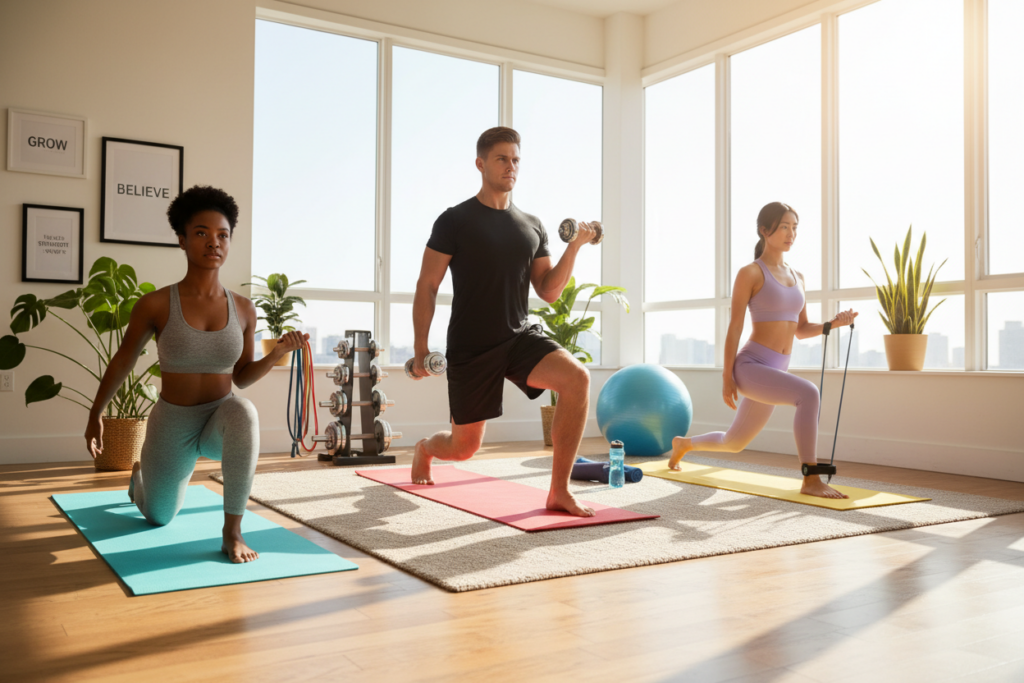
Why convenience and privacy help: when your training space is steps away, skipped sessions drop. Privacy lets you practice movements, pause videos, and try dumbbells or bodyweight drills without feeling watched. That grows confidence and reduces fit-related friction.
“Exercise snacks” that actually add up
Short bursts spread through the day keep your week intact when time is tight. Try two minutes of stairs, a set of 10 squats, a 30-second plank, or a quick 3-move dumbbell circuit. Do one or two snacks a day.
- Snack example: 2 min stairs + 10 pushups (knees ok) = strength + cardio boost.
- Weekly math: five 2–3 minute snacks add ~15 minutes — that keeps training identity alive.
Cues and rewards: leave your gear visible, set a timer, and use a tiny ritual (music clip or mug) that signals “workout time.” Reward consistency—check marks, a favorite song, or a small treat—so the habit sticks.
| Tip | Action | Why it works |
|---|---|---|
| Dedicated spot | Keep mat and dumbbells visible | Reduces friction to start |
| Micro-sessions | 2–5 min snacks, 1–2x day | Maintains progress on busy days |
| Ritual + reward | Timer + small post-session treat | Builds cue-reward loop for habit |
Conclusion
Pick a single 15–20 minute routine, mark the day on your calendar, and start with controlled bodyweight practice.
Begin with a 5–10 minute warm-up, then run the circuit focusing on clean reps and steady breathing. Make form your priority; slow, repeatable reps build real strength and protect your joints.
Keep these priorities: consistency, clean reps, smart rest, and gradual progression. Schedule at least two strength sessions and one cardio session each week, plus one full rest day.
Scale moves with chair support, knee push-ups, shorter plank holds, or a slower tempo. These are tools to train safely, not shortcuts.
You don’t need a gym or lots of equipment to build stronger legs, steadier arms, and a more resilient back. If you want guided options that mix bodyweight and modest gear, check this Total Gym roundup: total-gym options.
Practical checkpoint: reassess in four weeks. Add a few reps, hold the plank longer, or choose a harder variation only when your form stays solid across sets.
FAQ
What makes a home workout beginner-friendly and actually effective?
How do bodyweight exercises build real strength without a gym or machines?
How can I reduce injury risk when starting a routine at home?
How much space do I need to exercise safely at home?
What zero-equipment moves still hit the whole body?
When should I add resistance bands or dumbbells?
What’s a practical 5–10 minute warm-up I can repeat every day?
How do reps, sets, and rest vary by goal?
Can you give a repeatable 20-minute full-body routine I can use now?
How do I scale exercises if they’re too hard or too easy?
What basic form cues help with common bodyweight moves?
What low-impact cardio options protect knees and joints?
How do intervals work for a beginner HIIT session?
How should I pick a starting weight for dumbbells?
What’s a simple weekly template that fits a busy life?
How do I measure progress without relying on the scale?
How do I recover and manage soreness as a new trainee?
What are simple motivation tactics to keep training for three months?
If weight loss is my goal, what role does this kind of training play?