A Simple Bodyweight Routine for Any Travel Day

 0
0
 1
1 A travel-friendly bodyweight workout you can do anywhere should be short, repeatable, and built around squats, push-ups, lunges, rows or pulls when available, and planks. Keep walking too, since the Centers for Disease Control and Prevention advises adults to get at least 150 minutes of moderate-intensity physical activity per week. You don’t need to train until you’re wrecked. You need a routine you can repeat after a flight, a long walking day, and the next poor night of sleep.
Last updated: 2026-08-12
The overall pick
The best routine covers your whole body without requiring a gym, a mat, or a heroic amount of floor space. Start with these movements:
- Bodyweight squat: Sit your hips down and keep your feet planted. Stop when your range starts to shorten or your knees lose control.
- Push-up: Keep your ribs down, body straight, and elbows moving at a comfortable angle. Use an elevated surface if the floor version breaks apart.
- Reverse lunge: Step back, lower under control, and push through the front foot. Reverse lunges are easier to balance than forward lunges in a cramped room.
- Hip hinge: Push your hips back while keeping your spine steady. Use a backpack later if the unloaded version no longer challenges your hamstrings and glutes.
- Plank: Brace your stomach and squeeze your glutes. End the hold when your lower back starts doing the work.
- Row or pull: Use a sturdy outdoor bar or a safely loaded backpack when available. A no-equipment hotel room has no honest substitute for pulling strength, so don’t pretend floor work replaces it.
How do you run the session?
Move through the exercises in order. Use controlled repetitions and stop each set with clean reps still available. The goal is productive work, not a dramatic collapse beside the bed.
A practical session looks like this:
- Warm up with easy squats, shoulder circles, and walking lunges.
- Perform a controlled set of squats.
- Perform a push-up variation.
- Perform reverse lunges on both sides.
- Add a hip hinge or backpack hinge.
- Finish with a plank.
- Add rows or pulls if you have a safe bar or bag.
Use the best bodyweight exercises if you want more movement options. However, don’t keep changing exercises because a list promised novelty. Pick movements you can perform well and beat your previous work over time.
This travel-friendly bodyweight workout fits vacations, work trips, and missed-gym weeks because the plan has to fit your week. If you can walk, sleep, and recover well, repeat the session after enough recovery. If your legs are sore from sightseeing, train your upper body and core or take a brisk walk instead.
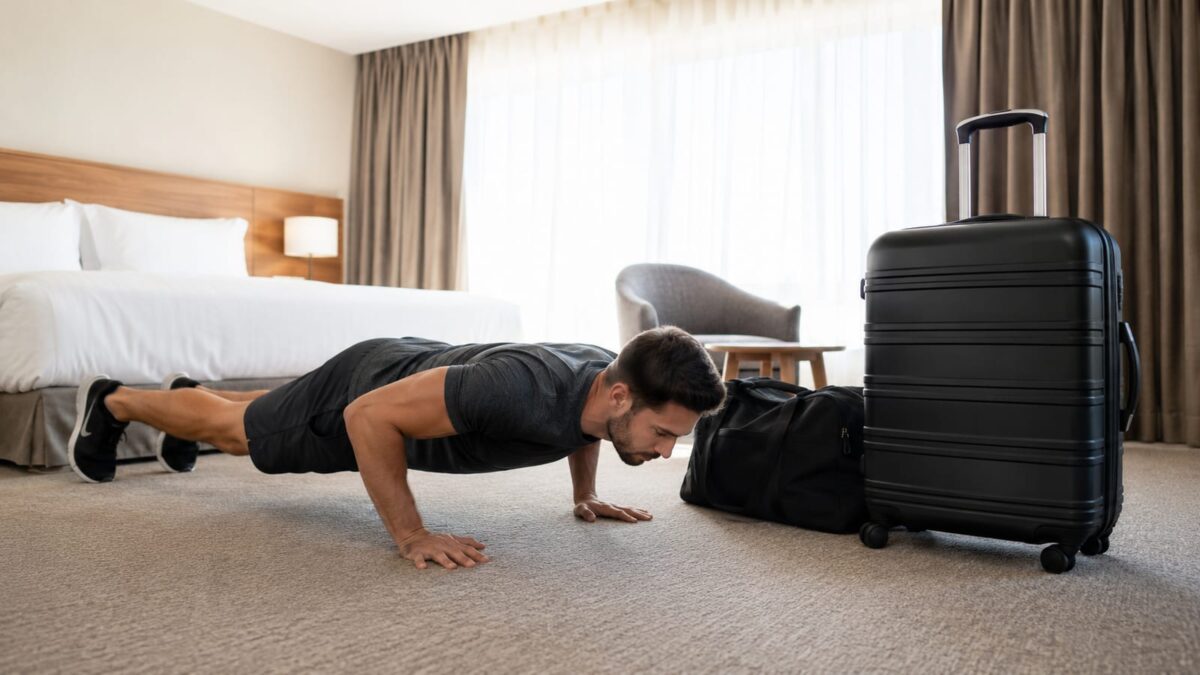
The hotel room circuit
Use a circuit when time and space are limited. Keep the exercises quiet, leave room between movements, and rest before your technique slips.
A good hotel room circuit uses:
- Squats
- Incline or floor push-ups
- Reverse lunges
- Slow hip hinges
- Planks
Perform one controlled set of each movement, then rest as needed. Repeat the circuit while your reps stay sharp. Stop before the final round turns into rushed half-reps.
What should you leave out?
Skip jump squats, burpees, and repeated floor slams if you’re above another room. They add noise and often less useful training than controlled work. A quiet squat performed with intent still trains your legs. The carpet doesn’t need to know you’re exercising.
Use a chair, desk, or bed only if it’s stable and doesn’t slide. An unstable surface makes a simple movement harder to control, not more effective. Test it with your hands before placing your full weight on it.
A hotel gym can give you better options for pulling and loading. Use this hotel gym workout routine for travelers when the facility is open, safe, and worth the time. Otherwise, train in the room and keep the session moving.
Beginner adjustments
A beginner routine should teach movement, not punish you for being out of practice. Start with easier variations and leave several clean reps in reserve.
Use these adjustments:
- Squat: Reduce the depth or sit to a stable chair.
- Push-up: Use a wall, desk, or sturdy counter before moving to the floor.
- Lunge: Hold a wall for balance and use a shorter range.
- Hip hinge: Place your hands on your hips and practice pushing them back.
- Plank: Brace from your knees or use an elevated surface.
- Pull: Skip improvised doorframe pulls unless the structure is clearly designed to support your weight.
Perform a manageable amount of work and stop while your technique still looks the same as your first repetition. You don’t need soreness to prove the workout counted. You need a baseline you can repeat on the next travel day.
Keep your breathing steady. Move slowly enough to know where your knees, hips, shoulders, and spine are moving. If you lose balance or start rushing, use an easier variation.
The most common beginner mistake is copying an advanced version too early. Decline push-ups and single-leg squats look impressive, but they’re poor choices if your regular push-up or split squat is inconsistent. Earn the harder version with good reps first.
Progress without equipment
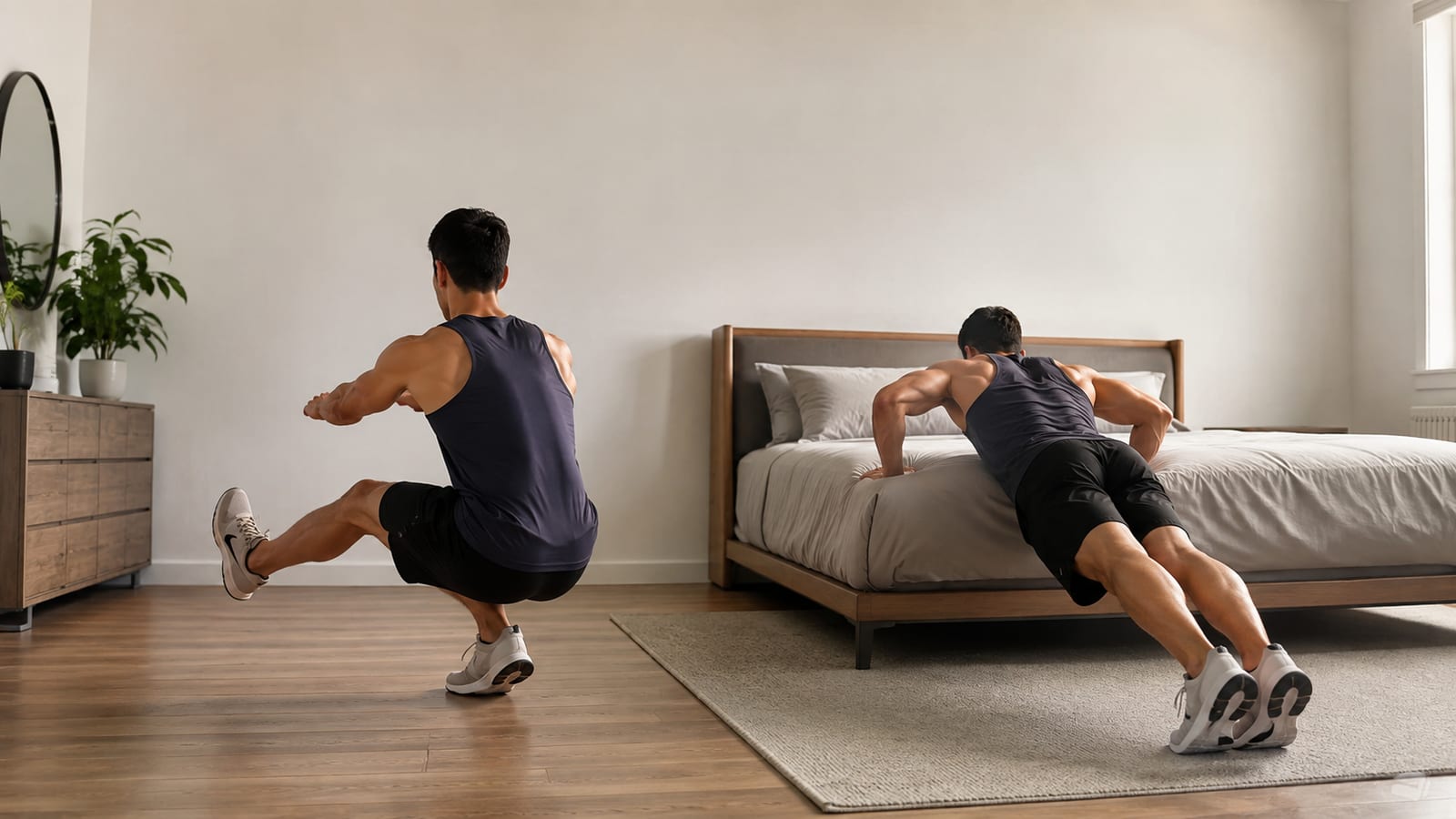
Progress bodyweight exercises by changing one clear variable at a time. Add repetitions, improve range of motion, pause in the hardest position, slow the lowering phase, or use a harder variation.
Track the change in a notebook or phone. Write down the exercise, variation, repetitions, and how the final reps felt. A workout you can’t compare is difficult to improve.
Use this progression order:
- Make the current variation consistent.
- Add a small amount of work without losing technique.
- Slow the lowering phase or add a pause.
- Increase the range of motion.
- Move to a harder gear.
- Retest the easier variation if soreness, travel stress, or poor sleep reduces performance.
For push-ups, move from a wall to an elevated surface, then to the floor. Later, use a slower descent, a pause near the floor, or a decline position. For squats, increase depth, add a pause, or use a split stance before attempting single-leg work.
Don’t turn every session into a new challenge. Novelty makes progress hard to measure. Choose a variation, train with intent, and earn the next increase.
Advanced progressions worth using
Advanced movements are useful when they solve a clear training problem. They’re not useful because they look difficult in a hotel mirror.
Use these progressions when the easier version is controlled:
- Decline push-ups: Raise your feet on a stable surface to shift more work toward your shoulders and upper chest.
- Pike push-ups: Keep your hips high and lower your head between your hands. Use a shorter range if your shoulders aren’t ready.
- Bulgarian split squats: Place your rear foot on a stable surface and keep the front foot doing the work. Skip this if the support wobbles.
- Single-leg squats to a target: Lower toward a chair or bed, then stand without dropping into the surface.
- Single-leg hip hinges: Reach the free leg back and keep your hips level.
- Long-lever planks: Move your elbows slightly forward while keeping your ribs and pelvis controlled.
- Isometric holds: Pause in a difficult position without letting your joints collapse.
Start with the easiest advanced version that lets you keep repeatable technique. Your joints get a vote, especially after long flights and days spent carrying luggage.
Single-leg work can create plenty of challenge without weights. It also exposes balance problems quickly. Hold a wall when needed, because falling beside a hotel desk is a poor training plan.
Luggage as resistance
A loaded backpack can provide useful resistance for squats, hinges, rows, and carries. A suitcase can work for some lower-body movements, but only if the handle, wheels, and contents stay secure.
Pack the load tightly so nothing shifts. Keep the weight close to your body, and start lighter than your ego suggests. A loose laptop, bottle, or toiletry bag can turn a simple row into a bad decision.
Useful luggage exercises include:
- Backpack squat: Wear the bag high and tight against your back.
- Backpack hinge: Hold it close to your chest or against your body.
- Backpack row: Support one hand on a stable surface and pull the bag toward your ribs.
- Suitcase carry: Hold the bag at your side and walk with your torso upright.
- Front-loaded split squat: Hold the backpack close while lowering under control.
Don’t swing a suitcase. Don’t use a bag with a damaged strap. Don’t perform overhead movements with a load you haven’t checked.
The load should make the same movement harder without changing your posture. If you lean, twist, or rush to control it, remove weight or return to bodyweight work.
Timed circuits
Timed circuits work best when you need structure, not when you want to chase exhaustion. Set a short work period, perform clean reps, then rest long enough to repeat the effort.
Use time to control the session rather than force a fixed rep count. Stop the set when your range of motion shortens, your breathing becomes chaotic, or your joints start taking over.
Timed work suits:
- Squats and reverse lunges
- Incline push-ups
- Planks
- Slow mountain climbers
- Marching in place
- Carries with a secure backpack
Timed intervals are less useful for movements that need careful balance or precise control. Single-leg squats and pike push-ups deserve attention, not a countdown that pressures you to rush.
You can use a simple work-rest pattern, then repeat it only while quality stays high. The exact timer matters less than the standard. Good reps before more work.
Adults are advised by the Centers for Disease Control and Prevention to get at least 150 minutes of moderate-intensity physical activity per week. The World Health Organization gives the same weekly target for adults aged 18–64 years. A bodyweight strength session helps, but it doesn’t replace walking or other aerobic activity.
Outdoor and playground options
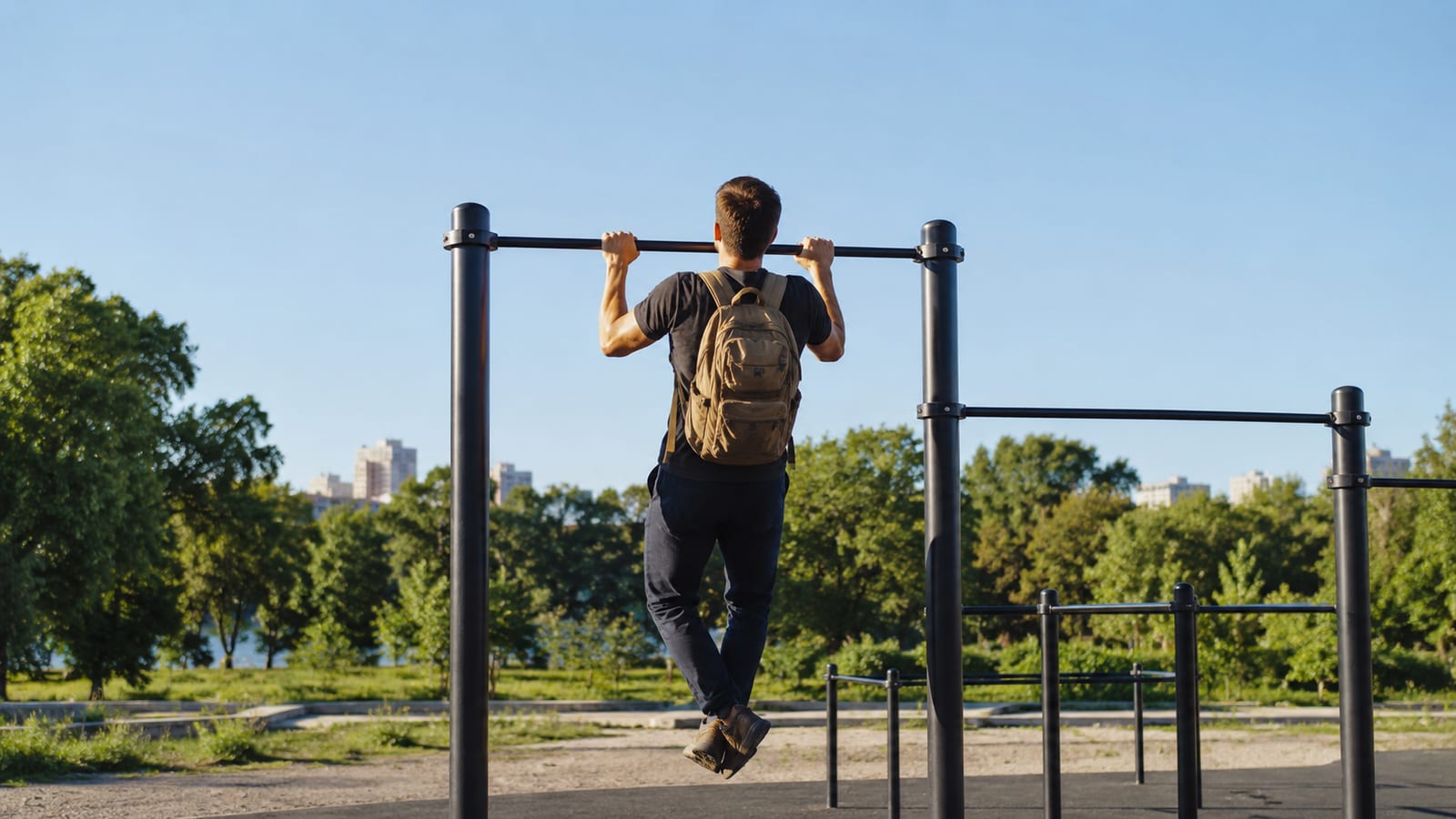
A playground gives you the pulling options that a hotel room usually lacks. Use sturdy bars, benches, steps, and open ground, but inspect each surface before loading it.
Good outdoor choices include:
- Rows under a low bar: Keep your body straight and pull your chest toward the bar.
- Pull-ups: Use a bar that doesn’t wobble, spin, or show damage.
- Incline push-ups: Place your hands on a stable bench.
- Step-ups: Use a solid step and control the descent.
- Split squats: Use a bench only when it stays fixed.
- Bear crawls: Keep the movement controlled on clear ground.
- Carries: Walk with a secure backpack across an open, even surface.
Avoid wet bars, loose benches, sharp edges, and crowded areas. Don’t climb equipment that wasn’t made to support that movement. Playground equipment is not a free pass to ignore basic safety.
Pull-ups are useful, but they’re not mandatory. If you can’t perform one clean repetition, use rows, hangs, or a backpack row instead. Build the strength that supports the next version.
Outdoor training also changes with weather and ground conditions. Heat, glare, rain, and poor footing can turn a sound plan into a bad one. Move indoors when the environment becomes the limiting factor.
How often should frequent travelers train and recover?
Train often enough to maintain the habit without competing with sleep, walking, work, or sightseeing. For many travelers, that means short full-body sessions separated by recovery days.
Use the following decision guide:
- Good sleep and low soreness: Complete the planned session.
- Poor sleep but normal movement: Reduce the work and keep technique sharp.
- Sore legs from walking: Train upper body and core or take an easy walk.
- Heavy luggage day: Skip extra loaded leg work.
- Jet lag or illness: Recover first and resume with an easier version.
- Several missed sessions: Restart below your previous workload.
A study of 122 adults ages 18–65 found that vacations lasted one to three weeks. That is long enough for an all-or-nothing plan to fail. A repeatable routine gives you a way to train without asking travel to behave like home.
About 68% of international business travelers experience negative symptoms regularly. Don’t schedule your hardest session immediately after a long flight because an app told you to stay disciplined. Let your sleep and coordination improve first.
Walking counts as useful activity, but it also adds fatigue. Your plan has to account for the miles, stairs, heat, and luggage already in the day. Leave recovery capacity for the next session.
Food and sleep on the road
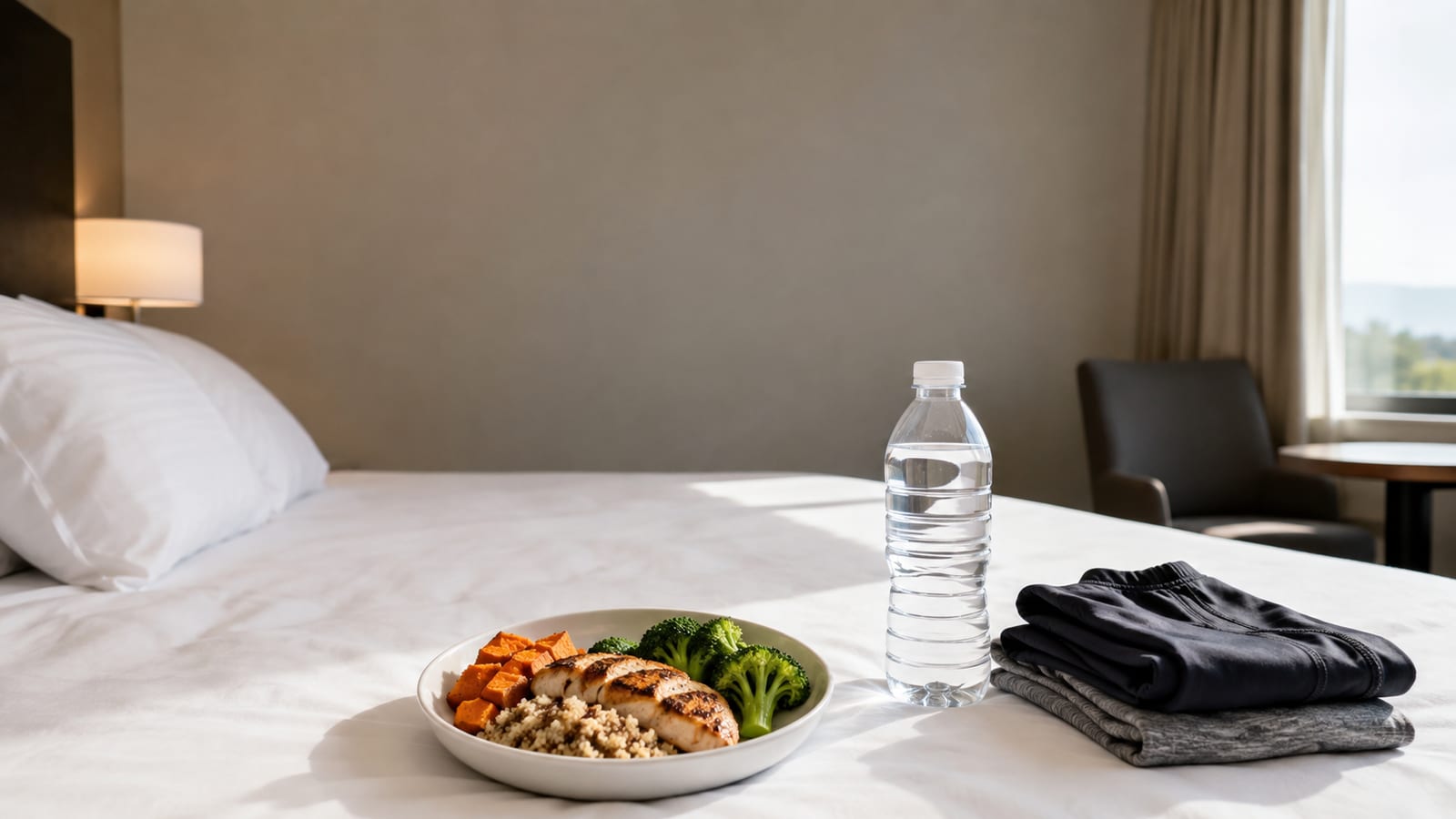
Eat enough food to support the activity you’re actually doing. Include a useful protein source at meals, drink water regularly, and avoid turning every travel day into a contest between restriction and overeating.
You don’t need a perfect menu. You need reliable choices:
- Protein at breakfast and main meals
- Fruit or vegetables when available
- Carbohydrates before long walking or training days
- Water during flights and hot days
- A simple snack for delays and missed meals
What matters most on travel days?
Sleep is harder during travel, especially across time zones. Keep your room dark, limit unnecessary late-night activity, and avoid training hard when coordination is poor. Hard work performed badly is still performed badly.
The vacation weight research is less dramatic than many headlines suggest. Adults gained an average of 0.7 pounds while on vacation and 0.9 pounds throughout the entire study. That doesn’t justify aggressive dieting on a trip. It does show why a few sensible meals and regular movement beat the usual cycle of excess followed by punishment.
Among Australian travelers, 55% say exercise is important while traveling. That survey result shows interest, not a training requirement. The preference only helps if the routine is easy to start. Pack the habit first, then adjust the exercises to the room, weather, and energy you have.
Around 85 percent of U.S. hotels offer a fitness center, but you don’t need to depend on one. A bodyweight plan remains useful when the gym is crowded, closed, poorly equipped, or nowhere near your room.
For a little more structure, use this minimal-equipment strength routine when you can pack a band or another small training tool. If you have nothing, return to squats, push-ups, lunges, hinges, planks, and safe pulls.
Who should use this workout, and who should change it?
This routine suits healthy adults who want to maintain strength, movement, and training consistency during travel. It also works for beginners because each exercise has an easier version.
Change the plan if you have an injury, a medical condition, or pain that changes your movement. Pain that worsens during a set is a reason to stop and seek qualified advice, not a challenge to overcome.
It’s also a poor fit if your main goal requires heavy external loading, such as maximizing a barbell lift. Bodyweight training can maintain a lot, build useful strength, and improve control. It won’t replace every form of training.
The trade-off is clear. You gain convenience and flexibility, but you lose precise loading and usually lose direct pulling options. Use a backpack, playground bar, or hotel gym when you need more resistance.
FAQ
Can I build muscle with a vacation bodyweight workout?
You can build muscle if the exercises challenge the target muscles and you progress over time. Use harder variations, more controlled reps, longer pauses, or a secure backpack when the basic version becomes easy.
What if my hotel room has no floor space?
Use standing movements such as squats, reverse lunges, hip hinges, calf raises, and marching. Perform push-ups against a wall or sturdy counter, then finish with a standing brace or a short walk.
Should I work out after a long flight?
Only if you feel coordinated, hydrated, and ready to move. After a long flight, an easy walk and gentle mobility may serve you better than a hard circuit.
Do I need to train every day on vacation?
No. Daily movement is useful, but daily hard training is unnecessary. Alternate focused sessions with walking, light mobility, or full rest based on soreness and sleep.
How can I keep the workout quiet in a hotel?
Remove jumps, drops, and fast floor transitions. Use slow squats, incline push-ups, reverse lunges, hinges, planks, and controlled backpack work instead.