Build Muscle While Losing Fat: A Recomp Guide

 0
0
 0
0 You don’t bulk and cut at the same time. You run a controlled body recomposition: eat around maintenance or in a small deficit, lift with intent, keep protein high, and accept slower progress. This works best if you’re new to lifting, returning after time away, or carrying extra body fat. You can build muscle and lose fat together, but you can’t maximize both as if you were running a full bulk and a dedicated cut.
Last updated: 2026-08-10
Can you bulk and cut at the same time?
Bulking means eating in a calorie surplus to support muscle gain. Cutting means eating in a calorie deficit to reduce body fat. Those targets pull in opposite directions.
Body recomposition is the practical middle ground. You eat near maintenance or slightly below it, train hard, and give your body enough protein to build or preserve muscle while stored fat supplies part of the energy gap.
The tradeoff is speed. A dedicated bulk can support faster muscle gain, while a dedicated cut can reduce fat faster. Recomping asks you to accept slower change in both directions.
So, how to bulk and cut without wasting months? Start near measured maintenance, train consistently, and judge progress by strength, waist size, photos, and average body weight. Don’t chase a dramatic scale change.
Who should try body recomposition?
Body recomposition makes the most sense for lifters who have room to improve without needing extreme calorie targets.
You’re a good candidate if you’re:
- New to resistance training
- Returning after a long layoff
- Regaining muscle after detraining
- Carrying a higher level of body fat
- Still adding weight or reps to your main lifts
- Able to train consistently and recover from it
Beginners often gain muscle from a modest routine because nearly every well-performed set gives them a new training signal. Returning lifters can also regain lost muscle faster than they built it the first time.
Experienced, lean lifters face a harder job. They may still recomp, but muscle gain becomes slower and a calorie deficit can hurt training performance. If you’re already lean, strong, and close to your preferred body composition, a dedicated phase usually makes more sense.
That doesn’t mean you need an aggressive bulk. Read how to eat for muscle gain without getting fat before adding a large amount of food. Most natural lifters need less than the internet claims.
Should you eat at maintenance, a surplus, or a deficit?
Start close to your measured maintenance calories. Hold that intake long enough to see what your average body weight and waist are doing.
Use this order:
- Start near maintenance. Keep food intake steady and track your body weight across the week.
- Use a small deficit if fat loss is the priority. You should lose fat gradually while keeping your lifts reasonably stable.
- Stay near maintenance if muscle gain is the priority. This gives training performance more room without making fat gain the main result.
- Avoid a large surplus. Extra food cannot force your muscles to grow at the same speed. It mostly makes the eventual cut longer.
- Adjust one thing at a time. Change food intake or activity, then watch the trend before making another change.
You don’t need a training-day surplus and a rest-day deficit to make this work. That setup can help some people manage hunger and workout energy, but it also creates more chances to miscount the week.
A calorie deficit can support muscle gain for newer and returning lifters, especially when protein and resistance training are in place. Can you build muscle on a calorie deficit? explains where that strategy works and where it starts to fail.
A simple calorie decision table
| Your main goal | Starting approach | What should improve |
|---|---|---|
| Lose more fat | Small calorie deficit | Waist size falls while strength is mostly maintained |
| Build more muscle | Maintenance or a modest surplus | Reps, load, and measurements improve without rapid waist gain |
| Do both slowly | Near maintenance | Strength rises while waist size stays steady or declines |
Your target has to fit your week. If hunger ruins sleep and training, the deficit is too aggressive. If your waist climbs while your lifts barely move, the surplus is doing more work than your muscles.
How much protein and which macros do you need?
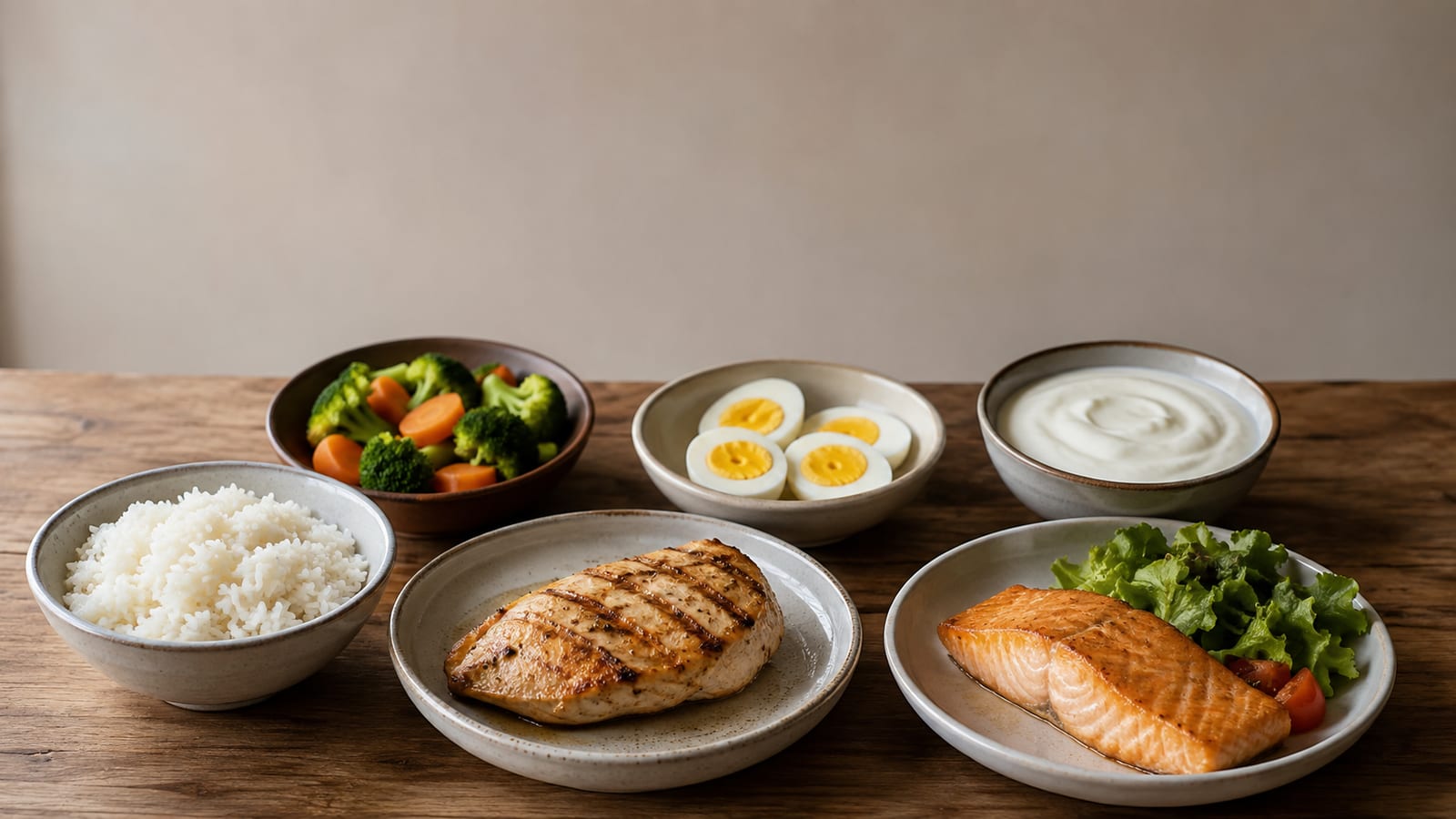
Protein gets the first decision. For athletes in energy balance seeking to optimize resistance-training adaptation, about 1.6 grams per kilogram of body mass per day is a strong target.
Going beyond that amount up to 2.2 grams per kilogram per day may help in some situations, but additional effects are greatly diminished. More protein is not a replacement for hard sets, good sleep, or enough training food.
Spread protein across the day instead of saving it all for dinner. Research on muscle protein synthesis has found that about 0.25 grams per kilogram of high-quality protein per meal can maximally stimulate the response in young men. A separate recommendation gives 0.4 grams per kilogram per meal as a useful upper target for that meal response.
Build meals around foods such as:
- Meat, poultry, fish, eggs, or dairy
- Soy, beans, lentils, or other protein-rich plant foods
- A protein shake when normal food isn’t practical
Dietary fat should not disappear during a cut. Keep a sensible minimum from foods such as eggs, olive oil, nuts, seeds, dairy, and fatty fish.
Use carbohydrates to support training. Rice, potatoes, oats, fruit, bread, and similar foods can help you train with intent. You don’t need to ban them on rest days, and you don’t need to force them into a narrow post-workout window.
Track macros closely if that helps you control intake. Otherwise, track total calories and protein first. A plan that takes over your life is not a better plan.
What training builds muscle while you lose fat?

Use a simple resistance-training plan built around compound lifts and repeatable technique. Your program should include a squat or leg press, a hip hinge, a press, a pull, and direct work for smaller muscles.
Train each movement with enough effort to make the set count. Most working sets should finish with 1 to 3 reps in reserve, meaning you could still perform that many clean reps before technique breaks down.
Start with a manageable amount of weekly work. Research on trained individuals has examined 12 to 20 weekly sets per muscle group for hypertrophy, but more work is not automatically better. One study found no significant difference between moderate and high volumes for the quadriceps or biceps brachii. High training volume appeared better for triceps brachii muscle gains, but that does not make high volume the right starting point for every muscle.
Use fewer productive sets if you’re in a deficit or new to training. Add work only when your performance and measurements have stalled, your sleep is sound, and your current sets are hard enough to count.
A practical weekly structure
You can use a full-body plan, an upper-lower split, or another schedule you can repeat. The split matters less than covering the major patterns and progressing over time.
A full-body session might include:
- Squat or leg press
- Romanian deadlift or another hip hinge
- Bench press or overhead press
- Row or pulldown
- Curl, triceps extension, lateral raise, or calf work
Keep the exercise menu stable long enough to improve. Constantly rotating movements makes progress harder to measure and gives your joints no chance to settle into repeatable technique.
High-volume punishment workouts are a poor match for recomposition. You need to recover and come back stronger, not prove that you can make one session ruin the next one.
How do you progress without burning out?
Progressive overload means gradually doing more useful work. It does not mean forcing more weight onto the bar every workout.
Use a rep range and keep the load steady until your technique earns an increase. For example, if your plan calls for 3 sets of 8 to 12, stay with the same load until you can complete 12, 12, and 12 with 1 to 2 reps in reserve. Then add the smallest practical amount and build the reps again.
Progress can also mean:
- Adding a clean rep
- Using better control
- Moving through a longer range of motion
- Keeping the same work with less strain
- Improving technique at the same load
Change one variable at a time. Otherwise, your logbook can’t tell you what improved.
Your performance may slow during a deficit. That does not mean the program failed. Try to maintain load and quality reps first. If strength falls across several sessions, your sleep, food intake, exercise order, and total volume need attention.
Skip routine failure training on squats, deadlifts, and heavy presses. The final ugly rep usually creates more fatigue than useful muscle stimulus. You can take the last set of a safer isolation exercise, such as a curl or leg extension, close to failure occasionally.
How do you preserve muscle while cutting?
Muscle retention during fat loss comes from a small set of boring decisions repeated well:
- Keep lifting heavy enough to maintain strength
- Eat about 1.6 grams of protein per kilogram of body mass daily
- Use a modest calorie deficit
- Keep productive sets in the program
- Sleep at least about 7 hours per night
- Avoid turning cardio into a second training program
Resistance training tells your body that muscle still serves a purpose. Protein supplies the raw material. Food and sleep give you a better chance of keeping performance high enough to send that signal.
The Centers for Disease Control and Prevention recommends about 7 to 8 hours of sleep for most adults. The lower end is a floor, not a medal. If your sleep is poor, expect worse training, more hunger, and slower recovery.
Creatine monohydrate is optional, but it can support strength and training quality. A standard daily maintenance dose is 3 to 5 grams. You don’t need a complicated loading plan to use it.
Do this first: protect your lifting performance before adding more cardio or cutting more food. A smaller deficit that you can sustain beats a harsh plan that costs muscle.
How much cardio should you do while recomping?
Use walking and modest cardio to support health, calorie control, and recovery. Don’t use cardio to punish yourself for eating or to compensate for a diet you can’t manage.
Walking is the easiest place to start because it usually creates less fatigue than hard intervals. You can also use cycling, rowing, swimming, or other low-impact work if your joints tolerate it.
Keep harder cardio away from demanding leg sessions when possible. If your squats, hinges, or leg presses keep getting worse, reduce cardio before cutting more food.
High-intensity interval training can fit some plans, but it is not required for fat loss. The best cardio is the amount that helps your energy balance without reducing quality reps in the weight room.
How do you track whether recomposition is working?
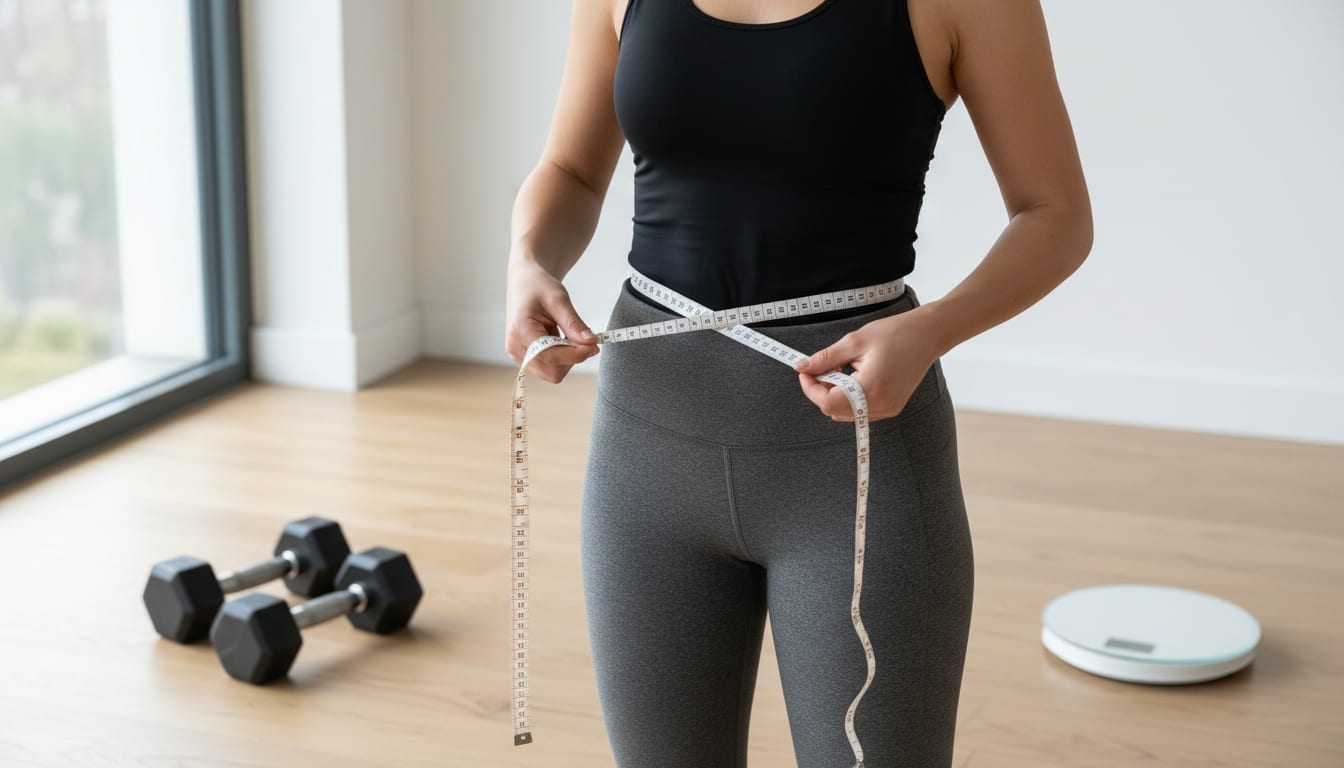
Use several signals because no single measurement tells the whole story. Daily body weight moves with food, water, digestion, and training stress.
Track these consistently:
- Weekly average body weight
- Waist measurement
- Progress photos under similar conditions
- Load and reps in your main lifts
- Food intake and protein
- Sleep and recovery
A falling waist with stable or improving strength is a good sign. Stable body weight with a smaller waist can also show that you’re gaining muscle while losing fat.
Don’t change the plan after one heavy weigh-in or one bad workout. Look for a trend across several weeks. Then make a small adjustment if the scale, waist, photos, and performance all point in the same direction.
Your logbook should answer the main question: are you earning the next increase while your body measurements move in the direction you want?
When should you stop recomping and choose a bulk or cut?
Recomping is useful, but it isn’t a rule you follow forever. Switch to a dedicated phase when the evidence says your current target no longer fits.
Choose a dedicated muscle-gain phase if:
- Your body fat is already near your preferred level
- Your lifts have stalled despite good training
- Recovery and sleep are solid
- You can accept a little fat gain for faster muscle progress
- More food clearly improves your training
Keep the surplus modest. If your waist rises quickly while strength barely changes, reduce the intake. Gaining too much fat while bulking covers the common signs that a bulk has stopped serving its purpose.
Choose a dedicated fat-loss phase if:
- Fat loss is your main goal
- Your waist has stopped changing during recomp
- You’re carrying more body fat than you want
- You can maintain training performance with less food
- Your current muscle level is already sufficient for your priorities
Stop recomping when progress has stalled for a meaningful stretch despite consistent food, training, sleep, and tracking. Don’t keep changing exercises or blaming genetics before checking those basics.
The right phase is the one that matches your current goal and your ability to recover. A natural lifter with limited time usually does better with a clear target than with constant calorie tricks.
FAQ
Can you recomp without counting calories?
Yes, but you still need some way to control intake. Start with consistent meals, daily protein, and regular body-weight and waist tracking. If both measurements move the wrong way, portions or activity need to change.
Does body recomposition work for women?
Yes. The same basic rules apply: resistance training, enough protein, sensible calorie control, and recovery. Menstrual-cycle changes can affect scale weight, so waist measurements and longer trends matter more than isolated weigh-ins.
Can you recomp with home workouts?
Yes, if your home training provides enough resistance and progression. Dumbbells, bands, machines, or bodyweight movements can work when you add reps, load, control, or range of motion over time.
Should you eat more on training days?
Only if it helps your weekly intake and training performance. More food on workout days is a tool, not a requirement. Your average intake across the week still determines whether you lose, maintain, or gain body weight.
How long should you try recomposition?
Stay with it while your waist, photos, and training performance show useful progress. If those measures stall despite consistent execution, choose a dedicated bulk or cut instead of making the plan more complicated.
Related: Why Workouts Cannot Target Fat Loss in One Area
Related: Bodybuilding Myths, Tested Against How Muscle Grows
Related: A Smarter Way to Manage Hunger During a Cut
Related: Does Bulking Make You Tired? Fix the 4 Main Causes