Rebuild Strength After Birth Without Rushing Recovery

 0
0
 0
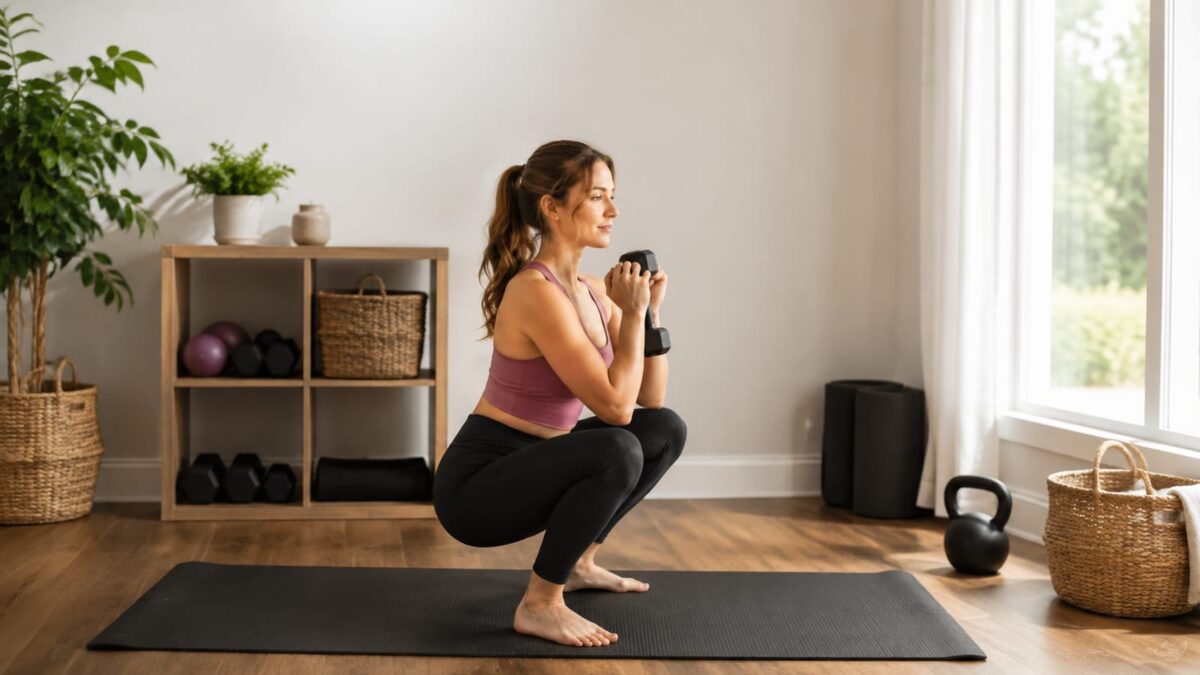
0 A safe postpartum workout routine to rebuild strength should feel controlled, repeatable, and almost too easy at first. Start with breathing, pelvic-floor control, walking, chair squats, supported hinges, rows, and wall presses. Progress only after your obstetric or midwifery team agrees, and stop for pain, increased bleeding, pelvic pressure, leaking, or abdominal doming. A punishing 30-day challenge has no place here. Your body needs enough food, sleep, and recoverable effort to heal while it gets stronger.
Last updated: 2026-08-26
Safe timing for postpartum exercise
After an uncomplicated vaginal delivery, the American College of Obstetricians and Gynecologists says gentle exercise may resume within a few days after giving birth or when you feel ready. That means easy walking, breathing work, and comfortable movement. It does not mean testing your old squat or running pace.
A routine postpartum checkup often happens around 4-6 weeks and should take place no later than 12 weeks. However, clearance is not a fitness test. It only tells you that your clinician has not found a medical reason to hold you back.
Ask your care team before moving beyond gentle activity if you had:
- A cesarean birth
- Heavy blood loss
- A severe tear
- High blood pressure
- Infection
- Pelvic-organ prolapse symptoms
- Wound problems
- Ongoing pelvic, abdominal, or back pain
- Other pregnancy or birth complications
After a cesarean birth, loading must respect the healing incision and deeper abdominal tissues. So, avoid using a fixed calendar as permission to train hard. Your wound comfort, daily movement, bleeding, fatigue, and clinical review matter more.
The American College of Obstetricians and Gynecologists postpartum exercise guidance explains the broad return to activity. Still, your own obstetric or midwifery team has the details that an online plan cannot see.
Recovery stages guide progression
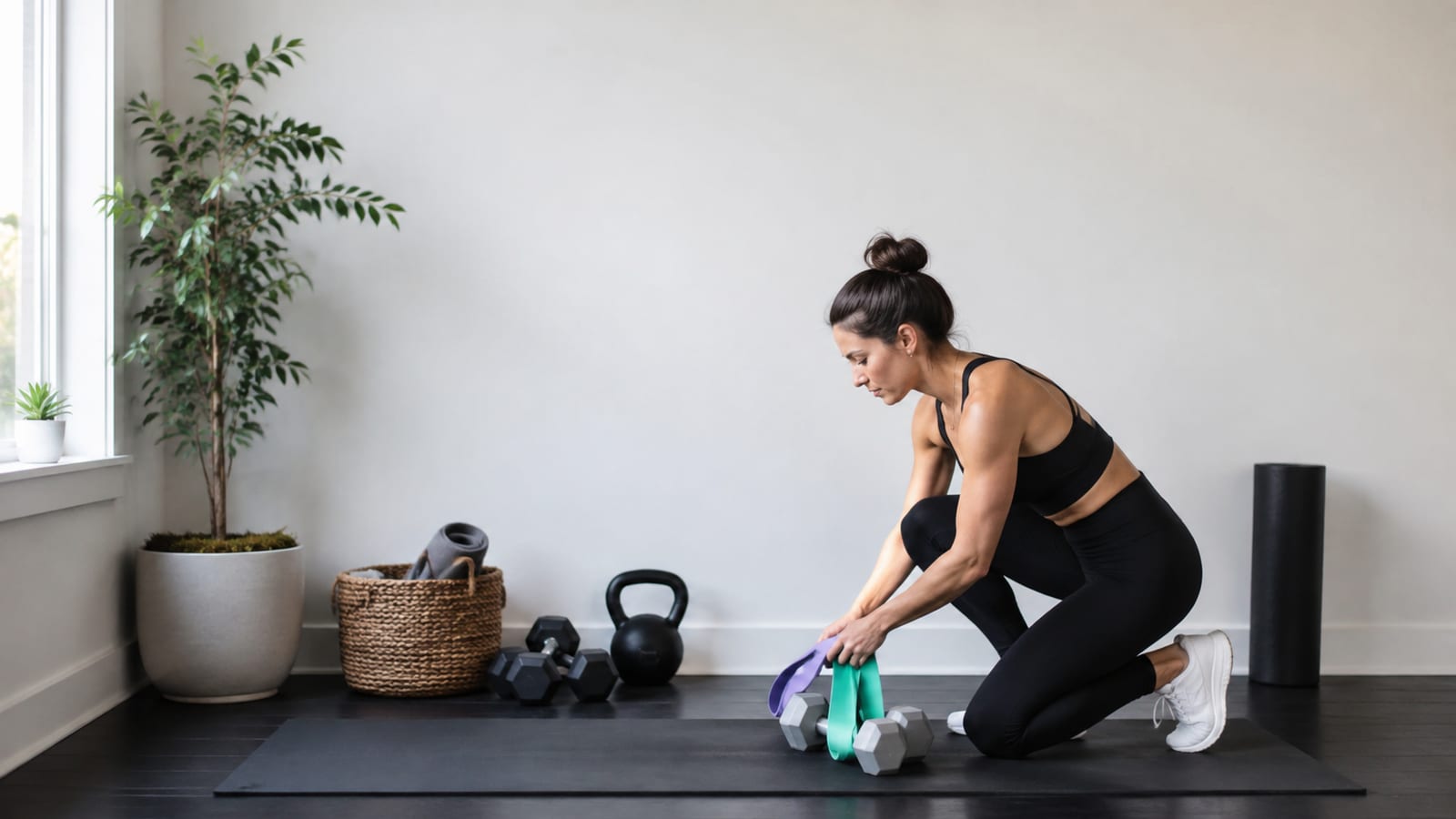
Move through recovery stages based on symptoms and control, not a countdown. Each stage earns the next one.
| Recovery stage | Main work | Move forward when |
|---|---|---|
| Restore breathing and basic movement | Relaxed breathing, short walks, gentle mobility, easy pelvic-floor coordination | Daily movement does not increase pain, bleeding, pressure, or wound discomfort |
| Rebuild movement patterns | Sit-to-stands, supported hinges, wall presses, rows, heel slides | You can breathe through each effort without doming, bearing down, or leaking |
| Build full-body strength | Squats, hinges, presses, rows, carries, controlled trunk work | Technique stays repeatable and symptoms remain settled during and after training |
| Return to heavier or faster work | Heavier resistance, deeper ranges, harder carries, gradual impact preparation | You tolerate foundational training and your clinician supports the next step |
The first stage may last a short time after an uncomplicated birth. However, complications can keep you there longer. That is not failure. It is the correct response to the recovery in front of you.
Meanwhile, walking can grow from brief, comfortable bouts into longer moderate activity. Healthy postpartum women are generally advised to work toward at least 150 minutes of moderate-intensity aerobic activity each week under the U.S. postpartum activity guidelines. That can also be spread across 30 minutes 5 days a week.
Those targets describe where you may build toward. They are not a bill due the week after birth. If a short walk increases bleeding or pelvic heaviness, shorten it and speak with your care team if the response continues.
What should a safe postpartum workout routine to rebuild strength include?
Use a low-impact full-body session that fits into about 30 minutes. You need a chair, a resistance band, and an optional light dumbbell or household load. Keep room for your baby, but do not use the baby as an unstable weight.
How should you perform the routine?
Work through the following sequence at a calm pace:
Breathing and pelvic-floor coordination
Lie down, sit tall, or use a comfortable hands-and-knees position. Inhale without forcing your stomach flat. Then exhale gently and feel the lower abdomen and pelvic floor respond without a hard squeeze.Chair squat or sit-to-stand
Sit back under control and stand while exhaling. Use your hands for support if needed. Reduce the depth if you feel pelvic pressure or cannot keep your trunk steady.Supported hip hinge
Hold a wall, chair, or countertop. Push your hips back while keeping your ribs stacked over your pelvis. Stop before your back takes over.Band row
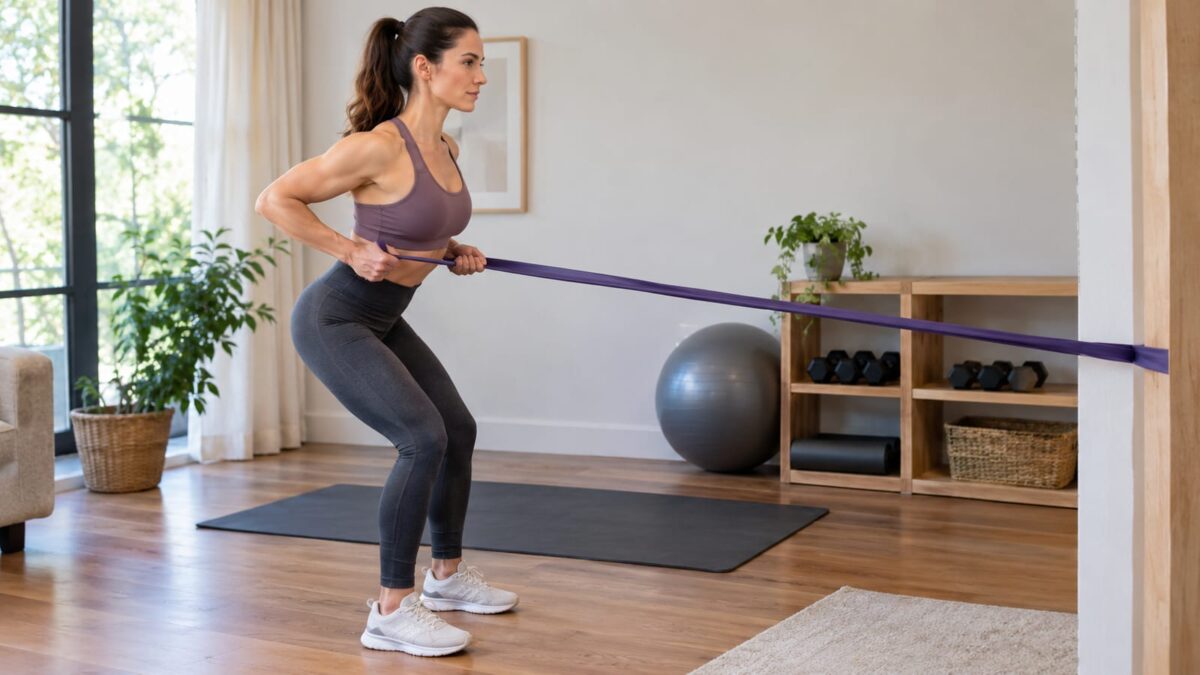
Pull the band toward your ribs without shrugging. Keep the resistance light enough that you can finish each repetition without holding your breath.Wall or countertop press
Use a higher surface to make the movement easier. Exhale as you press away, and lower slowly. Move closer to the floor only after you can control your trunk without doming.Supported carry or march
Hold a light load at your side, or march slowly beside a counter. Stay tall and avoid leaning away from the weight. Skip loaded carries if they create pelvic heaviness.Heel slide or bent-knee fallout
Move one leg while keeping the pelvis quiet. Shorten the range if your abdomen bulges along the midline or your back arches.
How much work is enough?
Move through the list while your quality reps stay clean. Rest whenever your breathing becomes rushed or your technique changes. For another compact option later in recovery, use this minimal-equipment strength routine and keep the same symptom checks.
This routine is simple on paper and demanding in practice. Make every exercise serve a purpose. More movements will not help if fatigue turns them into strained repetitions.
Core and pelvic-floor rebuilding
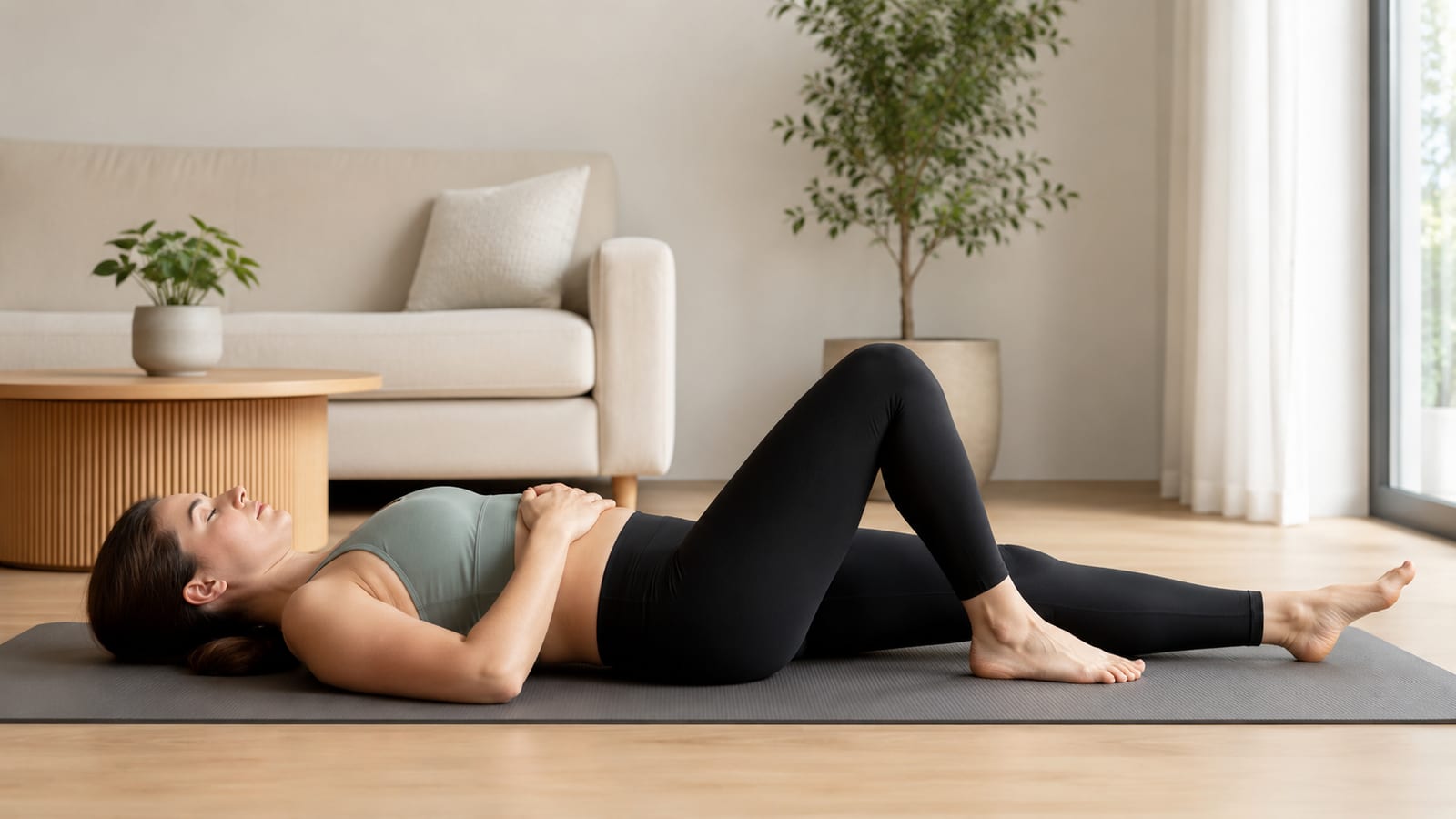
Start by coordinating pressure, not by squeezing harder. Your diaphragm, abdominal wall, back muscles, and pelvic floor work together to manage pressure around your trunk.
Inhale during the easier part of a movement. Then exhale through the harder part, such as standing from a chair or pressing away from a wall. Avoid forcefully drawing your stomach inward or holding your breath.
A useful progression looks like this:
- Relaxed breathing in a supported position
- Heel slides and bent-knee fallouts
- Bird-dog variations with a short range
- Incline plank holds with steady breathing
- Band presses that resist rotation
- Carries that challenge you to stay upright
The last movements are called anti-extension and anti-rotation exercises. They train your trunk to resist unwanted arching and twisting. That is useful core strength for lifting a car seat, carrying groceries, and getting off the floor.
Pelvic-floor work also needs both contraction and relaxation. Constant hard Kegels are not a complete plan. Some people have a tense pelvic floor that needs better release and coordination, not more squeezing.
If you cannot feel a clear contraction and release, or symptoms continue, see a pelvic-health physical therapist. Guessing harder rarely fixes a coordination problem.
Adjustments for diastasis recti and prolapse
Diastasis recti abdominis means the connective tissue between the abdominal muscles has stretched and the gap has widened. It is common after pregnancy. Published research on diastasis recti prevalence reports 60.0% at 6 weeks post partum and 45.5% at 6 months post partum.
It can also persist. Using an inter-rectus distance criterion of 2 cm, prevalence has been reported at 36% at 3 years postpartum. So, an abdominal gap is not proof that you failed recovery.
The gap alone does not decide what you can do. Watch how your abdominal wall manages pressure and whether you have pain, weakness, or poor control.
If you see abdominal doming or coning:
- Reduce the exercise range
- Use a lighter load
- Raise your hands during presses or planks
- Slow the movement
- Exhale through the hard part
- Return to an easier core variation
A small amount of doming that you can correct is feedback. Persistent or severe bulging means the exercise is currently too demanding.
Prolapse symptoms need a different adjustment
Possible prolapse symptoms include pelvic heaviness, vaginal bulging, dragging pressure, or the feeling that something is falling downward. Leaking urine or stool also deserves attention, even if someone told you it is normal after childbirth.
For these symptoms, shorten standing sessions and reduce load, depth, and impact. Then ask for a pelvic-health assessment. Training through pressure and leaking does not earn progress. It teaches you to ignore useful warning signs.
Home training with limited time
Use the minimum effective dose. A short session completed around feeding, naps, and broken sleep beats an ambitious plan you keep postponing.
You can split the work across the day:
- Breathing and heel slides after feeding
- Sit-to-stands while your baby rests safely nearby
- Band rows and wall presses during a quiet window
- An easy stroller walk when you feel ready
- Light carries without holding the baby as resistance
However, secure your band to a stable anchor. Check that chairs and counters cannot move. Home training only works if the setup is safe when your attention is divided.
On difficult days, perform the warm-up and a few controlled strength movements. On better days, complete the full routine. The plan has to fit your week, including the week your baby sleeps badly.
If you need an even shorter template, this beginner resistance circuit can work after you adjust the movements for postpartum symptoms. Keep good reps before more work.
Progress without overdoing it
Leave several repetitions in reserve. In plain terms, stop each set while you could still perform several clean repetitions with the same breathing and control.
Choose a manageable repetition range for each exercise. Keep the same load until every planned repetition looks stable and causes no symptoms during the workout or afterward. Then add a few repetitions, increase the range of motion, or use the smallest practical load increase.
Change one thing at a time:
- Add repetitions
- Use a slightly harder exercise angle
- Increase movement range
- Add a light load
- Reduce support
- Improve control at the same difficulty
Do not increase load, range, and total work together. If symptoms appear, you will not know which change caused the problem.
Also, account for your joints. Relaxin levels can remain elevated for up to five months after birth. Levels may stay slightly higher for longer in breastfeeding mothers.
Therefore, control matters more than stretching deeper or rushing back to explosive exercise. Your joints get a vote. If a movement feels loose, unstable, or painful, reduce the range and choose a more supported version.
What should a four-week postpartum strength plan look like?
Treat this as a flexible four-week framework, not a promise that every body advances on schedule. Repeat a week when symptoms, sleep, wound comfort, or fatigue say you need more time.
| Week | Strength focus | Walking and recovery | Progress test |
|---|---|---|---|
| Week 1 | Breathing, pelvic-floor coordination, sit-to-stands, supported hinges, easy rows | Short comfortable walks with full recovery between efforts | No increase in bleeding, pressure, pain, leaking, or wound discomfort |
| Week 2 | Repeat the basics and add wall presses plus controlled heel slides | Walk as tolerated and keep recovery days easy | Technique stays steady and you can exhale through effort |
| Week 3 | Add light carries or marching and harder exercise angles if symptoms allow | Gradually build moderate movement without chasing fatigue | The next day feels normal rather than depleted |
| Week 4 | Add reps, range, or a small amount of resistance to selected movements | Keep easy days between demanding sessions | Symptoms remain quiet and quality does not drop |
Strength sessions can happen on nonconsecutive days. Walking and mobility can fill the days between them, but complete rest is also productive when sleep is poor.
A safe postpartum routine to rebuild strength should finish with you feeling worked, not flattened. If the plan makes baby care harder for the rest of the day, the session was too demanding.
At the end of the framework, do not automatically move to running, jumping, or heavy lifting. Repeat the final stage until it feels steady. Then earn the next increase.
Warning signs that mean you should stop
Stop exercising if symptoms rise during the session or later that day. Increased postpartum bleeding, pelvic pressure, leaking, abdominal doming, wound pain, or sharp pelvic pain all mean the current dose needs to change.
Seek prompt medical care for:
- Chest pain
- Trouble breathing
- Dizziness or fainting
- Fever
- A severe headache
- New or one-sided swelling
- Heavy or increasing bleeding
- Severe abdominal, pelvic, or wound pain
- A wound that opens, drains, or becomes increasingly red
- Sudden weakness or unusual confusion
Urinary or fecal leakage is not always an emergency. However, ongoing leakage should be assessed rather than accepted as the price of motherhood. Studies of antenatal and postnatal women report urinary incontinence prevalence ranging from 3.84% to 38.65%, depending on the population and how it was measured.
Most women who had incontinence during pregnancy return to full continence after delivery. Still, about 5% have stress incontinence a year later. Early help is more useful than months of avoiding coughs, jumps, and loaded movement.
Exercise should also stop if you feel emotionally or physically unwell in a way that seems wrong. If you are unsure, contact your medical team. This is not the stage to prove you can push through.
Food and recovery support strength gains
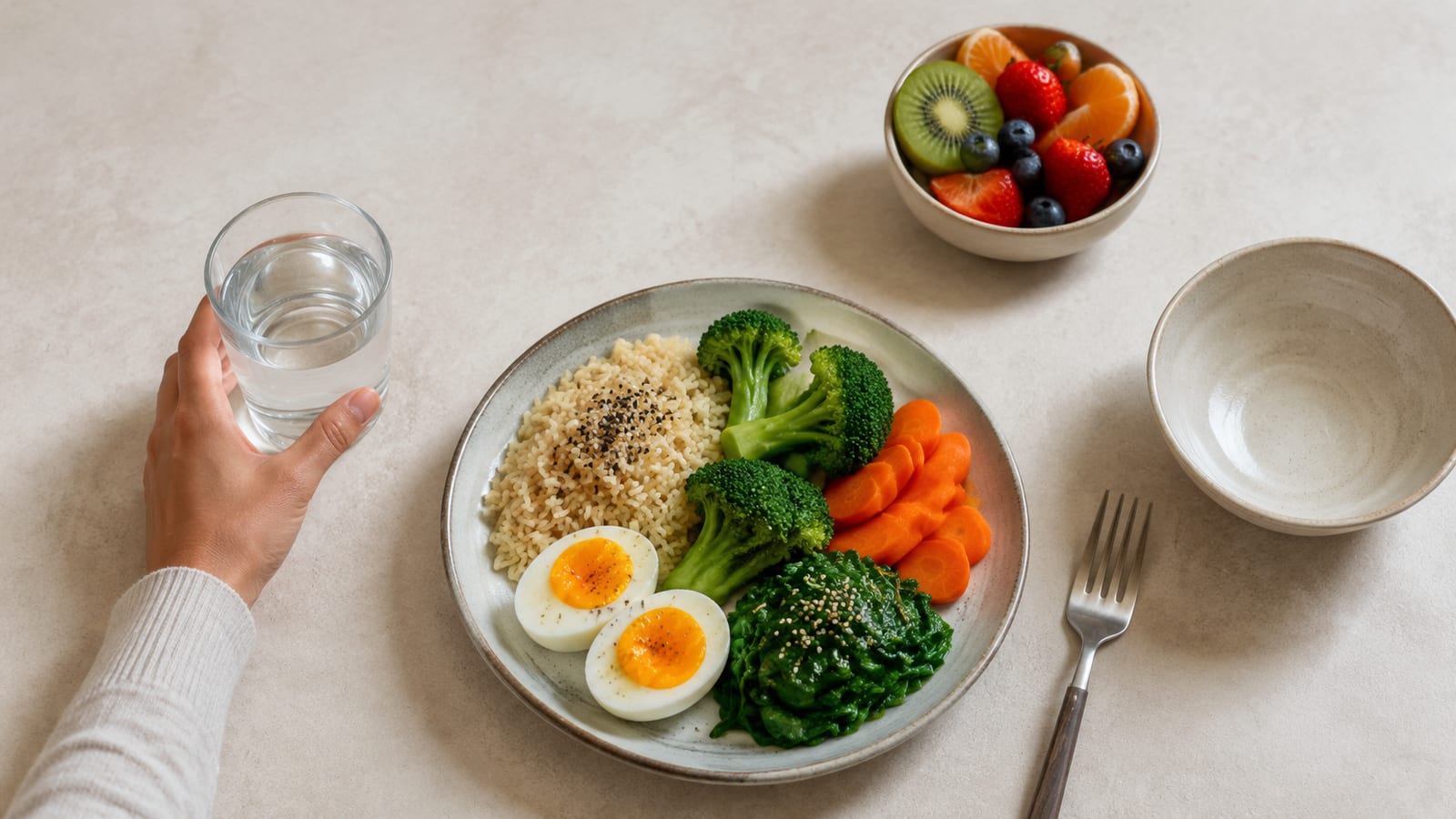
Do not pair early postpartum recovery with aggressive dieting. Healing tissue, disrupted sleep, feeding a baby, and strength training all require energy.
Build meals around:
- A clear protein source
- Carbohydrates for training and daily activity
- Fats for energy and meal satisfaction
- Fruit and vegetables you can prepare without extra work
- Fluids kept nearby throughout the day
Breastfeeding can raise your need for food and fluids. So, use hunger, thirst, milk supply concerns, body weight changes, and your clinician’s advice to guide intake. A rigid diet copied from someone else has no idea how you are feeding or recovering.
Sleep will not be neat with a newborn. However, you can still protect recovery by reducing training on poor-sleep days, accepting help, and resting when the chance appears. Do not try to outwork exhaustion.
Exercise can support mood and rebuild confidence, but it is not treatment for postpartum depression or anxiety. Speak with a medical professional if low mood, panic, frightening thoughts, or loss of interest continues or worsens.
The best postpartum strength plan is the one that lets you train, care for your baby, and recover enough to come back stronger. Small increases add up. The body does not care whether the workout looked impressive online.
FAQ
Do I need postpartum-specific weights or equipment?
No. A stable chair, a resistance band, and a light household load can cover the main movement patterns. Equipment matters less than secure setup, symptom-free movement, and a load you can control.
Is normal muscle soreness safe after a postpartum workout?
Mild soreness in the muscles you trained can happen. However, pelvic pain, incision pain, vaginal pressure, increased bleeding, or symptoms that disrupt normal movement are not ordinary training soreness. Reduce the session and contact your care team if those signs persist.
Does a postpartum belly binder rebuild core strength?
A binder may provide temporary comfort or support for some people. It does not retrain breathing, pressure control, or abdominal strength. Use it only if your clinician approves, and do not tighten it enough to restrict breathing.
Is yoga enough to rebuild postpartum strength?
Gentle yoga can help mobility, breathing, and body awareness. However, it may not provide enough measurable resistance to rebuild full-body strength on its own. Add progressive squats, hinges, rows, presses, carries, and trunk work when you are ready.
What should I look for in a postpartum trainer?
Choose someone with recognized postnatal training education who asks about your birth, symptoms, medical clearance, and current capacity. Skip anyone who promises a flat stomach by a deadline or treats leaking and pelvic pressure as minor inconveniences. A good coach refers you to a pelvic-health clinician when the problem falls outside coaching.
Related on this blog