

Build Muscle in About an Hour With Three Weekly Workouts

 0
0
 0
0 Start with a three-day low volume workout routine for muscle growth that uses basic lifts, two hard working sets per exercise, and steady progression. Each session should take around an hour. You’ll train the whole body often enough to practice the lifts, while keeping fatigue low enough to recover and come back stronger.
Last updated: 2026-08-31
This plan suits a natural lifter with limited time. It also suits anyone whose current routine has become a collection of exercises, missed sessions, and sore joints.
The low-volume workout routine at a glance
Train on Monday, Wednesday, and Friday. Alternate the two workouts so each week includes both sessions.
| Day | Workout | Main focus |
|---|---|---|
| Monday | Workout A | Squat, press, row, hip hinge |
| Wednesday | Workout B | Leg press, overhead press, pulldown, hamstrings |
| Friday | Workout A | Repeat Workout A |
| Following Monday | Workout B | Keep alternating |
Perform two working sets for each exercise. Use a weight that lets you finish the set with clean technique and roughly 1 to 3 reps in reserve.
Workout A
- Squat or leg press – 2 sets of 6 to 12 reps
- Bench press or dumbbell press – 2 sets of 6 to 12 reps
- Chest-supported row or cable row – 2 sets of 6 to 12 reps
- Romanian deadlift – 2 sets of 6 to 12 reps
- Lateral raise or cable curl – 2 sets of 10 to 15 reps
Workout B
- Leg press or split squat – 2 sets of 6 to 12 reps
- Overhead press – 2 sets of 6 to 12 reps
- Lat pulldown or assisted pull-up – 2 sets of 6 to 12 reps
- Leg curl – 2 sets of 8 to 15 reps
- Triceps pressdown or dumbbell curl – 2 sets of 10 to 15 reps
Rest at least 90 seconds between working sets. Take longer before another demanding compound set if your breathing or grip has not settled.
Use a few lighter warm-up sets before the first heavy movement. Do not count those as productive working sets. They prepare you to train; they don’t need to drain you.
This is a minimalist workout routine, but it still asks for focused effort. The plan only works if the sets are hard enough to count.
For another three-day option, see this full-body workout for muscle gain. The exercise choices can change, but the standard stays the same: repeatable technique and measurable progress.
What makes a short workout effective for muscle growth
Useful training volume is hard work you can recover from and improve. A longer session is not automatically a better session.
A set earns its place when it does three things:
- Trains the target muscle through a useful range of motion
- Finishes close enough to failure to create a strong stimulus
- Leaves you able to perform the next session well
More than nine weekly resistance-training sets per muscle group were associated with increased muscle hypertrophy in the dose-response meta-analysis by Schoenfeld, Ogborn, and Krieger. That finding matters, but it does not mean you should jump straight to high volume.
Your routine has to fit your training age, schedule, sleep, food, and exercise selection. A new lifter may grow on fewer sets because almost every well-performed set is a new stimulus. An experienced lifter may need more direct work for a muscle that has stopped progressing.
This routine sits near the minimalist end of training. It gives you a small amount of direct work and a useful amount of overlap from compound lifts. If your logbook and measurements stall for several weeks, add a set to the muscles that need it. Don’t rebuild the entire plan because one lift had a bad day.
A three-day plan for busy natural lifters

The routine uses a push-and-pull structure inside full-body workouts. Every session includes a knee-dominant leg exercise, a press, a pull, and a hip- or hamstring-focused movement.
That structure keeps the sessions balanced. It also prevents the common mistake of spending the whole workout on chest and arms while treating the lower body as an afterthought.
Exercise order
Start with the lift that needs the most coordination and stability. Follow it with the main press or pull, then use simpler movements as fatigue builds.
The order should look like this:
- Lower-body compound lift
- Upper-body compound lift
- Opposing upper-body movement
- Hip hinge or hamstring movement
- Isolation exercise
You can place the press before the leg exercise if your upper-body strength is the main priority. Keep that choice consistent so your logbook remains useful.
Heavy and back-off sets
Use a heavier first set and a slightly lighter second set on the main lifts.
- First set: 6 to 8 controlled reps
- Second set: 8 to 12 controlled reps
The first set gives you a clear strength target. The back-off set lets you collect quality reps with less joint and technical strain.
For isolation movements, use both sets in the higher part of the range. Curls, lateral raises, leg curls, and pressdowns rarely need heavy loading. They need controlled reps and a target muscle doing the work.
Do not turn every exercise into a test of maximum strength. Your joints get a vote, and your technique must survive the full week.
Keep the sessions moving
Set up your equipment before you start. Pair a non-competing isolation exercise with another isolation exercise if the gym is busy.
For example:
- Pair cable curls with triceps pressdowns
- Pair lateral raises with leg curls
- Pair calf work with a light abdominal exercise
Do not rush squats, deadlifts, presses, or rows to save a few minutes. Short rest can make the workout feel efficient while reducing the reps you can perform. The set still counts, but it may become a weaker training set.
Train often without overdoing it
Low-volume high-frequency training means you practice a movement or train a muscle two or three times each week while keeping the number of sets in each session low.
This works because frequency spreads the work across the week. You avoid putting every set for a muscle into one exhausting session. You also get more chances to improve technique.
Training a muscle group twice per week produced superior gains in muscle mass compared with training it once per week when weekly volume was equated in a peer-reviewed meta-analysis. That supports the structure of this plan, but frequency cannot rescue careless programming.
A low-volume, high-frequency protocol for weekly lower-body resistance training produced a significant increase in muscle thickness of 2.8 mm from pre- to post-test. The result came from the high-frequency intervention group in that study. It shows that frequent exposure can work with limited per-session volume.
Keep the repeated work stable. If you change the squat, press, row, and pulldown every week, you lose the practice that makes higher-quality reps possible.
High frequency also has a limit. If your performance falls each session, your sleep worsens, or your joints stay irritated, reduce the effort or spread the work out. More exposures are useful only when you can recover from them.
Choose exercises that earn their place
Choose exercises that are stable, easy to load, and simple to repeat. You have fewer sets, so each movement must produce a clear training effect.
Keep these movement categories
- Squat or leg press for the quads and glutes
- Romanian deadlift for the glutes and hamstrings
- Bench press or dumbbell press for the chest and triceps
- Overhead press for the shoulders and triceps
- Row for the upper back
- Pulldown or pull-up for the lats and upper back
- Leg curl for direct hamstring work
- Curl, pressdown, or lateral raise for a short isolation finish
Machines are allowed. A stable machine can be the better choice if it helps you train the target muscle without wasting energy on balance.
Barbells are not automatically superior. A barbell squat may suit you, while someone else gets better reps from a hack squat or leg press. The right low-volume exercise is the one you can perform safely, load gradually, and repeat without changing shape every set.
Skip novelty for its own sake. A new exercise can feel productive because it creates soreness. Soreness does not tell you if the muscle is growing.
The minimalist gym workout plan covers the same basic idea from a recovery-first angle. Use either plan as a template, then keep the exercises that fit your body and your gym.
How does a low volume workout routine for muscle growth work?
A small routine builds muscle through four linked parts:
- Enough weekly sets to stimulate the target muscles
- Sets performed close enough to failure
- Full-range reps with consistent technique
- Gradual increases in reps or load
Remove any one of these and the plan gets weaker.
Two easy sets with poor range of motion may not provide enough stimulus. Two hard sets with controlled reps can work well, especially when you repeat them and improve over time.
The dose-response meta-analysis on weekly resistance-training sets found increased muscle hypertrophy above nine sets per muscle group per week. Your minimalist plan may fall below that amount for some muscles, especially during the first weeks of training. That is a deliberate tradeoff for time and recovery.
If maximum muscle gain is your only goal, you may eventually need more work. If your goal is sustainable progress on a busy schedule, start with the smallest routine you can perform consistently. Add work only when your results show that the current dose is no longer enough.
Read the reps as feedback. If your target muscles stay sore but your numbers do not improve, the routine may be too fatiguing. If every set feels easy and your logbook never moves, the effort may be too low.
How hard to train
Train most working sets between 0 and 5 repetitions short of failure. For most people, staying closer to 1 to 3 reps in reserve gives the best balance of stimulus and recovery.
Repetitions in reserve means the number of clean reps you could still complete before your technique breaks down. You do not need to guess perfectly. Learn to stop when another rep would slow sharply, shorten, or change the movement.
Use these rules:
- Compound lifts: usually stop with 1 to 3 reps in reserve
- Isolation lifts: occasionally reach technical failure
- First week of a new movement: leave more reps in reserve
- During poor sleep or high life stress: reduce effort before reducing technique
- If form changes, the set is over
Failure has a place, but it should be selective. Taking the final set of a curl, lateral raise, leg curl, or pressdown to failure can be useful. Repeated failure on squats, heavy deadlifts, and demanding presses creates fatigue that can damage the next workout.
A low-volume high-intensity workout still needs recoverable effort. High intensity means the set is demanding and productive. It does not mean turning every session into a punishment test.
Productive effort versus punishment training
Productive intensity improves performance over time. Punishment training leaves you too tired to repeat good work.
Forced reps, sloppy partials, and long rest-pause battles can make a small routine feel harder. They also make it harder to judge progress. If the first set looks controlled and the final reps look like a different exercise, the load is too high or the effort is poorly managed.
Excessive soreness creates the same problem. You may feel that the workout worked because walking downstairs becomes unpleasant. Meanwhile, your next session suffers and your weekly performance drops.
Use a simple test: can you repeat the exercise with similar technique at the next planned session? If yes, the effort was probably useful. If no, reduce the load, stop farther from failure, or remove the set that caused the problem.
The goal is to earn the next increase. You do that by training hard enough to stimulate growth, then recovering well enough to perform again.
Progression that saves time
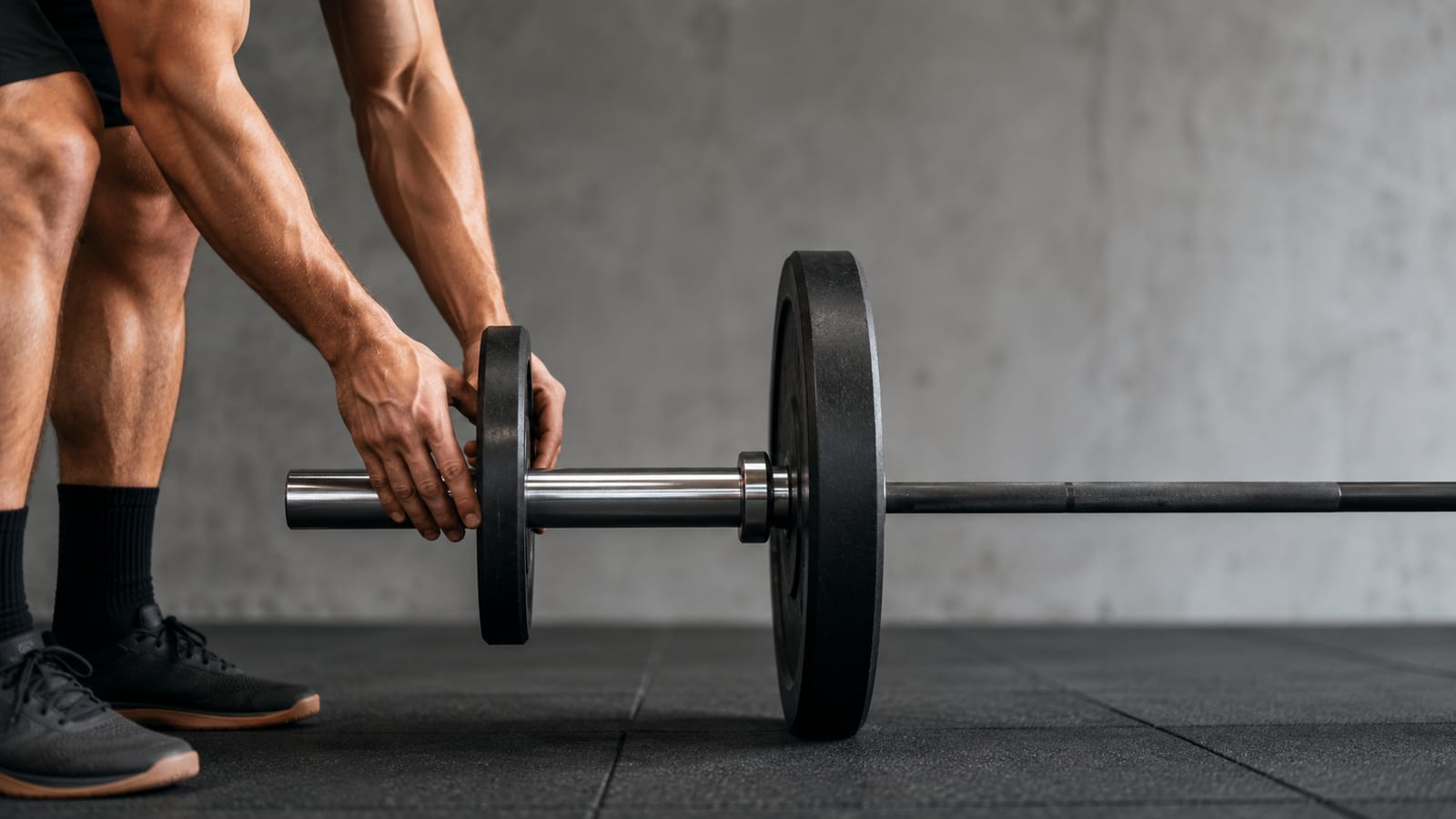
Use double progression for the main lifts and isolation exercises. This gives you a clear way to add reps before adding weight.
- Pick a load you can lift for the bottom of the rep range.
- Keep that load until both working sets reach the top of the range.
- Add the smallest practical amount of weight.
- Return to the lower end of the range.
- Build the reps again with the same technique.
For a target of two sets of 6 to 12, the progression might look like this:
| Session | Set one | Set two | Action |
|---|---|---|---|
| Start | 8 reps | 7 reps | Keep the load |
| Next session | 9 reps | 8 reps | Keep the load |
| Later session | 12 reps | 12 reps | Add a small amount |
| Next session | 7 reps | 6 reps | Build again |
The exact numbers will vary. The rule does not.
Progressive overload includes more than adding plates. It can mean another clean rep, better control, a deeper range of motion, or less strain at the same load. The progressive overload concept is simple, but applying it requires patience.
Change one variable at a time. If you change the exercise, rep range, rest period, and load together, the logbook cannot tell you what improved.
Track these details:
- Exercise
- Load
- Reps
- Reps in reserve
- Any technique problem
- A short note about pain or unusual fatigue
A low-volume resistance training plan gives you little room to hide. The logbook will show whether you are training with intent.
Nutrition and recovery

Low training volume does not remove the need for enough food. Your body still needs energy and building materials to add muscle.
Eat enough total food to support your training and body-weight trend. Include a reliable protein source in your meals. You do not need a complicated meal plan, but you do need consistency.
Recovery also includes:
- Regular sleep
- Rest days between sessions
- Enough carbohydrates to support hard training
- Hydration
- Stress that stays within a manageable range
A minimalist training program can expose poor recovery faster than a higher-volume plan. If every set is hard, low sleep and low food will show up in the logbook.
Do not add sets to fix a nutrition problem. Eat better, sleep more consistently, and reassess your performance first.
Most muscles do not need separate attention every day. They need a repeated training signal and enough time to repair. Your plan has to fit your week, or it will not last long enough to matter.
For practical habits that support short sessions, use these muscle-building habits for busy people.
Common programming mistakes
Low volume fails for predictable reasons. The solution is usually simple, but it may require more honesty than another program change.
Mistake: treating low volume as low effort
Two easy sets are not the same as two productive sets. Keep most working sets within the recommended proximity to failure range and use controlled technique.
Mistake: adding exercises instead of improving performance
Random exercise changes erase your baseline. Keep the main lifts long enough to learn them and beat the logbook.
Mistake: taking every set to failure
Failure can work on safe isolation exercises. It is a poor default for heavy compound lifts because the fatigue spreads into the rest of the week.
Mistake: using unstable exercises for every set
Balance and coordination can limit the target muscle. Use stable exercises for most muscle-building work, especially when you have only a few sets.
Mistake: confusing soreness with progress
Soreness is an experience, not a performance measure. Track reps, load, range of motion, and technique instead.
Mistake: eating too little
A hard session cannot compensate for consistently inadequate food. If body weight, strength, and recovery all trend down, check nutrition before adding training.
Mistake: expecting the minimum dose to produce the maximum result
Low volume saves time and may improve recovery. It may also produce slower gains than a higher-volume plan for an advanced lifter. That is the tradeoff.
Start with the minimum effective dose. Add work only when you have earned the reason.
Compare the plan with your schedule
Use this approach if you:
- Can protect three training days each week
- Need sessions that fit into around an hour
- Prefer basic lifts over constant exercise changes
- Want a plan that is easy to track
- Recover poorly from high-volume training
- Have a busy job, family, or unpredictable schedule
A minimalist strength training plan is also useful during a maintenance phase, a stressful work period, or a return from time away.
Skip it as your only plan if you are an advanced lifter who has already stalled on well-executed low volume. You may need more direct sets for certain muscles. Add that work carefully rather than copying a high-volume routine from someone with a different schedule and recovery capacity.
If you can only train twice per week, use two full-body sessions and keep the same movement categories. You will have less weekly stimulus, so progress may be slower. Still, two repeatable sessions beat a three-day plan you keep missing.
FAQ
Can low-volume training build muscle for beginners?
Yes. Beginners often grow from a modest amount of well-performed training because every basic movement demands new coordination. Start with stable exercises, keep the reps repeatable, and let performance improve before you add more work.
Should you train at home with a low-volume plan?
Yes, provided your equipment can make the exercises difficult and gives you a way to progress. Adjustable dumbbells, resistance bands, and a pull-up setup cover most movement categories. Use harder variations only when you can no longer make the equipment heavier.
How long should you follow a low-volume program?
Stay with it until your training record shows a real pattern rather than a single poor session. A change makes sense when an exercise causes pain, no longer suits your equipment, or stops moving despite steady effort and recovery.
Can you use low volume while losing body fat?
Yes, but your main job becomes holding onto strength and muscle. Keep the basic lifts, control fatigue, and expect slower improvements while your food intake is lower.
What should you do if one muscle stops growing?
Check the basics before changing the plan: technique, effort, food, sleep, and exercise choice. If those are in order, give that muscle one additional productive set and watch the logbook before making another change.